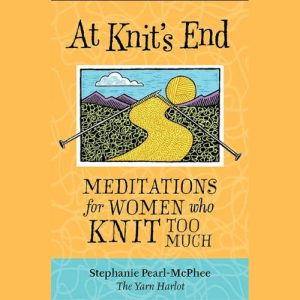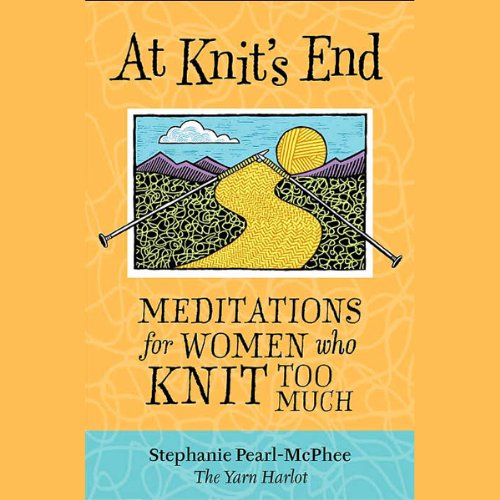
My grandmother knit. That is where my experience of the craft begins and ends, but I spent enough time watching her work through projects she had been carrying around for years to understand something about the psychological texture of the obsession. At Knit's End made me understand it considerably more, and it made me laugh genuinely, which is harder to achieve in audio than in print. Stephanie Pearl-McPhee, known to her readers as the Yarn Harlot, has been writing about knitting with comic precision since the early 2000s, and this 2007 collection remains the definitive expression of her particular gift: the ability to make the experience of loving something inconvenient and irrational feel like a form of shared sanity.
The format is unusual and worth knowing before you start. At Knit's End is not a narrative. It is a collection of short reflections, each one launched from a quotation and each one concluding with a kind of lesson or observation that Pearl-McPhee has drawn from the collision between the quote and her knitting life. The entries are brief, sometimes only a page or two in their original print form, which makes the audio version feel more like a set of connected sketches than a sustained argument. That is not a criticism. It is the correct form for this material, which is concerned with the small and specific rather than the grand and comprehensive.
Humor Built on the Accuracy of Observation
Pearl-McPhee is funny in a way that depends entirely on the accuracy of her observation. The joke about stalking a man in the grocery store not because he is attractive but because he is wearing an Aran sweater you want to decode is only funny if you recognize the internal logic it describes. The observation that knitting burns approximately 90 calories an hour, not counting the extra for retrieving your yarn ball from under the couch, works because it captures the exact kind of detail that knitters notice and non-knitters would never think to track. This is humor built on precision rather than exaggeration, which is both its strength and its limitation. Reviewers consistently note that non-knitters are welcome but may miss the jokes, and that is accurate. The book rewards knitting experience but does not require advanced technical knowledge; it is about the psychology of the craft rather than the technique.
Self-Narrated Timing Honed at Live Knitting Events
Author-narrated humor is a high-risk, high-reward proposition. When it works, it works because the timing is genuinely the author's own. Pearl-McPhee has been performing versions of this material at knitting events for years, and that performance experience is audible. She knows where to breathe, where to slow down, where to let a phrase complete itself before moving on. Her voice has a warm, slightly conspiratorial quality that suits the material's invitation into shared absurdity. At under four hours, the listening commitment is minimal, and the brevity is appropriate to the format. Each reflection is complete in itself, which means this is also an audiobook that works well in short sessions between other activities, a pleasure rather than a project.
Stash Guilt, Sly Deception, and Shared Absurdity
One of the recurring preoccupations in At Knit's End is the knitter's relationship with yarn acquisition, which Pearl-McPhee describes as involving guilt, over-optimism, sly deception, and the optimistic certainty that you will absolutely knit all of this someday. The stash, the accumulation of yarn a knitter cannot bring herself to stop buying, is treated here with the same anthropological precision that the best comic writers bring to any genuine human compulsion. One reviewer wrote about her grandmother's dresser entirely dedicated to yarn, and the recognition in that image is exactly what Pearl-McPhee is generating: the sense that your particular absurdity is widely shared, which turns out to be enormously comforting.
Laughing With Knitters, Not at Them
This is an audiobook for knitters, crocheters who are willing to translate across fiber crafts, and anyone who loves someone who knits and wants to understand what is actually happening in their head. It works as a gift in audio form in the same way the book works as a gift in print, which several reviewers report doing. It is not a book for people who want sustained narrative or progressive argument. It is a book for people who want to spend under four hours with someone who loves the same thing they love and has the vocabulary to say so in a way that makes them laugh. A free audiobook option makes it a no-cost way to confirm whether Pearl-McPhee's sensibility is yours. It almost certainly is, if you knit. Pearl-McPhee's particular gift is that she treats the knitter's compulsions not as something to be explained away or cured but as evidence of a specific kind of seriousness about beauty and craft that the world at large consistently fails to recognize. The knitting community she writes for and to is real, extensive, and passionate, and the humor in At Knit's End is the kind that only works because the author is completely inside the experience she is describing. She is not laughing at knitters from the outside. She is laughing with them from the middle of a project that is going both wrong and wonderfully right. The book is also surprisingly honest about the ways knitting can fail and frustrate. Pearl-McPhee does not write about knitting as an activity that produces only satisfaction and beautiful objects. She writes about the projects that went wrong, the stitches dropped and not noticed until thirty rows later, the sweater that came out the right size for someone considerably smaller than its intended recipient. These failures are treated not as reasons to stop but as the texture of the relationship with the craft, which is a considerably more mature and accurate account of what any skill-based obsession actually feels like to live inside.
- Narration: Stephanie Pearl-McPhee reading her own comedic meditations is a genuine pleasure; she has the timing of someone who has performed this material in front of rooms full of knitters and knows exactly where the laughs are.
- Themes: The guilty, obsessive, deeply loving relationship knitters have with their craft, humor as community glue, the absurdity of an activity that is simultaneously frustrating and consuming
- Mood: Warm, wry, and affectionately self-mocking
- Verdict: A delightful short listen that will make every knitter feel profoundly understood and every non-knitter slightly bewildered in an entertaining way.
Is At Knit's End funny if you don't knit?
Pearl-McPhee is explicit that non-knitters are welcome, and some of the humor is broad enough to land without craft context. But reviewers across editions consistently note that the specificity is what makes it work, and non-knitters will miss a significant portion of the jokes. It works better as an inside view for the curious than as general humor writing.
Is At Knit's End available as a free audiobook?
Yes, it was listed as a free audiobook for Audible members at the time of this review. Check the current listing for availability, and note that at under four hours the time investment is minimal regardless.