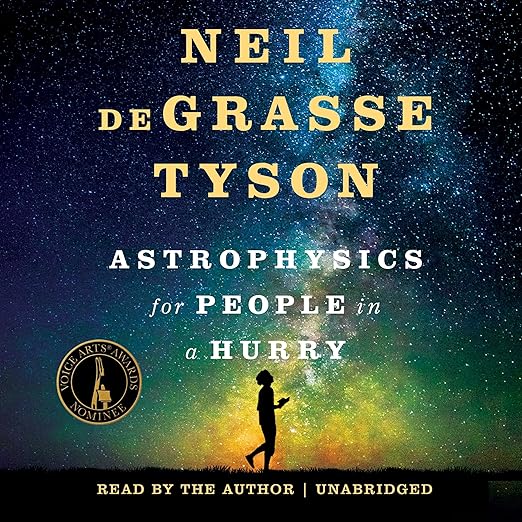
I was about fifteen minutes into a long walk when I realized I was no longer paying any attention to where I was going. Neil deGrasse Tyson had gotten to dark matter, and the specific argument he was making for why we know something is there that we can't see or detect directly, something that outweighs all observable matter in the universe by a factor of roughly six, had pulled my full attention inward. I almost walked past my street. This is what good science communication does, and Tyson is among the best practitioners alive.
Astrophysics for People in a Hurry is a deliberately modest title for a book that covers an ambitious range: the Big Bang, the expansion of the universe, dark matter, dark energy, the cosmic microwave background, the periodic table as a byproduct of stellar evolution, the search for exoplanets, and the broader question of how human consciousness relates to an indifferent cosmos. Tyson compresses all of this into just under four hours of audio without sacrificing accuracy and without losing the wit that makes his public presence so effective.
The self-narration is the defining feature of this audiobook and the main reason to seek out the audio version specifically rather than the print. Tyson speaks the way he writes, with the timing of someone who has spent decades explaining complex ideas to live audiences and has refined a sense of exactly where to place emphasis and where to let a surprising fact simply land. The chapter on dark energy, in particular, benefits from hearing him deliver the cumulative revelation in real time. The pauses are his. The slight acceleration when he's building to something is his. No hired narrator would bring that.
Reviewer Kenneth L. Matheny, who described this as a brief, clear, concise overview of current astrophysics, was being accurate in all three adjectives. The book doesn't linger. Each chapter is a self-contained unit built around a specific concept or question, and Tyson moves on when the concept has been sufficiently illuminated. That compression is both the book's strength and its limitation.
Why Listen to Astrophysics for People in a Hurry
Reviewer Billy offered the most important interpretive note available for this book: the title "Astrophysics for People in a Hurry" is not the same as "Astrophysics for Beginners." The book does assume a baseline of scientific literacy. It assumes you know what a periodic element is, what a photon does, and roughly what the Big Bang means. It does not explain these from scratch. The "in a hurry" qualifier means it's a condensed treatment for intelligent generalists, not an introductory treatment for people who've never thought about physics.
Reviewer Crenshaw, who described himself as an idiot who nonetheless understood the material, offers a more optimistic data point. The book's explanatory language is genuinely accessible even when the concepts are advanced. Tyson's gift is not just knowing the science but knowing how to build intuitive bridges from everyday experience to cosmological scale. The chapter that opens by reminding you that every atom in your body was forged in the nuclear furnaces of ancient stars, and that you are therefore literally made of star stuff, is a model of this kind of bridging.
What to Watch For in Astrophysics for People in a Hurry
The runtime is notably short for a nonfiction audiobook, and some listeners will finish it wanting more. That's a deliberate structural choice, and it's the right one. Tyson isn't trying to write a comprehensive cosmology textbook. He's trying to give intelligent, busy people enough of the framework to engage meaningfully with the next cosmic headline they encounter, whether it's about gravitational waves, a new exoplanet, or a collision between galaxy clusters.
Reviewer Billy noted that the epigraph itself is a kind of reader's guide: the book is "a conduit," not a destination. That framing is accurate. You finish Astrophysics for People in a Hurry curious rather than satisfied, which is exactly what good popular science is supposed to do. It opens doors rather than closing arguments.
Who Should Listen to Astrophysics for People in a Hurry
This audiobook is best suited for the intelligent general reader who wants to update their cosmological vocabulary and is looking for something that rewards active listening rather than background noise. The self-narration makes it specifically worth seeking in audio over print. It's an ideal companion for commuting, exercise, or any context where you have continuous attention available for stretches of twenty to thirty minutes.
Very advanced science readers who want technical depth will find the compression limiting. Complete beginners who need foundational science literacy before engaging with cosmology will want to supplement with something more introductory. Everyone in between, which is most of us, will find this exactly what it promises.
At a Glance
- Narration: Neil deGrasse Tyson reading his own work is the ideal configuration for this book, his delivery has the quality of a captivating lecture rather than a read text.
- Themes: Big Bang cosmology, the structure of space and time, dark matter and dark energy, cosmic perspective and human humility
- Mood: Energizing and awe-generating, best consumed in the commute or exercise context the title itself suggests
- Verdict: A precise distillation of current astrophysics delivered with wit and warmth, shorter than you expect, but exactly as substantial as it needs to be.
Questions Listeners Ask
Is the audiobook significantly better than the print edition because Tyson narrates it himself?
Yes, in a meaningful way. Tyson's delivery carries the timing and emphasis of a seasoned science communicator who has given this material in front of live audiences. The audio has a lecture quality that the print version cannot replicate, and specific passages, particularly on dark energy and cosmic perspective, are more effective when heard in his voice.
How does Astrophysics for People in a Hurry compare to other popular cosmology audiobooks like A Brief History of Time?
Tyson's book is shorter, more contemporary, and more conversational than Hawking's classic. A Brief History of Time goes deeper into the physics of space-time and quantum mechanics. Tyson's book covers more ground in broader strokes with more explicit attention to the human and philosophical dimensions. They complement each other rather than competing.