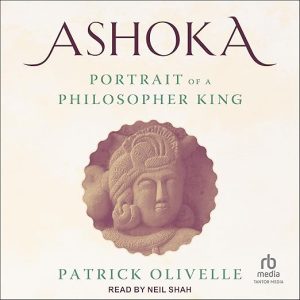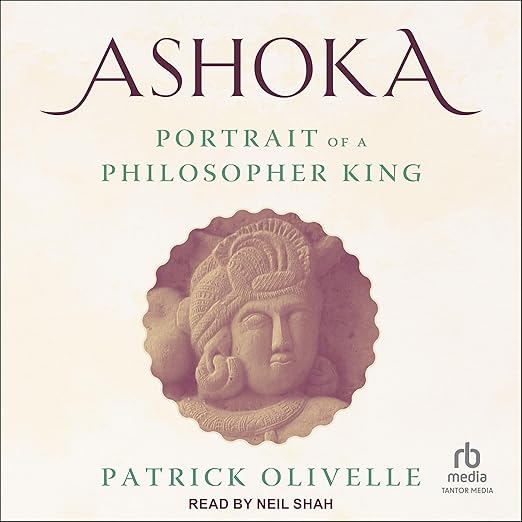
Ashoka's edicts are among the most remarkable documents in human history: a third-century BCE emperor carving his moral philosophy onto rock faces and pillars across a subcontinent, addressing not just his subjects but rulers and peoples he had never met and never would. Patrick Olivelle's Ashoka audiobook, narrated by Neil Shah, builds its account of the emperor primarily from those inscriptions, treating Ashoka's own words as the most direct evidence available rather than as supplementary material to later legendary accounts. That methodological choice shapes everything about what the book is and what it isn't.
Olivelle is a scholar of Sanskrit and Indian religious texts with decades of specialized research behind him. He is not writing a popular history. He is writing a deeply researched reconstruction of Ashoka as ruler, Buddhist, moral philosopher, and ecumenist, drawing on the inscriptions and on the art and architecture Ashoka pioneered. The result is a book that rewards patient attention and that contains more genuine historical substance than most biographies of ancient rulers currently available in audio.
Dharma as Unity Across a Heterogeneous Empire
The concept of dharma is the book's organizing principle, and Olivelle is careful to establish what Ashoka meant by it before applying it as an analytical lens. For Ashoka, dharma was not a religious concept in the narrow sectarian sense but a moral philosophy capable of providing unity of purpose across a vastly heterogeneous empire spanning multiple languages, ethnicities, and religious traditions. His aspiration, inscribed in stone, was that practicing dharma would bring international conflicts to an end. That this aspiration sounds contemporary is one of the more startling things the book establishes.
One reviewer found the book calming when looking at current political leadership, drawing an implicit contrast between Ashoka's inscribed commitment to non-violence and religious tolerance and present-day governance. Another found it repetitive and argued it could be condensed significantly, a critique that reflects the scholarly approach rather than a structural flaw: Olivelle returns to the inscriptions repeatedly because they are the evidence, and treating them as such requires engagement that a more narrative history would smooth over. A third review describes it as pedantic, focused on the rock edicts rather than thematic content or storyline, which identifies the same methodological choice from a different evaluative frame. The disagreement between these readers reflects a genuine tension in ancient biography writing that Olivelle has chosen to resolve on the side of rigor.
Shah Sustains Sanskrit Terms Across Twelve Hours
Neil Shah is a strong choice for this material. The narration requires someone who can handle Sanskrit terminology without stumbling, who can convey the scholarly register of Olivelle's writing without making twelve hours of academic prose feel like a lecture, and who can sustain the listener's engagement through the extended sections on specific edicts and their interpretive implications. Shah delivers on all three counts. His narration is measured without being slow, and his familiarity with South Asian linguistic and historical context is audible in the way he handles proper names and technical terms.
The book's twelve-hour runtime is appropriate for its scope. Ashoka ruled over a larger area of the Indian subcontinent than anyone else before British colonial rule, and Olivelle's account spans the reign's administrative, philosophical, religious, and artistic dimensions. Cutting the length would require cutting the substance. Nothing extraneous appears here; the repetitions exist because the evidence repeats, and Olivelle is honest about that rather than eliding it.
Olivelle also draws on the art and architecture Ashoka pioneered alongside the textual record. The pillars, the stupas, and the iconographic programs Ashoka commissioned tell a story about his priorities and self-presentation that complements and sometimes complicates what the inscriptions say. Shah delivers these sections with the same care as the edict analyses, and the combined effect produces a more rounded portrait than either source alone would permit.
Inscriptions Over Intrigue, and Repetition by Design
The book's reliance on the inscriptions as primary evidence means that extended passages deal with close reading of texts that, in many cases, repeat the same moral injunctions across different edicts. Olivelle is attentive to the variations and what they reveal about Ashoka's evolving thinking, but listeners who want a traditional narrative biography, with battles, court intrigue, and human drama, will find this approach less satisfying than they might hope. The human Ashoka emerges through interpretation of formal public statements rather than through personal correspondence or contemporary accounts.
The one German-language review attached to this listing describes the book as excellent and very readable while adding a pointed observation about political standards set in third-century India being still routinely ignored today. That international readership reflects the book's subject matter accurately: Ashoka's significance extends well beyond South Asian history into the history of governance, moral philosophy, and what it means to try to rule ethically across difference. Olivelle makes that significance plain without overstating it.
Essential for Serious Students, Demanding for Others
Serious students of South Asian history who want the most carefully grounded account of Ashoka currently available in audio will find this essential. Listeners with background in Buddhist history and philosophy will get particular value from Olivelle's account of how Ashoka's Buddhism shaped his governance without reducing his rule to mere religious propaganda. Anyone interested in the history of moral philosophy, particularly the question of how ethical frameworks translate into governance of diverse populations, will find this unusually rich source material.
Listeners expecting a narrative biography with the pace and color of popular history will find the scholarly approach demanding. The book is honest about uncertainty in ways that narrative histories often aren't, which is intellectually responsible but requires a different kind of patience than a more dramatized account would. Those willing to meet Olivelle's rigor on its own terms will come away with a relationship to Ashoka's inscribed words that no secondary account could provide.
Common Questions
Is the Ashoka audiobook suitable for listeners without prior knowledge of Indian history?
Olivelle provides enough context to follow the narrative without specialist knowledge, but some familiarity with the broad outlines of ancient Indian history and Buddhist thought will enrich the experience considerably. Complete newcomers can follow the argument; listeners with some background in the Maurya Empire or early Buddhism will get more from the interpretive sections.
How does Patrick Olivelle approach Ashoka's Buddhism in this audiobook?
With scholarly care. Olivelle distinguishes between Ashoka's personal Buddhist practice, his promotion of dharma as a political philosophy, and the legendary accounts that later Buddhist tradition developed around him. He treats the inscriptions as primary evidence rather than accepting the legendary tradition, which produces a more reliable but also more restrained account of the emperor's religious life.
Is the Ashoka audiobook repetitive, as some reviews suggest?
The close attention to the inscriptions means certain moral injunctions appear across multiple chapters because they appear across multiple edicts. Olivelle is interested in what the repetitions reveal about Ashoka's priorities and evolution as a ruler. Listeners who want a fast-moving narrative will find the methodology demanding; those interested in what the documentary evidence actually shows will find the approach appropriate to its subject.
How does Neil Shah's narration handle the Sanskrit and historical terminology throughout this audiobook?
Very competently. Shah navigates the Sanskrit terms, proper names, and historical references without the hesitation or mispronunciation that can undermine academic content in audio form. His background makes the linguistic material feel familiar rather than alien, which sustains the listener's immersion in the historical world Olivelle is reconstructing.