Key Details
- Narrator: Jonathan Keeble is the definitive voice for Warhammer 40K audio, and his work here adds ceremonial weight to the post-Heresy devastation without over-dramatizing.
- Subjects: Power vacuums and political legitimacy, grief as political action, what an empire is for after its purpose has been shattered
- Tone: Bleak and politically charged, with the particular Warhammer atmosphere of overwhelming stakes and constrained human agency
- Bottom line: A sophisticated opening to the Scouring series that trades galaxy-shaking duels for the harder drama of deciding what comes next.
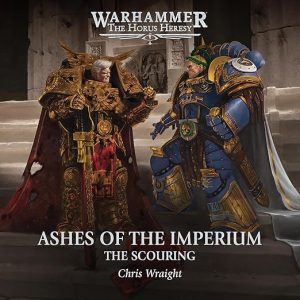
I finished the Horus Heresy series in installments spread across several years, because no sane reading life can absorb fifty-four novels in one continuous motion, and I came to Ashes of the Imperium with genuine curiosity about where Chris Wraight and Black Library would take the story after the siege's end. The short answer is: somewhere more interesting than I expected. I was halfway through my morning run when the opening chapters reset my expectations about what a post-Heresy Warhammer novel could do.
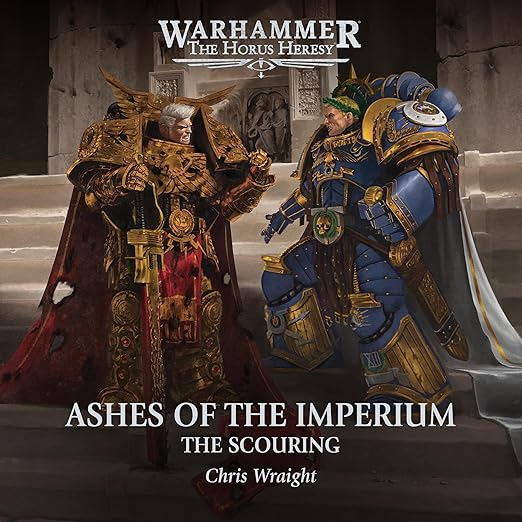
The premise of the Scouring series is built around the question that the Horus Heresy never had space to ask: what happens next? Horus is dead. Terra is in ruins. The Emperor is interred on the Golden Throne, silent. The Traitor Legions are scattered and desperate. And the survivors of the loyal forces, the Primarchs, the Custodians, the various factions that held together under the pressure of existential war, now have to figure out what they are without the war to define them. Ashes of the Imperium is the opening of that argument, and Wraight approaches it as a political drama first, a war story second. That inversion is where the novel earns its distinction from the action-heavy final volumes of the Heresy sequence that preceded it.
How Ashes of the Imperium Holds Up
What makes this novel work as a first chapter in the Scouring is that Wraight understands that the most interesting dramatic territory in the post-Heresy Imperium is not the mop-up operations against fleeing Traitors, though those are present. It is the question of who holds power now and on what basis. The Primarchs who survived the Heresy are functionally demigods in a political vacuum, and the ways they disagree about whether to pursue vengeance or rebuild, about what the Imperium is supposed to be in the absence of the Emperor's active guidance, create the kind of conflict where no one is simply right. One reviewer described the novel as showing the gravity of every decision hitting harder than anywhere else in the series so far, and that is accurate: these are choices that will shape the forty-first millennium the reader knows from the main Warhammer 40K setting, and Wraight writes them with the full awareness of what they will eventually become. The political chess is not background; it is the main event, and it is more demanding and more rewarding for it.
Why Ashes of the Imperium Works as an Audiobook
Jonathan Keeble has narrated enough Warhammer fiction to have developed a specific register for this universe, one that balances the operatic scale of the setting with the human-scale moments that make individual characters legible within it. His work on Ashes of the Imperium is consistent with his best output for Black Library: the political scenes have gravity without becoming ponderous, the action sequences have urgency without losing the ceremonial quality that Warhammer's aesthetic requires. At fifteen-plus hours there are stretches where the density of political maneuvering asks for patience, and Keeble's pacing helps those sections earn their weight rather than feeling like obstacles between combats. His voice for the various Primarchs carries the appropriate sense of inhuman scale without sacrificing individuation, and that technical achievement matters more in this book than in most Heresy volumes because the Primarchs' debates are the dramatic center.
Weak Spots in Ashes of the Imperium
New listeners coming to this series without Heresy background will be genuinely lost. The Scouring is explicitly built on the emotional and political residue of fifty-four novels, and the significance of the Primarchs' disagreements, the specific grief attached to the betrayals, the weight of certain character deaths, all of that requires the prior investment. Reviewers who have made that investment describe Ashes of the Imperium as exactly what they needed from the continuation: not a reset but a reckoning. Those who have not made that investment should start somewhere considerably earlier in the Black Library chronology. There is no shortcut into this material, and Wraight does not attempt to provide one, which is the honest and correct choice.
The Right Listener for Ashes of the Imperium
This is for dedicated Horus Heresy readers who want to follow the story into the Scouring era. It is one of the stronger Black Library releases of recent years precisely because Wraight is more interested in the political and moral aftermath of the Heresy than in providing immediate action payoff. Warhammer readers who found the Heresy's final volumes too slow or too political may find this similarly demanding; those who appreciated the complexity will find it a rewarding continuation of everything they invested in the longer arc. The free audiobook availability makes this an easy addition for committed Heresy readers, and Keeble's narration makes the fifteen hours feel appropriately substantial rather than merely long. The Scouring series has the potential to do something the Heresy could not: explore what it costs to rebuild after catastrophe rather than simply document the catastrophe itself. Ashes of the Imperium establishes that the series intends to make good on that potential, and Wraight's political imagination is well-suited to the task. For readers who have invested years in the Heresy, this is the continuation the scale of that investment deserves. The novel establishes that the Scouring series intends to do real intellectual and moral work rather than simply extending the Heresy's momentum, and that intention, if sustained across the series, will make this one of the more substantial achievements in Black Library's history.