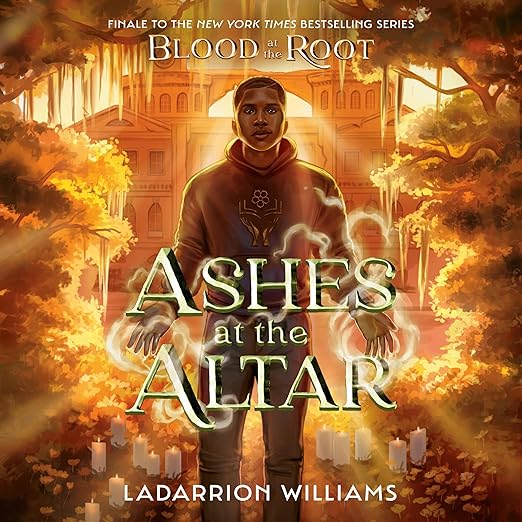
Ashes at the Altar closes Malik Baron's story at stake-raising speed, with no interest in a gentle landing. This audiobook is the finale of LaDarrion Williams' New York Times bestselling Blood at the Root trilogy, and it opens with Malik already carrying the weight of everything the first two books built: a hidden magical HBCU, a mother possessed by the evil spirit Marinette, and a family history he's still piecing together.
Even after risking everything to trap Marinette, her power keeps growing, and the Bokors working alongside her remain at large. As Malik starts learning about his father's side of the family, the Bonclairs, their power gets challenged just as the wider magical community's tensions reach a breaking point, forcing him to decide where his loyalty actually lies when every answer costs him something.
Our Take on Ashes at the Altar
The hidden magical HBCU setting, Caiman University, remains the trilogy's most distinctive worldbuilding choice, and this finale leans further into what that setting makes possible: magic rooted specifically in African diaspora spiritual traditions rather than a generic fantasy system, playing out against the backdrop of a historically Black campus community with its own internal politics and histories. That specificity has set Blood at the Root apart from more conventional magic-school YA from the start.
Williams frames the book's central question directly in the synopsis: whether Malik can fight for the kind of happy ending the world has always told him is impossible for a Black boy like him. That's an unusually explicit thematic stake for a YA fantasy finale to name outright, and it gives the trilogy's closing volume a weight beyond simply resolving plot threads around possession, loyalty, and inherited power.
The HBCU setting carries real weight beyond being a striking backdrop for magic. Historically Black colleges and universities occupy a specific, meaningful place in American educational and cultural history, and grounding a hidden magic school there, rather than in a generic boarding-school setting, lets Williams build worldbuilding rules and community dynamics that feel specific to the culture the trilogy is drawing from, rather than borrowed wholesale from more familiar magic-school templates.
The trilogy's own titles trace a clear thematic arc worth noticing. Blood at the Root grounds the story in inheritance, family, and origin, while Ashes at the Altar closes it with the language of sacrifice and ending, an altar being a place of both worship and offering. That progression signals a series more interested in cost than easy triumph, and this final book appears to follow through on that promise directly, treating Malik's hard-won victories as things he has to pay for rather than simply being handed them. It's a more ambitious framing than most YA fantasy trilogies commit to by their conclusion.
Why Listen to Ashes at the Altar
As the concluding volume of a bestselling trilogy, this book carries real narrative momentum: family secrets are converging, the Bonclairs' power is genuinely at risk, and the magical community's fractures, hinted at across the earlier books, finally reach their breaking point here. Readers invested in Malik's arc since book one get the payoff of watching every thread, Marinette's possession of his mother, his father's family, his own magical inheritance, collide in the same volume.
The blend of horror-adjacent stakes, spirit possession, dangerous magic users called Bokors, with grounded family drama gives this finale a genre texture that's distinct from more straightforward fantasy conclusions. Listeners who've appreciated how the earlier books balanced supernatural threat against very human questions of belonging and legacy should find that balance sustained, and intensified, through to the end.
Structurally, this finale runs against the pattern of trilogies that narrow focus for their conclusion: rather than stripping back to a single final confrontation, Ashes at the Altar appears to widen scope further, introducing the Bonclairs as a new faction even this late in the story alongside the already-established Marinette and Bokors threads. That's a riskier structural choice, since finales that add new material can feel unfocused, but it also signals a book unwilling to simply go through the motions of a predictable final showdown.
What to Watch For in Ashes at the Altar
No narrator is listed on the current product page, which is worth flagging especially strongly for a trilogy finale with a large returning cast of named entities, Marinette, the Bokors, the Bonclairs, that listeners from books one and two will already have voices in mind for. If continuity with the earlier audiobooks matters to you, it's worth checking specifically whether the same narrator returns before starting this one.
At 18 hours, this is a substantial listen, and likely the longest entry in the trilogy given how much ground the synopsis suggests it needs to cover. Budget accordingly, especially if you're planning to relisten to the earlier two books beforehand to refresh plot details before diving into the conclusion.
This is explicitly not a starting point. As the third book in a trilogy building toward a specific, foreshadowed confrontation, Ashes at the Altar assumes full familiarity with Blood at the Root and its second installment, and the emotional and plot payoffs depend entirely on that accumulated context landing correctly.
Parents or younger teen listeners choosing this for a sensitive reader should know the content leans into real intensity: spirit possession of a parent, family trauma, and violence tied to the magical conflict all factor in heavily, consistent with how the earlier books in the trilogy have handled similarly weighty material.
Who Should Listen to Ashes at the Altar
Recommended for existing fans of Blood at the Root and its second book who are ready for Malik's story to reach its conclusion, and for readers drawn to HBCU-set fantasy that blends horror-adjacent stakes with serious family and identity themes. The trilogy's specific cultural grounding sets it apart from more generic magic-school series, and this finale rewards listeners who've stayed with it from the start.
Skip it if you haven't read or listened to the first two books, since this will not function as a standalone entry in any meaningful way. New listeners curious about the series should start with the first Blood at the Root book instead and work forward from there rather than beginning at the end.
- Subjects: HBCU magic school, family legacy and spirit possession, loyalty tested by inherited power
- Tone: Tense, emotionally high-stakes, mythic in scope
- Bottom line: A strong, thematically ambitious finale for existing trilogy fans; do not start the series here.
Good to Know
Do I need to listen to the Blood at the Root audiobook and its second book before starting Ashes at the Altar?
Yes. This is the third and final book in the trilogy, and it assumes full knowledge of the characters, magic system, and plot threads established across the first two books.
Who narrates the Ashes at the Altar audiobook, and is it the same narrator as the earlier books in the trilogy?
This edition does not credit a narrator as of this review, so listeners who care about voice continuity from the first two audiobooks should check for an updated credit before starting this one.
Is Ashes at the Altar more horror-leaning or more contemporary fantasy in tone?
It leans notably toward horror-adjacent fantasy, with spirit possession and dangerous magic users called Bokors driving much of the tension alongside the family and identity themes.