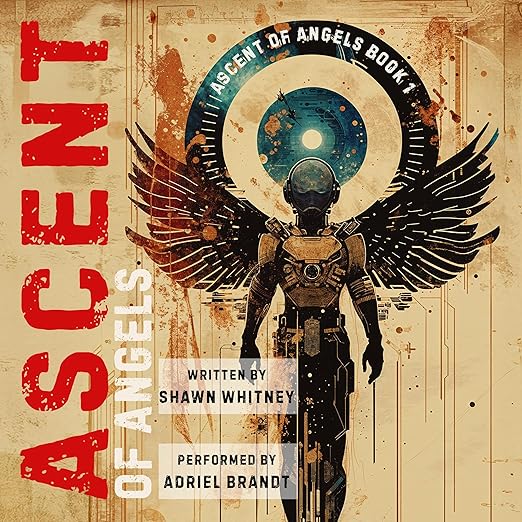
Before You Press Play
- Read by: Adriel Brandt gives Simon's underdog arc genuine conviction, navigating the grim colony-ship setting with a performance that grounds the social commentary in human stakes.
- At its heart: Class warfare and manufactured spectacle, autonomy under oppression, found-family solidarity
- Vibe: Grim and propulsive with sharp social edges
- Short version: A dystopian series opener that earns its Hunger Games comparisons through specific, thought-through worldbuilding and a protagonist whose constraints feel genuinely systemic rather than arbitrarily dramatic.
I started Ascent of Angels on a Tuesday evening when I wanted something that would push back. The kind of story with teeth. Shawn Whitney's debut delivers on that expectation within the first hour, establishing a colony ship society so precisely stratified that the injustice feels structural rather than theatrical. That is the difference between dystopian fiction that works and dystopian fiction that feels like costume.
The premise is, on its surface, familiar. A lowborn protagonist is unjustly thrown into a deadly televised competition designed to entertain the elite and crush the poor. The Hunger Games comparison is made explicitly in the marketing, and it is not inaccurate. But what Whitney does with that framework is specific enough to earn its own attention. The Exsta is not just a generic spaceship, it is a 200-year-old society with its own theology, its own language of power, and its own history of failure. The Choir of Higher Angels is not a simple villain faction. It is an institution, complete with the internal contradictions that institutions accumulate over centuries.
Simon's arc in this first book is essentially the education of someone who believed the rules were fixed. His false conviction forces him onto the Fallen, a team of criminals assigned to fail spectacularly as a lesson to the lower classes. The forbidden body mods his team acquires, the kind that the Higher Angels have banned precisely because they might equalize the competition, are both a plot mechanism and a metaphor. The system's rules exist to maintain outcomes, not to ensure fairness, and every rule Simon breaks is a step toward understanding that.
One reviewer described seeing Simon evolve from a powerless individual into a courageous leader, and noted how his bonds with the Fallen challenged the existing power structures. That is accurate, and Whitney handles it without leaning on the chosen-one shortcuts that make this kind of story feel predetermined. Simon is not special because destiny decided so. He is developing because circumstances forced him to.
The Strengths
Adriel Brandt handles the emotional range the story requires, Simon's early confusion and grief, the gradual formation of trust among the Fallen, and the adrenaline of the competition rounds themselves. The colony-ship setting with its seven Earth-inspired ecosystems gives the audiobook a variety of tonal registers that Brandt navigates cleanly. At 10 hours and 12 minutes, the pacing is tight for the amount of worldbuilding involved, and Brandt's delivery keeps the exposition from slowing things down.
The social commentary in the book is not subtle, and it should not be. The class warfare that structures the Exsta's society maps onto real-world dynamics that Whitney is clearly interested in examining. Listeners who want their dystopian fiction to have something to say beyond the competition itself will find more here than in more superficial genre entries.
Things to Know Before Starting Ascent of Angels
The book opens with significant worldbuilding investment before the competition properly begins. Give it 60-90 minutes before assessing the pacing, the setup is load-bearing, not padding. The first act also establishes several characters within the Fallen whose individual backstories matter to later plot developments, and Brandt differentiates them clearly enough that the cast does not blur together despite the density of the opening chapters.
The romance is present but secondary. Readers who came for that specific thread should know it exists within the larger story rather than driving it.
Recommended For
Fans of Pierce Brown's Red Rising and Suzanne Collins's Hunger Games who want something set in space with genuine class-warfare politics will find this series opener rewarding. Listeners aged 16 and up are the target demographic; the competition violence is intense but not gratuitous. If you prefer your dystopian fiction with clean resolutions, note that this is book one of a series and ends with threads open for continuation.
How closely does Ascent of Angels compare to The Hunger Games beyond the competition premise?
The comparison is structural rather than stylistic. Both involve a televised competition designed to reinforce class hierarchies, but Whitney's setting is a generation ship with 200 years of accumulated inequality, and his social commentary is more explicitly about systemic oppression than individual survival.
Does the book end on a cliffhanger, or does it resolve its central competition arc?
The book resolves its immediate arc while leaving larger threads open for the series to continue. It functions as a satisfying first installment rather than an incomplete story.
Is Adriel Brandt's narration well-suited to the colony-ship setting and the cast of the Fallen?
Yes. Brandt differentiates the team members clearly and brings conviction to Simon's progression from confused victim to emerging leader. He handles the action sequences without losing the emotional undercurrent the story requires.