- Performance: Rory Young reads with confident pace and clean enunciation, making dense AI concepts significantly easier to parse on a single listen without pausing.
- What it covers: AI agents and task automation, precision prompt engineering for non-coders, generative AI output across content types
- Feel: Energetic and access-oriented
- Our call: A genuinely beginner-friendly AI primer that trades depth for breadth. The companion PDF makes it substantially more useful as a working reference beyond the initial listen.
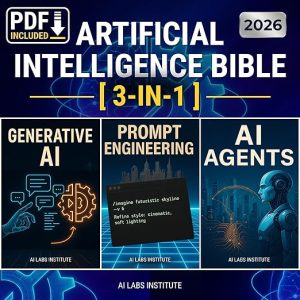
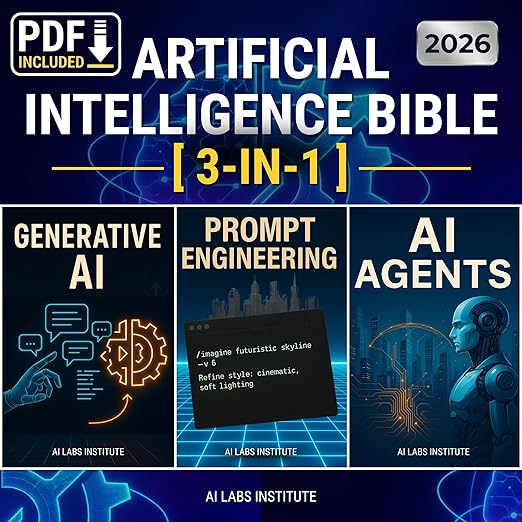
The Artificial Intelligence Bible (3-in-1) arrives at a moment when most people understand that AI tools matter but have no coherent framework for thinking about them in sequence. This audiobook, published by AI Labs Institute and narrated by Rory Young, positions itself squarely as the on-ramp for that audience: the solo entrepreneur, the manager navigating digital transformation, the curious person who has opened ChatGPT and felt uncertain about what to do next. At nearly 12 hours across three bundled volumes, it covers AI agents, prompt engineering, and generative AI in sequence, treating each as a practical domain rather than a theoretical one. A companion PDF is included with purchase and available in your library alongside the audio.
Young Makes Hallucinations Easy to Follow
The bundle structure is both the main advantage and the main limitation of this audiobook. Covering three substantial subjects in under 12 hours means each section moves briskly through its territory. The prompt engineering section, which is probably the most immediately actionable for most listeners, gives you principles and examples that work in real interactions with ChatGPT, Claude, and Gemini. The generative AI section covers content creation, audio generation, image generation, and data output with the kind of practical orientation that prevents it from becoming abstract. The AI agents section explains automation concepts without assuming any coding background whatsoever.
Rory Young's narration is professional and appropriately paced. He reads technical material with enough clarity that terms like "hallucinations," "retrieval-augmented generation," and "prompt chaining" land without confusion on a first pass. That is not a minor achievement. AI content read too quickly or without clear sentence structure becomes genuinely hard to absorb as audio. Young avoids that problem consistently throughout the runtime, and the clarity of delivery is one of the main reasons the three-volume format works as well as it does.
Metaphors Help Listeners Who Cannot Pause
The book's opening promise of "no jargon, no overwhelm" is largely kept throughout. The authors use metaphors actively, which helps audio learners who cannot pause to re-read a technical definition. When the book describes AI agents, it grounds them in workflow analogies that most business listeners will recognize from their own operational experience. When it covers prompt engineering, it provides specific before-and-after examples rather than abstract principles alone, which is exactly the right decision for a listening format where you cannot flip back to a diagram.
One reviewer described the experience as delivering "step-by-step insights into AI concepts and applications" along with "real-world strategies for leveraging AI in business and daily life," which is an accurate summary of what the book aims for and mostly achieves. Another called it "a good place to start," which is also fair. This is entry-level material presented competently, not advanced material oversimplified. That distinction matters significantly when evaluating whether this is the right audiobook for a particular listener's existing knowledge level.
The three-volume structure helps listeners who absorb one subject at a time. You can listen to the prompt engineering volume, apply what you learn for a week, then return for the AI agents section. The format supports that kind of paced engagement better than a single monolithic treatment would, and the total runtime is substantial enough to warrant that approach.
Download the Companion PDF Before Starting
The companion PDF is described as containing templates and practical tools. For listeners who want to retain and apply what they hear beyond the listening experience itself, the PDF is not optional. Audio alone will give you the concepts and frameworks, but the written templates make implementation feasible in actual work contexts. Download it from your library before you begin rather than after, so you can reference it alongside the more tactical sections of each volume.
The book also claims that content is "structured to reflect the most current breakthroughs with regular updates over time." Treat this with realistic expectations. The audiobook you are listening to was recorded at a specific point in time, and the AI landscape changes at a pace that recorded content cannot match. The core principles around how to structure effective prompts, how to conceptualize agent workflows, and how to evaluate generative output have reasonable shelf lives. Any specific tool comparisons or capability claims will date faster than the underlying frameworks, so verify current tool specifics independently before acting on them in a business or professional context.
What the three-volume structure does particularly well is create natural stopping points that allow a listener to process and apply one domain before moving to the next. Many single-volume AI primers fail because they move from concept to concept without allowing any of them to settle. The format here, even at nearly twelve hours total, respects the reality that understanding AI tools enough to use them confidently takes time that a single sustained listen cannot compress. Treating it as three separate investments of attention rather than one long session is the most productive approach.
Complete Beginners Get the Most Value
This audiobook is most useful for complete beginners who need an organized conceptual framework for thinking about AI tools before they start experimenting with them in practice. Small business owners, freelancers, and non-technical managers who have felt left behind by the pace of AI adoption will find it a useful orientation. If you have never used a prompt intentionally, never automated a workflow, and are genuinely uncertain what a language model actually does, this is a reasonable first investment of listening time.
It is less suited to anyone with meaningful prior experience in AI tools. If you already use ChatGPT or similar tools regularly, have experimented with automation platforms, or have any technical background in machine learning or software engineering, this bundle will cover substantial ground you already know at a pace that may feel slow. Know your own starting point honestly before deciding whether this is the right investment of twelve hours.
Common Questions
Is the Artificial Intelligence Bible (3-in-1) audiobook suitable for someone with no technical background whatsoever?
Yes. This is explicitly designed for non-technical users. The authors avoid jargon, use workplace analogies throughout, and focus on practical application rather than machine learning theory. No coding knowledge or technical background is assumed at any point.
Does this audiobook cover all three AI subjects equally, or is one section stronger than the others?
The prompt engineering section tends to draw the most positive feedback because it is the most immediately actionable. The AI agent and generative AI sections are solid introductions but require more independent follow-up research before practical implementation in most real workflows.
Will the content of this audiobook stay relevant as AI tools continue to evolve rapidly?
The foundational concepts around how to structure prompts, conceptualize agents, and evaluate generative output have reasonable staying power. Specific tool comparisons and capability claims will date quickly, so treat those as starting points and verify current specifics independently before acting on them professionally.