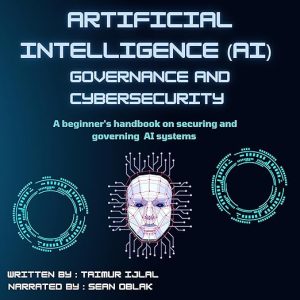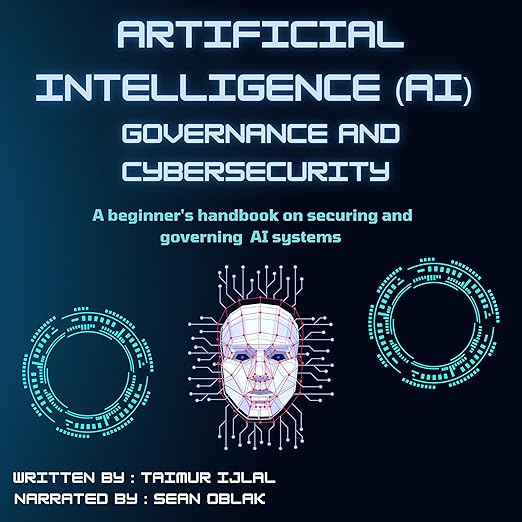
Zero prior knowledge of AI or machine learning is the explicit starting assumption behind this audiobook, and that constraint shapes everything about how Taimur Ijlal built it. Rather than opening with technical architecture or model internals, the book works through governance and cybersecurity risk in plain professional language: what unique risks AI systems introduce, how to build a governance framework to catch them, what a cybersecurity baseline for AI actually requires, and which skills that kind of security assessment demands. At one hour and forty minutes, it reads more like a structured briefing than a comprehensive technical manual, and that's clearly the intent.
Three Reviewers Confirm It Truly Suits Newcomers
Reviewer MMind12 gets at what makes this useful despite the short runtime, describing concepts around governance and security that are, in their words, 'not usually common conversations, except in very professional settings,' and crediting the book with helping them understand the complexity behind AI's fascinating everyday uses. That's a fair summary of the book's actual function: translating boardroom and compliance-level AI risk conversations into language a newcomer can follow without a technical or statistics background, which the synopsis explicitly promises and the review confirms it delivers.
Reviewer My kid is a coder takes a more skeptical, tangential angle, joking about Skynet and Ultron-type robots before noting that general-purpose AI 'remains very far away' compared to the narrower, already-deployed Single Purpose AI the book actually addresses. That distinction matters for setting expectations: this is not speculative future-risk content about sentient AI, it's practical governance guidance for the AI systems already making real decisions inside real organizations today.
The reviewer roster itself is a useful cross-check on the book's stated audience: MMind12 writes with the voice of a genuine newcomer to the subject, Vg identifies as a working cybersecurity professional, and My kid is a coder writes with the casual confidence of someone already comfortable around technology without claiming AI-specific security expertise. All three rate it highly despite starting from different baseline knowledge, a reasonably strong signal that the material actually calibrates to zero prior knowledge rather than quietly assuming a technical background it explicitly disclaims.
The Checklist Behind the Governance Framework Promise
The governance-framework promise is more concrete than that phrase usually turns out to be in AI content generally. Rather than a generic have-a-policy recommendation, the book walks through identifying which specific AI systems inside an organization actually carry elevated risk, then mitigating those risks systematically, closer to a structured risk-assessment checklist than an abstract ethics lecture. That practical, checklist-oriented approach is consistent with what reviewer MMind12 describes as coming to understand the complexity behind everyday AI use, rather than getting a surface-level policy overview.
The synopsis lists its five core promises in a deliberate order worth noticing: unique risks first, then a structured way of catching them, then the cybersecurity risks specifically, then a security baseline, then the individual skills a reviewer needs. That sequence moves from identifying a problem to building a system to address it to naming the concrete human capability required to run that system, a structure closer to an actual professional workflow than a random grab-bag of AI-adjacent topics.
Designed to Be Updated Annually, Never Stale
The book's own promise to get updated at least annually to track the latest AI trends and risks is worth taking seriously as a structural feature rather than marketing language, since AI governance genuinely is an area where guidance from even two years ago can miss entire new categories of risk. A security or compliance professional picking this up gets a snapshot that's explicitly designed not to go stale silently.
Reviewer Vg, a cybersecurity professional by their own framing, calls it a 'very great read' with 'great points on ai security that cybersecurity professionals should read,' and specifically says they 'can't wait to continue the series.' That's a meaningful endorsement from inside the target profession, and it also confirms the book functions as intended: a first volume meant to be followed by further entries in the AI Risk and Security Series rather than a standalone comprehensive reference.
Short-format professional development audio has a real, distinct place next to full certification courses and multi-week training programs: it's built for someone who needs functional literacy on a topic fast, before a meeting, before drafting a policy memo, before a job interview touches on AI risk, rather than deep expertise built over months. This book fits squarely into that category rather than trying to compete with a full technical curriculum.
A Primer Under Two Hours, Not a Full Course
At just under two hours total, this is genuinely a primer, not an exhaustive technical resource, and listeners should calibrate expectations accordingly. This is book one of a series specifically, which means the compact runtime reflects a deliberate scope decision, covering governance and security fundamentals clearly, rather than an attempt to compress a full technical curriculum into under two hours. Anyone expecting deep implementation detail, specific tooling walkthroughs, or hands-on technical configuration guidance will need to look to later volumes or a more specialized technical resource.
The zero-prior-knowledge framing is genuinely honored throughout, per both reviews on file, which is worth flagging as a real strength but also a real limit: listeners who already work daily in AI security or governance may find the pace too introductory to teach them much new, while the newcomers the book is actually built for will get the clearest value.
Compared to a full AI security certification course, which might run dozens of hours across multiple modules with hands-on labs, this operates at a completely different scale and should be judged against that category, professional orientation audio, rather than against comprehensive technical training. Anyone who needs certification-level depth should treat this as a supplement to, not a substitute for, that more extensive kind of program, useful for building shared vocabulary with a technical team rather than replacing one.
A Fast Entry Point for Security and Compliance Staff
IT, security, and compliance professionals who need a fast, credible entry point into AI governance, without first working through a machine learning textbook, are exactly who this was built for. Anyone tasked with assessing an AI system's security for the first time, or asked to help draft a governance framework without prior specialization in the area, will get immediately usable structure here in under two hours.
Security professionals already deep in AI research, or looking for hands-on technical implementation detail, should treat this as a warm-up rather than a destination; the compact runtime and explicit beginner framing mean the ceiling here is orientation, not mastery. Given how directly reviewer Vg frames it as an entry point, pairing this with whatever volume comes next is the more realistic way to get full value out of the format.
- Voice: Sean Oblak narrates with no prior track record on file; the material calls for clear, unhurried delivery of unfamiliar terminology.
- Big ideas: AI governance frameworks, cybersecurity risk assessment, professional upskilling
- Atmosphere: Clear, focused, briefing-style
- Worth it?: A genuinely useful primer for professionals new to AI governance, not a substitute for deeper technical training.
Is this audiobook too technical for someone with no AI background?
No, it's explicitly built for zero prior knowledge of AI or machine learning and requires no advanced programming or statistics, per both the synopsis and reviewer MMind12's account of learning the material despite its complexity.
How long is this audiobook, and is that enough to actually learn AI governance?
At one hour and forty minutes, it functions as a focused primer rather than a comprehensive technical resource, appropriate for orientation rather than mastery.
Does this audiobook cover speculative, Skynet-style AI risk scenarios?
No, reviewer My kid is a coder specifically distinguishes the book's real-world Single Purpose AI focus from speculative general-purpose AI scenarios, which the book doesn't address.
Is this the only audiobook in the series, or are there more?
This is book one of the AI Risk and Security Series, and the synopsis promises annual updates to track evolving AI risks and trends.