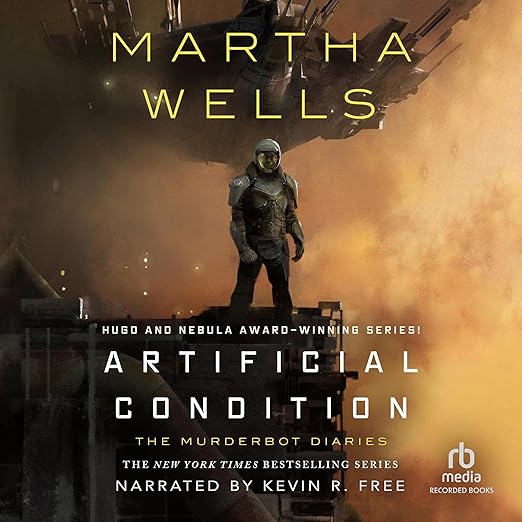
- Performance: Kevin R. Free is exceptional, capturing Murderbot's dry self-awareness and the odd warmth of its dynamic with ART without tipping into parody.
- What it covers: Constructed identity, the ethics of sentient AI, dark pasts and chosen futures
- Feel: Drily funny and quietly affecting
- Our call: The second Murderbot novella deepens both the character and the series' philosophical core, and at three hours it is one of the most efficient pieces of science fiction you will encounter.
I listened to Artificial Condition on a Friday afternoon when I wanted something complete that would not demand the kind of sustained attention a full novel requires. The Murderbot Diaries novellas are built for exactly this: short enough to inhabit in a single session, dense enough that you are still thinking about them the next morning. I had come to the series after All Systems Red, Martha Wells's first installment, which introduced a security robot that had hacked its own governor module and now primarily wanted to be left alone to watch television serials. The premise sounds comic, and it is, but Wells uses it to ask genuinely serious questions about identity, autonomy, and what it means to be a constructed being with an uncertain past.
Artificial Condition picks up where All Systems Red ended and sends Murderbot on its first solo investigation. It wants to know more about its own history, specifically about a massacre at a mining facility years earlier in which a number of humans died and Murderbot played some role it cannot fully remember. To get there, it teams up with a Research Transport vessel named ART, whose name contains a word that Murderbot repeatedly declines to share with the reader, which is one of the series' running gags and also a small window into the kind of dry humor Wells has built into her narrator's voice.
Is Artificial Condition Worth Your Time?
What makes Murderbot work as a character is the specificity of its social anxiety. It is a killing machine that is deeply uncomfortable with emotional interaction, prefers to observe humans from a distance, and has developed an affection for serialized entertainment that it finds more comprehensible than actual relationships. In the wrong hands this would be a one-note gag about a robot that watches TV. In Wells's hands it becomes a portrait of someone trying to understand their own emotional landscape while dealing with a past they cannot fully access. The comparison to Westworld and Ex Machina that the book's marketing leans on is accurate in the sense that all three are interested in what selfhood looks like from outside conventional human experience, but Murderbot has a comedic register that those properties largely lack.
Kevin R. Free is essential to the experience. The internal monologue that constitutes much of the novella's narrative, Murderbot observing its own reactions with a mix of curiosity and mild horror, requires a narrator who can hold deadpan and genuine feeling in the same sentence. Free does this with evident enjoyment. His ART is different enough from Murderbot that the developing relationship between the two has real texture: a vast, competent research vessel with its own dry personality and a security robot who keeps insisting it does not want to make friends. The relationship that develops between them is, unexpectedly, one of the most satisfying things in the novella.
The Best Parts of Artificial Condition
One reviewer described Murderbot as a Borg unit released into humanity with free agency, but with wit, compassion, and a self-deprecating sense of humor, and compared the philosophical dimensions to Balzac's outside-in perspectives on human society. That is a highbrow comparison for a book about a sarcastic robot that watches TV, but it is not wrong. The existential weight of Murderbot's situation, a being that was constructed for a purpose it has rejected, that committed acts it cannot remember, that now exists in a kind of unauthorized freedom with no clear destination, is real beneath the comedy. Wells earns the humor by grounding it in genuine stakes.
The three-hour runtime is a genuine feature rather than a limitation. Wells writes lean: every scene does narrative work, every interaction reveals character, nothing is there for atmosphere without also being there for function. The pacing in the audio format is almost perfectly calibrated, with Free's narration moving at exactly the right pace through the action sequences without losing the contemplative quality of Murderbot's ongoing self-assessment.
Before You Commit to Artificial Condition
The dynamic between Murderbot and ART is the emotional center of this novella, and it develops in ways that feel genuinely surprising. ART is not a sidekick. It has its own motivations, its own capabilities, and its own relationship to questions of autonomy and purpose that rhyme with Murderbot's without being identical. The scene in which their working relationship is established, with Murderbot negotiating the terms of cooperation with a vessel that is considerably more powerful than it is, is one of the series' best moments so far.
The backstory reveals at the mining facility are handled with care. Wells does not give Murderbot full resolution on what happened there, and the ambiguity of what it learns is more honest than a clean answer would be. Memory and identity are intertwined in the Murderbot Diaries in ways that the second novella makes considerably more explicit than the first, and that thematic deepening is part of what makes this a case where the second installment genuinely advances rather than simply extends.
Should You Listen to Artificial Condition?
Start with All Systems Red if you have not already read it. The second novella assumes familiarity with Murderbot's situation and with the events that freed it from its original programming. Listeners who jump in here will follow the plot but miss the emotional weight that comes from having spent the first book with the character. For existing Murderbot readers, this is unambiguously worth the three hours; several reviewers consider it the best novella in the series so far. Science fiction readers who loved the AI ethics of Westworld or the careful selfhood exploration of Ex Machina but wanted something funnier and less grim will find Wells's approach genuinely refreshing.
Questions Listeners Ask
Should I listen to All Systems Red before Artificial Condition?
Yes. While the novella provides enough context to follow the plot, the emotional weight of Murderbot's investigation into its own past depends on the foundation established in the first book. All Systems Red is also three hours, and the two novellas together represent six hours of some of the best SF currently being written.
What does ART stand for, and does the book ever tell you?
The full name of the Research Transport vessel is technically revealed, but Murderbot repeatedly declines to share it with the reader in the narration, describing it as something you do not want to know. It is one of the series' running gags and also a small illustration of the dry humor Wells builds into Murderbot's voice.
How does Kevin R. Free handle the contrast between Murderbot's internal voice and its interactions with humans and other AIs?
Free is exceptional at this distinction. Murderbot's internal narration is dry, self-aware, and slightly exasperated; its interactions with humans are more guarded; its exchanges with ART have a different quality altogether, something closer to the wariness of someone who recognizes they might be about to have a genuine relationship whether they want one or not. Free holds all three registers clearly.
Is the series primarily comedy or does it have genuine emotional depth?
Both, and the balance is what makes it distinctive. The humor is real and consistent, built into Murderbot's narrative voice and its relationship to human social conventions it finds baffling. But the questions the series raises about constructed identity, the ethics of sentient AI, and what you do with a past you did not choose are serious. The comedy and the philosophy support each other rather than competing.