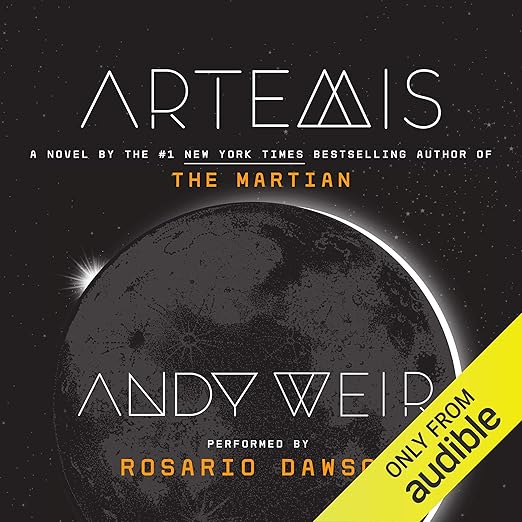
A heist needs a voice more than it needs a plan. The plan is furniture; the voice is what makes you care whether the safe opens. Andy Weir understood that going into Artemis, which is why the whole novel is routed through Jazz Bashara, a porter and part-time smuggler on the first and only city on the moon, and why the audiobook was built around a performer rather than a reader. The result is the second book after The Martian, arriving with a different problem to solve: nobody was going to be stranded alone this time, so the charm had to come from the person telling you about it.
The setup is efficient. Life on Artemis is hard if you are not a rich tourist or an eccentric billionaire, and Jazz's job as a porter barely covers the rent, so a little contraband barely counts as crime. Then a chance at the perfect crime turns up with a payout too large to refuse, and pulling it off drops her into a conspiracy over who controls the city, at which point survival requires an even riskier gambit than the first one. It is a caper structure with lunar engineering underneath it, and the engineering is not decoration: the economics of the city, the physics of the domes, and how anything gets welded or smuggled are all load-bearing.
The sharpest assessment on the page is a three-star from February 2026 titled "A Brilliant Setting Wasted on Cheap Thrills," and it earns the title. That response admires the scientific realism of imagining the first colony on the moon, built near the Apollo 11 moon landing, and describes a base with "parts that are as gritty as the spacecraft in Alien and parts that are as sparkly as a hotel on Park Avenue." Its complaint is that a setting that convincing gets spent on a plot that does not deserve it. Read that before you buy, because it is the most accurate warning available: the moon is the achievement here, and the caper is the part that has to be forgiven.
Rosario Dawson's Voices, Untested by Any Review
The publisher's copy spends an entire paragraph selling the performance, which is unusual and worth reading carefully. It names Rosario Dawson, lists the screen credits, and claims the reading captures Jazz's first-person perspective with the immediacy of someone one cracked helmet visor away from oblivion, while delivering the sarcastic one-liners and tonally somersaulting to voice Kenyan prime ministers, Ukrainian scientists and Saudi welders. That is a specific and checkable set of claims. What the page cannot do is corroborate any of them, because all five written responses grade the novel and none of them discuss the recording. So the casting argument stands on the seller's own description.
What is verifiable is the size of the job. This is a first-person comic voice sustained for nearly nine hours, carrying sarcasm, panic and technical exposition in the same breath, plus a cast the copy explicitly describes as drawn from all walks of life across an international colony. Books like this live or die on timing, since a one-liner that lands flat in print is merely weak, while a one-liner mistimed aloud is embarrassing. If the casting works for you, the novel's biggest weakness, a plot that gets sillier as it accelerates, becomes much easier to ride out. If it does not, the same weakness is exposed.
Weighed Against The Martian, and Ranked Below
The Martian is the shadow over everything, and the page proves it. A four-star from August 2018 says so in its headline, allowing that the book should keep science fiction fans entertained while ranking it below the earlier novel, and the response describes waiting eagerly for this release after loving both the first book and the film. That is the dominant reaction pattern: people who arrived because of The Martian, found the same trademark technical detail, and adjusted downward. Go in expecting the sequel to a beloved survival story and you will spend the first hours comparing rather than listening.
This record's review column is also smaller than it looks. Five written responses sit under a counter of forty-eight ratings, and two of the five were filed on other national storefronts, one of them written entirely in German, which leaves a very small English-language sample for a novel this widely read. None of them is unusable, and the only one of the two January arrivals written in English is a straightforward recommendation of a science fiction page turner with great characters and an engaging plot. Still, a buyer expecting the depth of discussion this book generated elsewhere will find a notably thin page here.
Best for Martian Fans Ready for Chaos
This suits listeners who liked the problem-solving parts of The Martian and can accept a lighter, more chaotic frame around them. A February 2019 five-star lays out that path exactly, describing an appreciation for the humor and the technical side of the science in the earlier book and an appetite for an unfamiliar landscape, then arriving here happy with the story and the characters. If that describes your relationship with hard science fiction, the lunar city will reward you. It also suits anyone who wants a crime story where the obstacles are physics rather than police, and anyone who enjoys a protagonist who is not admirable and does not much care.
Listeners who want their science fiction contemplative or their heroines respectable should look elsewhere, and anyone allergic to a wisecrack every ninety seconds will find the register exhausting rather than fun. The book is also not a good entry point for someone who has never read Weir, since almost everything about the reception here is measured against a novel you would not have read. Come to it as a stylish, technically detailed caper set somewhere nobody has taken you before, and it holds up for nine hours. Come to it expecting the second coming of a stranded botanist and the moon will not save you.
Frequently Asked Questions
Do I need to read The Martian before Artemis?
Not for the story, which shares no characters or setting. But almost every reaction to this book is framed against the earlier one, so knowing it explains the tone of the reviews you will read. If anything, coming in without that comparison is the easier way to enjoy this on its own terms.
How does the audiobook handle the first-person voice?
The novel is told entirely from Jazz's point of view, which the publisher's description makes the centerpiece of its casting pitch: a screen actor carrying the sarcasm, the panic and the technical exposition in one continuous voice. Whether that register suits you is personal, and the audio sample will settle it faster than any description can.
Is Artemis a thriller, a comedy or hard science fiction?
All three in uneven proportions. The frame is a heist that escalates into a fight over control of the city, the voice is comic throughout, and the problem-solving runs on real engineering: welding, life support, the economics of shipping mass to the moon. Anyone wanting a straight thriller will find the jokes constant.
Does the audiobook use a full cast for the colony's many nationalities?
No. The credit names one performer for everyone, with no dramatization and no second reader listed anywhere on the record, across eight hours and fifty-seven minutes released in November 2017. That is worth knowing given how many accents and nationalities the description promises inside the city.