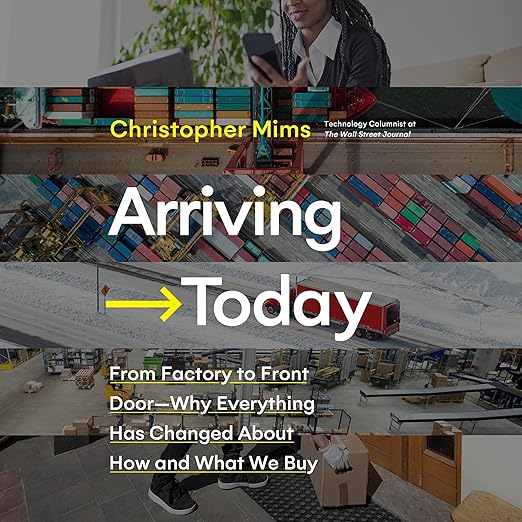
- Performance: James Fouhey's measured, documentary-style delivery lets Christopher Mims's reporting carry its own urgency without over-dramatizing it.
- What it covers: Automation and labor displacement, the hidden cost of instant delivery, global supply chain logistics
- Feel: Investigative, urgent, occasionally unsettling
- Our call: Essential listening for anyone who has ever clicked buy now without thinking about what happens next.
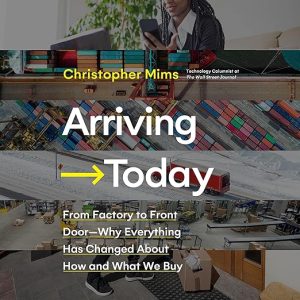
'Arriving Today' reads like a promise on a checkout screen, two words that Christopher Mims spends this entire audiobook quietly dismantling. The Wall Street Journal technology columnist treats that throwaway phrase as a kind of confession: behind the instant gratification of same-day delivery sits a genuinely staggering machine of ports, trucks, warehouses, and algorithms, most of it invisible to the person clicking 'buy now.' Mims structures the book as a single product's journey, following one purchase from a factory overseas through the world's busiest port, into the cab of an 18-wheeler, and finally through an automated Amazon warehouse to a front door. It is investigative journalism built around a supply chain rather than a scandal, and that structural choice is the book's real craft achievement.
Warehouse Robots in a Balletic Dance
What makes Arriving Today work as narrative nonfiction rather than a trend report is Mims's insistence on embedding himself in the physical world his subject describes. He is not writing from spreadsheets. The book puts him inside a shipping port, inside a long-haul truck cab, inside the automated aisles of a fulfillment center, and that ground-level reporting gives the audiobook a texture that a more abstract account of the future of retail would lack. The synopsis calls the balance between human labor and automation a 'balletic dance,' and that phrase turns out to be more literal than marketing copy usually allows, since Mims spends real time describing the actual choreography of warehouse robotics working alongside human pickers.
The book's real subject, though, is the cost of that choreography. Mims does not treat automation and labor displacement as a neutral backdrop to consumer convenience; he treats them as the central tension the whole system is built to obscure. The synopsis's own framing, 'equal parts inspiring, enlightening, and horrifying,' is an accurate three-word summary of the tonal range Mims sustains across eleven hours, moving between genuine admiration for the engineering involved and real unease about who absorbs the risk when that engineering displaces a worker.
The book's title concept also sits inside a longer retail history worth knowing. Overnight and two-day shipping became a serious competitive battleground only in the last two decades, accelerating sharply after Amazon Prime's 2005 launch reset consumer expectations around delivery speed. Mims is not writing about a timeless feature of commerce; he is writing about the tail end of a specific, recent arms race, and the book is strongest when it makes that recency visible instead of treating same-day arrival as something that has always simply been available.
Fouhey Lets Specificity Land Without Editorializing
James Fouhey narrates with the same measured, documentary authority he brings to other investigative nonfiction, and it is close to the ideal register for this specific book. Mims's reporting already carries its own momentum; a narrator who tried to inject extra urgency or outrage would undercut the effect of the reporting doing that work on its own. Fouhey instead lets specificity land, port statistics, warehouse logistics, one driver's daily route, without editorializing, which keeps eleven hours of supply chain detail from tipping into lecture.
That steadiness matters most in the sections about warehouse labor conditions, where the material could easily curdle into either sentimentality or polemic in the wrong narrator's hands. Fouhey keeps his delivery even through both the technically dazzling passages, automated sorting, algorithmic routing, and the more uncomfortable ones, worker injury rates, the pace demanded of human pickers competing against machines. One listener review specifically compares the book's approach to Barbara Ehrenreich's 'Nickel and Dimed,' and that comparison holds up well: both books earn their critique through embedded reporting rather than argument from a distance.
Readers who enjoyed Marc Levinson's 'The Box,' the standard history of how shipping containerization reshaped global trade, will recognize a similar instinct here: taking a piece of infrastructure most people never think about and showing how much of modern life depends on it working invisibly. Arriving Today updates that lineage for the algorithmic, last-mile delivery era, and Fouhey's steady narration serves both books' shared strength, letting infrastructure itself carry dramatic weight without needing invented tension.
Ten Minutes Lost Can Cost the Thread
Multiple listener reviews flag the same structural issue, a section roughly in the book's middle third that shifts from broad supply-chain reporting into a more pointed critique of Amazon's specific business practices. One reviewer calls this stretch 'the inevitable Amazon business practices bashing' and explicitly recommends skipping ahead if that is not what you came for. It is worth knowing this pivot is coming, since the book's opening and closing sections, about global logistics and automation's future, apply more broadly than the middle section's company-specific focus.
This is also a book that rewards attention rather than background listening. The supply chain Mims describes has enough distinct moving parts, port operations, trucking logistics, warehouse robotics, last-mile delivery, that losing the thread for even ten minutes during a commute can mean missing how one stage connects to the next. Listeners who want the full argument, not just isolated facts about warehouses or trucking, should plan for closer listening than eleven hours of typical business nonfiction usually demands.
It is worth being honest, too, about how quickly this kind of book can date. Mims describes a rapidly moving technological and labor landscape, published at a specific moment in retail history, and some of the automation timelines and company-specific details will inevitably be overtaken by events. That does not undercut the book's core argument about the tradeoffs baked into instant gratification, but listeners should treat the more specific predictions as a snapshot rather than a permanent forecast.
The book's geographic scope is also worth knowing upfront: while global supply chains obviously span the world, Mims's ground-level reporting concentrates heavily on American ports, trucking routes, and warehouses specifically. International listeners looking for a comparably detailed account of their own country's logistics infrastructure should expect this book's case studies to be U.S.-centric even as its broader arguments about automation and labor apply more widely.
Depth and Specificity Over Brevity
This audiobook is well suited to anyone who has ever wondered what actually happens between clicking 'buy' and a box showing up, and to readers of adjacent books like Nickel and Dimed who appreciate embedded reporting over abstract analysis. It also works well for listeners specifically interested in automation and the future of labor, since Mims treats that question with more nuance than either techno-optimist or doomsayer framing usually allows.
Skip it if you are looking for a purely celebratory account of logistics innovation, or if the idea of eleven hours spent on ports, trucks, and warehouses sounds tedious regardless of how well it is reported. The book's strength is depth and specificity rather than brevity, and listeners who want the headline version without the granular detail may find the runtime tests their patience more than the writing itself does.
Good to Know
Does this audiobook cover Amazon specifically or the wider shipping and logistics industry?
Both. Mims uses Amazon's automated warehouses as a recurring example throughout, but the audiobook also covers ocean ports, trucking, and the broader retail supply chain rather than functioning as an Amazon-only exposé.
How much of this audiobook is critical of Amazon's labor practices specifically?
One clearly identifiable stretch in the middle third focuses specifically on Amazon's business practices, and at least one listener review suggests skipping ahead if that particular section is not what you are looking for.
Do I need a supply chain or business background to follow this audiobook?
No. Mims writes for a general audience and explains logistics and automation concepts as they come up, though the eleven-hour runtime rewards close attention rather than background listening given how many moving parts it tracks.