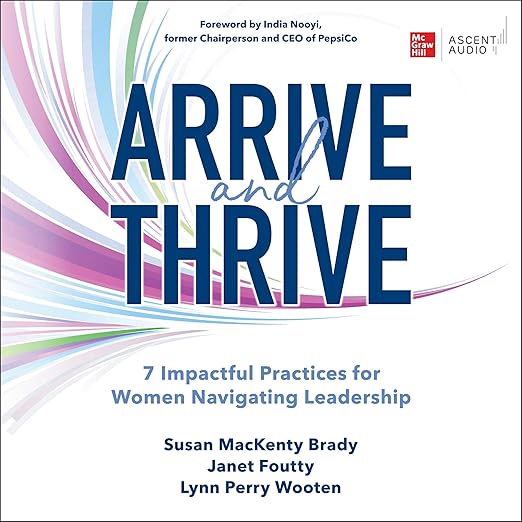
Arrive and Thrive, the audiobook narrated by Kim Niemi and co-authored by Susan MacKenty Brady, Janet Foutty, and Lynn Perry Wooten, announces its distinction from the genre's motivational baseline in the first chapter. The paradigm for women for far too long has been about surviving if you're lucky enough to arrive at the top, the book's central argument runs, and the seven practices it offers are structured around the question of what thriving actually requires once survival is no longer the operative mode. The difference between a leadership book organized around surviving obstacles and one organized around thriving after arrival is not just rhetorical; it produces different practical recommendations.
Foutty brings Deloitte's US board chair perspective, Wooten brings academic and organizational leadership research, and MacKenty Brady brings executive coaching. The combination means the book's examples are drawn from genuinely senior institutional positions rather than the aspirational mid-career scenarios that populate most women-in-leadership titles. Niemi's narration handles the professional register with appropriate crispness, and the 6 hours and 28 minutes of listening time keeps the seven practices moving without dwelling past the point of utility on any single chapter.
The seven practices are clearly delineated: Investing in Your Best Self, Embracing Authenticity, Cultivating Courage, Fostering Resilience, Inspiring a Bold Vision, Creating a Healthy Team Environment, and Committing to the Work of an Inclusive Leader. Each receives a dedicated chapter, and the structure is deliberately parallel so that readers can return to specific practices rather than needing to work through the book sequentially. This design choice matters in audio; listeners who want to revisit the Fostering Resilience chapter after a difficult professional experience can navigate to it without replaying the entire book.
The inclusion of contributions from both male and female leaders across major organizations gives the book a breadth that single-author leadership titles cannot achieve. The reviewer who describes the authors as having put together seven practices that will change the lives of women leaders is making a claim that the book's institutional evidence supports: these are not practices extracted from one career but from a wide evidentiary base of what actually functions at senior levels. The specific example about the late 1960s job market, offered by a reviewer whose wife encountered the gendered barriers of pre-HR-era corporate hiring, contextualizes how much and how little has changed between the environments the book's historical anecdotes describe and the present.
Niemi Frames Inclusion Problems as Leadership Problems
Kim Niemi's narration suits the audiobook's practical orientation well. She does not sentimentalize the personal stories the three authors contribute about their own careers, and she does not flatten the analytical sections into the generic optimism that makes many leadership audiobooks hard to distinguish from one another. The professional crisps of the delivery matches what the material is trying to do: give listeners tools they can use in their actual organizations, not inspiration they can absorb and forget.
The practice of Committing to the Work of an Inclusive Leader is worth flagging specifically because it positions inclusion not as an aspirational value but as a structural leadership competency. The book treats it alongside the individually-oriented practices like Cultivating Courage and Fostering Resilience rather than relegating it to an appendix or afterword, which reflects the authors' institutional understanding that teams with inclusion problems have leadership problems. This is a more rigorous approach than many leadership books take.
What Got You Here Won't Get You There
The book's primary audience is women who have arrived at senior positions or are close to doing so, and the examples and scenarios throughout are calibrated for that context. Listeners earlier in their careers will find the material valuable as anticipatory preparation but may find some of the specific dynamics, the board room negotiations, the managing-upward scenarios, the inclusive-culture-building responsibilities, somewhat removed from their present situations. The book is honest about its audience rather than pretending the practices apply uniformly across career stages.
The Marshall Goldsmith quote that one reviewer leads with, what got you here won't get you there, is actually a useful frame for understanding what Arrive and Thrive is doing. The book's implicit argument is that the skills and strategies that enabled arrival are different from the practices required for sustained thriving once there, and each of the seven practices addresses a specific gap that arrival creates rather than fills.
Niemi's reading of the firsthand contributions from outside the three authors, the chapters drawing on leaders from major organizations across sectors, keeps the material from feeling like a closed conversation among institutional insiders. The range of voices the book incorporates means the seven practices are tested against genuinely different organizational contexts, not just the Deloitte and academic environments the co-authors inhabit professionally. That breadth of evidence base is audible in the listening experience as a kind of distributed confidence: the practices are not claims but observations drawn from a wide enough sample to support the conclusions Arrive and Thrive draws.
Extractable Practice Over a Compelling Story Arc
This audiobook is for women in leadership roles or approaching senior positions who want concrete frameworks rather than general encouragement. Mentors who recommend books to developing women leaders will find it a more practically useful recommendation than most titles in this space. Skip this one if you are looking for memoir or personal narrative; the three authors share their own experiences throughout, but the orientation is always toward extractable practice rather than compelling story. Listeners who want both personal narrative and leadership framework in the same audiobook would be better served by a single-author memoir from a senior practitioner willing to subordinate the practical content to the story arc.
Quick Take
- Voice: Kim Niemi reads with professional clarity and an appropriate energy level for the material, which is leadership-oriented and practical rather than confessional or emotionally demanding.
- Big ideas: women's leadership, inclusive organizational culture, resilience as a structural practice
- Atmosphere: Brisk, practical, and collaborative in tone
- Worth it?: Arrive and Thrive is a well-constructed leadership audiobook that offers concrete practices over vague inspiration, and the co-authorship model means the seven practices are tested from multiple institutional angles.