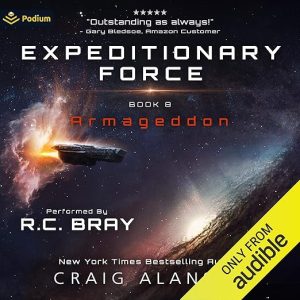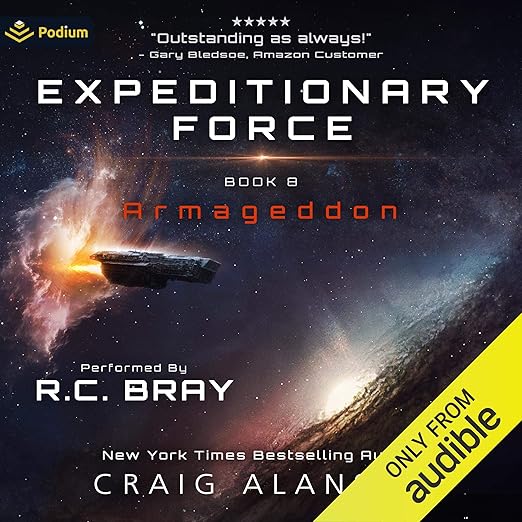
Craig Alanson has been building toward something in the Expeditionary Force series, and with this eighth audiobook, the scaffolding finally comes down. The word armageddon gets thrown around a lot in military science fiction, but Alanson earns it here in ways that feel genuinely consequential rather than cosmetic. For anyone who has logged the hundreds of hours it takes to reach book eight, this is not an entry point; it is a reckoning. The series has always balanced its outsized threats with humor and nerdy charm, and what makes this volume remarkable is how fully it honors both sides of that balance at the exact moment it pushes the stakes beyond anything the earlier entries attempted.
The premise picks up where the Renegade mission left off. Earth was supposed to be safe for centuries. Then domestic trouble forces the President to authorize a nuclear strike on an American city, and suddenly the Merry Band of Pirates are needed again. What starts as a straightforward recon assignment aboard the Flying Dutchman turns into something that earns its title. R.C. Bray delivers every twist with the timing and control that has made him synonymous with this series, and his performance here is among his best work in the full run.
Our Take on Armageddon
What Alanson does better than most military SF writers is sustain tonal balance across long runtimes. The series has always mixed near-continuous cliffhangers with humor and nerdy Easter egg references to real science, and at seventeen hours and fifty-one minutes, Armageddon keeps that engine running without letting it sputter. But this volume also shifts the emotional register in ways earlier books did not attempt. One reviewer put it plainly: characters are finally showing meaningful development, and then half of them are dead. That frustration is real. Alanson has a habit of giving readers genuine attachment and then weaponizing it against them. Here he does it at a scale that justifies the book's name. The narrative does not flinch, which is precisely why the humor that follows darker moments does not feel cheap or deflecting.
The revelations in this volume include ideas reviewers note they have not encountered in other science fiction series. Without detailing specifics, the scope of what the series' central adversarial forces can actually threaten expands considerably, and the geopolitical framing at the start, with the nuclear strike on an American city as a domestic political act, adds a layer of worldbuilding texture that grounds the cosmic stakes in something recognizable and immediate. Alanson is working in a larger canvas than his typical entry-level premise suggests, and this volume is where that larger ambition becomes unmistakable.
R.C. Bray is simply the reason. His voice has grown so thoroughly into these characters that imagining the series with any other narrator is close to impossible. Joe Bishop's sardonic internal commentary, Skippy's insufferable genius, the crew's increasingly tight-knit dynamic: Bray renders all of it with a consistency that eight books in still feels energized rather than routine. His comedic beats land without undercutting the genuine tension when it arrives. Seat-of-the-pants nervous excitement, as one reviewer described the series' core appeal, is something Bray manages at the performance level as much as Alanson manages it at the writing level. At nearly eighteen hours, this is a commitment that rewards listeners who have built the full context over the prior seven volumes.
The audiobook format serves the pacing particularly well throughout. Alanson structures his chapters in a way that makes pausing difficult, and Bray's momentum through those stretches makes them feel shorter than they are. The humor never flattens into formula; each book finds new comedic configurations while the stakes climb. This volume's darker material is handled with enough emotional honesty that the laughs that follow don't feel like a reset button being pressed. They feel like what they are: relief, earned.
What to Watch For in Armageddon
The character development question is the central tension for longtime listeners. Reviewers are divided: some feel Alanson finally delivers on the promise of real growth before yanking it away; others appreciate that consequence feels real in a genre where it often doesn't. The nuclear strike subplot, which sets the action in motion, is handled in broad strokes and may frustrate listeners who want that thread developed with more political complexity and follow-through. The series has never been deeply invested in that dimension, and this entry is consistent in that regard. What it is invested in is momentum and emotional investment, both of which are present in full measure.
New listeners who stumble onto this entry expecting a standalone experience will find themselves lost immediately. The series builds on itself in ways that demand sequential listening from book one. The payoffs here are entirely dependent on accumulated attachment to the crew, and that attachment is earned, not given. Seven books of groundwork are required before Armageddon lands the way it is designed to land.
Who Should Listen to Armageddon
This book is for listeners who have already been through the first seven volumes and are ready for the series to step up its stakes. Fans of military science fiction with strong comedic elements, particularly in the tradition of John Scalzi's Old Man's War or the lighter registers of David Weber, will find Alanson's approach comfortable and then surprising. R.C. Bray listeners who have followed his work across long-form series will find this another strong entry in his catalog.
Skip it if you are new to the Expeditionary Force universe. Skip it also if you want character investment without the risk of that investment being tested painfully. If you want a military SF series that earns its dramatic moments rather than gesturing at them, Armageddon is the volume where Alanson cashes in what he has been building.
Good to Know
Do I need to listen to all seven previous Expeditionary Force audiobooks before starting Armageddon?
Yes, without exception. The payoffs in this volume depend entirely on attachments and plot threads developed across the prior seven books. Starting here would mean missing the context that makes the major events land.
How does R.C. Bray's narration handle the tonal shift toward darker material in this audiobook?
Bray manages the balance well. His comedic timing with Joe's internal monologue remains sharp, and he adjusts register convincingly when the emotional stakes escalate. Longtime listeners will find his performance consistent with the series' voice while deepening in emotional range.