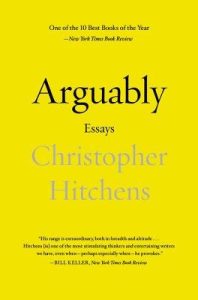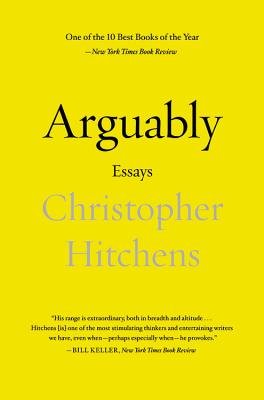
Christopher Hitchens wrote his best sentences the way other people throw punches, aimed to land and impossible to take back once thrown, and this audiobook gathers a hundred and seven of them into more than twenty-eight hours of pure argument. The listing for this title carries only a garbled, bare bibliographic fragment rather than an actual description, not much to work with on its own, so this review draws on the real, well-documented book rather than the broken listing text itself.
Arguably collects work spanning nearly three decades of magazine and newspaper writing, originally published across outlets including The Atlantic, Slate, The Wall Street Journal, and Vanity Fair, and gathering all of it into one place lets a listener track how consistent Hitchens's voice remained even as his subjects ranged from Charles Dickens to Karl Marx.
How Arguably Holds Up
Hitchens himself organized this collection around three distinct registers: literary journalism, political commentary, and what he called cultural complaint, and that structure holds up well across a runtime this long. The literary pieces, on Dickens, on the science fiction of J.G. Ballard, sit comfortably beside sharper political writing on figures like Thomas Jefferson and George Orwell, whose legacies Hitchens treats with the same unsentimental scrutiny he brings to living politicians.
The collection also includes several introductions Hitchens wrote for new editions of classic books, including Animal Farm and Our Man in Havana, and those shorter pieces work particularly well in audio, self-contained enough to function as a standalone chapter even for listeners unfamiliar with the reissued texts themselves. His essays on anti-Semitism and jihad, and on Marx's actual arguments rather than the caricature version, show the same range that made him equally comfortable in a literary review and a foreign policy debate.
The cultural complaint category is where Hitchens is often at his most entertaining, essays that pick apart a specific irritant, a bad piece of public rhetoric, a lazy consensus opinion, with the same rigor he brings to weightier political subjects. That willingness to spend real intellectual effort on seemingly minor targets is part of what made his voice distinctive: nothing was too small to deserve an actual argument rather than a dismissive aside.
Hitchens wrote for a strikingly wide range of ideological audiences without noticeably softening his positions for any of them, publishing in outlets from the left-leaning Guardian to the more conservative Weekly Standard within the same active writing period. That range is part of what makes this collection function almost as an oral history of early twenty-first-century opinion journalism, not just one writer's personal output.
Simon Prebble narrates, and this is close to an ideal pairing based on his established strength with intelligent, argument-driven nonfiction. His work on Matt Ridley's The Red Queen showed a narrator whose articulate, unhurried authority lets an author's sharper and wittier formulations land without artificial vocal emphasis, exactly the skill a Hitchens collection demands, since overplaying the wit would undercut the very dryness that makes his sentences land.
Long-form argumentative nonfiction depends on the listener trusting the narrator across many separate chains of reasoning without losing the thread, and Prebble's track record with exactly that kind of dense, wit-inflected nonfiction suggests he is well equipped for close to thirty hours of a writer who rarely wastes a word but also rarely simplifies a point for the sake of pacing.
Essay collections generally suit audio well, since each piece is built to be consumed in one sitting rather than requiring a listener to track a novel's plot across hours of listening, and a collection this size benefits especially from the format's natural chapter breaks. Listeners can treat each essay as its own self-contained listen, returning to specific pieces on Dickens or Marx independently of the others, rather than needing to experience the whole collection as one continuous unit.
A collection built from originally separate magazine pieces also means Prebble has to reset tone repeatedly across the runtime, moving from a literary appreciation of Dickens to a pointed argument about foreign policy sometimes within the same listening session, and doing that without losing narrative momentum across dozens of tonal resets is its own quiet technical achievement worth crediting explicitly.
Weak Spots in Arguably
This particular audiobook's product page is unusually thin on its own merits, a bare string of bibliographic fragments rather than an actual synopsis, so anyone comparing listings should know the description above comes from independent research rather than from the platform's own text. Readers wanting to double-check any specific claim before committing to a purchase this size can find extensive, easily accessible coverage of the book from its original 2011 release, including reviews from major outlets that covered it at length when it first came out.
At more than twenty-eight hours, this is a genuine commitment, closer in scale to two or three standard audiobooks than one, and the essay format means it rewards dipping in and out rather than binging start to finish. Voice and subject shift constantly across entries written originally for very different outlets over nearly thirty years, so listeners should expect range rather than a single sustained argument.
Arguably was published in 2011, and Hitchens died later that same year, which retroactively gives several of the collection's more combative pieces an added weight even though the book itself was not written or marketed as a farewell statement. Listeners aware of that timeline going in may find themselves reading extra meaning into passages that were, at the time of writing, simply Hitchens doing what he always did.
Twenty-eight hours across a hundred and seven essays works out to roughly fifteen to twenty minutes per piece on average, so listeners can expect frequent natural stopping points rather than long unbroken stretches, a useful detail for anyone planning to work through the collection during scattered commute time rather than dedicated reading sessions.
The Right Listener for Arguably
Readers who enjoy sharp, combative political and literary essay writing, especially fans of George Orwell, whose legacy Hitchens engages with directly and repeatedly throughout the collection, will find plenty to argue with and admire here in roughly equal measure.
This also works well as an entry point for listeners who know Hitchens by reputation but have never actually read him, since the collection gathers pieces from many original outlets into one accessible starting place. Skip it if you want a single sustained argument or narrative rather than a career-spanning gathering, or if you are looking specifically for his memoir, Hitch-22, instead.
Listeners specifically interested in Hitchens's religious writing should note that this collection is not primarily about that subject; his most famous arguments against religious belief live mostly in a separate, dedicated book, so anyone hoping for an audiobook centered on that specific debate should look there first.
Before You Listen
Is this audiobook a good starting point for listeners new to Christopher Hitchens?
Yes, since it gathers pieces from many original outlets into one place, though newcomers should expect range and argument rather than a single sustained narrative.
Does this audiobook need to be listened to in order, or can essays be picked individually?
Essays can be picked individually without losing much context, since each one was originally written as a standalone piece for a different publication.
What topics does this audiobook's essay collection cover?
The range spans literary criticism on writers like Charles Dickens and J.G. Ballard, political commentary on figures including Thomas Jefferson and Karl Marx, and cultural criticism on subjects like anti-Semitism and jihad.