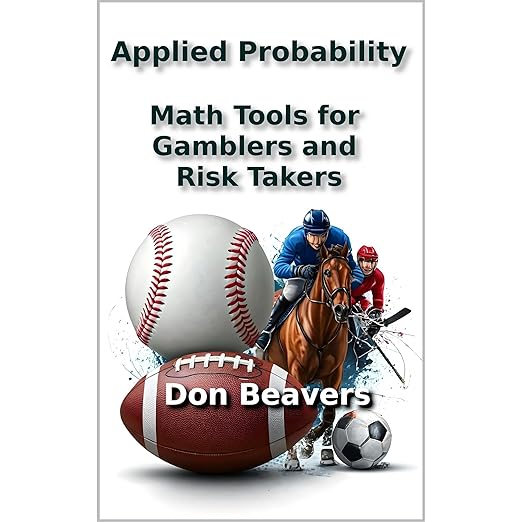
Don Beavers opens with a direct challenge to anyone who has ever walked away from a racetrack or a sportsbook wondering why the house always seems to win: stop guessing, and start calculating instead. Applied Probability is book four in Beavers' Horse Racing and Handicapping series, though its actual scope reaches well past the track, into roulette wheels and sportsbooks and anywhere odds get quoted, walking listeners from the plain mathematical meaning of probability through Expected Value, the competing notations used for odds (fractional, decimal, American), bankroll management, and sharper tools like the Kelly Criterion and line shopping. The audiobook uses Virtual Voice narration, Audible's AI-generated reading, a format choice that matters more here than in most nonfiction, since so much of this specific content, formulas, percentages, worked examples, leans on precision a synthetic voice has to earn sentence by sentence.
Is Applied Probability Worth Your Time?
Synthetic narration on dense numerical material is a real, recurring soft spot for text-to-speech narration generally: AI-generated voices tend to lose the natural emphasis a human reader would put on key figures, turning columns of odds and multi-step calculations into a flatter, harder-to-follow listening experience than the same material would get from a live narrator, and nothing about Applied Probability's own subject matter, expected-value math and staking formulas, suggests that particular limitation would resolve itself here. It is a fair tradeoff to weigh against the convenience of an audio format at all for a niche technical title.
The synopsis closes on a line worth reading as the book's actual thesis rather than a marketing flourish: 'it's not about beating the odds, it's about understanding them.' That framing deliberately distances Applied Probability from the 'guaranteed' betting systems the book itself dismisses as failures, positioning the material instead as a disciplined mathematical toolkit rather than a shortcut to easy winnings.
The book's own chapter list moves through a genuinely logical curriculum rather than a loose grab bag of gambling tips: starting from the plain meaning of probability, advancing through the different notations bettors encounter across fractional, decimal, and American odds formats, and only then layering in Expected Value as the concept that ties stake size to long-run outcome. That sequencing matters for a subject where skipping straight to advanced formulas without the underlying definitions tends to produce exactly the kind of confused, superstition-adjacent betting the book is explicitly trying to correct.
The distinction the book draws between a 'guaranteed' betting system and a genuine probabilistic edge is worth sitting with, since it is a common point of confusion among casual bettors: a system that wins consistently in a small sample can still be a net loser over a large enough number of bets, and Beavers builds the book around training listeners to think in those larger sample sizes rather than trusting a recent hot streak.
The book's title captures its actual ambition precisely: applied, not theoretical, probability, aimed at readers who want the math in service of a real decision rather than as an academic exercise for its own sake.
The Best Parts of Applied Probability
Reviewer steven wright engages with the material at a genuinely technical level, describing how the book 'progresses from basic calculations of expected value to considerations of the scale of bets' and noting that outcome ranges are 'sensitive to the assumptions of probability' fed into any given model, exactly the kind of precise, credentialed feedback a math-heavy niche title needs to be taken seriously.
Reviewer Rsizlle offers the more personal account, admitting to years of betting 'but never really understood the math behind it,' and reporting that the book 'broke it down in a way that actually made sense,' with the material on expected value and bankroll management landing as 'big eye openers.' That combination, one technically literate reviewer and one genuine convert, is a reasonably strong signal for a title that has not accumulated a large public review base.
Reviewer W adds a third data point specifically praising the book as 'the perfect blend of math, logic, and real world application,' language that lines up with the synopsis's own promise of moving from abstract formulas to genuine case studies and practical scenarios. Three independent reviewers converging on the same basic claim, that the math gets made usable rather than staying theoretical, is a meaningfully stronger signal than any single glowing review alone would provide.
Before You Commit to Applied Probability
Several of the book's own stated tools (bankroll management worksheets, decision checklists, quick-reference tables, and record-keeping templates) are inherently visual and reference-oriented, the kind of material meant to be consulted repeatedly rather than absorbed once in a linear listen. Audio carries the underlying reasoning and worked examples reasonably well, but listeners planning to actually use these tools day to day should expect to lean on a print or ebook companion for that part.
The public review record here is thin: only seven ratings are attached to this listing, which points to a dedicated, slowly returning niche readership rather than a single breakout title with broad mainstream reach. Treat any single review, positive or otherwise, with appropriately modest weight given how small that sample is.
The series name itself is worth a second look for anyone browsing by title alone: 'Horse Racing and Handicapping' suggests a narrower track-specific focus than what the synopsis actually delivers, since Beavers generalizes the framework here across roulette wheels and sportsbook lines just as readily as thoroughbred races. Listeners specifically wanting only horse-racing content should confirm the balance of examples matches their interest before committing a credit.
None of the seven ratings currently attached to this listing are negative, for whatever a sample that small is worth, which at minimum suggests no obvious quality complaint has surfaced yet from this book's early audience.
Should You Listen to Applied Probability?
Sports bettors and horseplayers, exactly the audience the synopsis names directly, along with anyone wanting a disciplined, math-based framework over hunches, and existing Beavers readers already through earlier volumes in the series, will get real value here.
Listeners drawn to the psychological side of gambling discipline specifically, the synopsis's own promised coverage of the Gambler's Fallacy, hot-hand thinking, and confirmation bias, will find that material as practically useful as the pure math, since knowing the correct formula rarely stops a bettor from making the same predictable cognitive mistakes under pressure.
Anyone comparing sports betting to other forms of probabilistic decision-making, insurance pricing, financial risk management, actuarial work, will recognize the same underlying mathematical toolkit at work here, just applied to a racetrack or a sportsbook instead of a spreadsheet.
Casual listeners hoping for entertaining gambling stories or a Moneyball-style narrative should adjust expectations, since Applied Probability stays almost entirely in instructional mode, working formula to formula rather than anecdote to anecdote, and the synthetic narration keeps the tone purely functional throughout.
Questions Listeners Ask
Is the Virtual Voice narration a problem for a math-heavy audiobook like this one?
It is a real limitation worth knowing about upfront. Synthetic narration tends to read flat against dense formulas and percentage-heavy passages, so listeners wanting interpretive emphasis on key numbers may prefer following along with the print or ebook edition.
Can I actually use this audiobook's bankroll management tools while listening, or do I need the print version?
The checklists, tables, and record-keeping templates described in the synopsis are reference tools meant for repeated use, so a print or ebook companion is genuinely useful alongside the audiobook rather than optional.