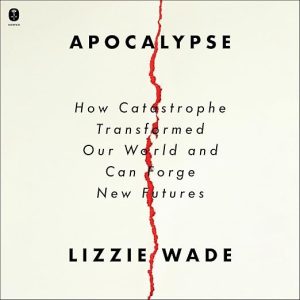
I started listening to Apocalypse on a Tuesday morning when the news was particularly grim, which turned out to be either terrible timing or perfect timing depending on how you interpret the experience. By the end of the first chapter, I had stopped thinking about the present and started thinking about the end of Old Kingdom Egypt, which is either a sign of excellent writing or a sign that I was desperate for perspective. Probably both.
Lizzie Wade is a science journalist who has covered archaeology and anthropology for Science magazine, and her writing has the rare quality of making expert knowledge feel earned rather than borrowed. She doesn't simplify the past so much as she renders it with the kind of texture that makes ancient catastrophes feel immediate and populated rather than abstract.
Wade Puts People Inside Every Ancient Collapse
The book's central argument is that the word apocalypse has distorted our understanding of historical collapse. Wade wants to replace the image of sudden, total annihilation with a more complicated picture: civilizations don't simply end, they transform, and the people who live through those transformations are making choices, not just surviving. She structures the book as a series of case studies moving roughly chronologically, from the extinction of Neanderthals through the fall of Classic Maya civilization, the Black Death, and forward into the climate pressures of the present day.
What distinguishes this from most popular archaeology writing is the degree to which Wade centers the people rather than the catastrophes themselves. When she writes about the end of a civilization, she asks what the individuals who lived through it thought was happening, what options they considered, and what they actually built in the aftermath. This requires some careful epistemology, since the evidence for what people thought in 3000 BCE is necessarily thin. One reviewer offered the pointed observation that the book is "great analysis of documented catastrophes, combined with annoying projections of what undocumented victims and survivors might have thought." That tension is real, and Wade acknowledges it, though how much it bothers you will depend on your tolerance for informed historical imagination versus strict evidential constraint.
Delaine's Steady Voice Builds a Convincing Case
Christina Delaine's narration is one of the book's quiet assets. She has a clear, measured voice that suits the journalistic register of Wade's prose, and she manages the shift between historical narrative, archaeological description, and the more speculative passages without making the transitions feel jarring. The audiobook runs just over ten hours, which is enough time for the individual case studies to accumulate into something larger than their parts. Wade's argument about the nature of apocalypse becomes genuinely convincing the longer you stay with it, and Delaine's pacing respects that accumulative logic.
The endorsements on this book are worth noting: Ed Yong, whose work on the immune system and on animal perception has set a high bar for science journalism, calls Wade "an exceptional journalist and a master storyteller," and the praise is deserved. Zoe Schlanger writes that the book "upended my understanding of the ancient world," which is the exact response it's designed to produce.
Strongest in the Middle, Speculative at the Edges
The book is strongest in its middle sections, where the historical evidence is richest and Wade's narrative gifts have the most to work with. The earliest case studies, dealing with periods where the archaeological record is necessarily fragmentary, require more speculative reconstruction. The final sections connecting ancient collapse patterns to contemporary climate instability are more journalistic and less thoroughly evidenced than the historical heart of the book, though they're also the sections most directly relevant to why a contemporary reader might pick it up.
One reviewer described the book as making them "feel strangely hopeful about the end of the world," and I think that captures the paradox at its center. Wade is not minimizing the severity of past collapses or of the present crisis. She is arguing, carefully and with evidence, that the human capacity to adapt and rebuild is itself a historical pattern, not just a reassuring fantasy. Whether that argument changes how you feel about the current moment will depend on what you bring to it.
Essential for Collapse Readers, Minus the Print Maps
Readers of popular archaeology and science history will find this essential. It stands well alongside Jared Diamond's collapse literature while offering a meaningfully different and less deterministic framework. Listeners who are anxious about contemporary environmental and political instability may find it genuinely useful as a frame for understanding crisis rather than just enduring it. Those who require strict empirical discipline in their popular science may find the speculative sections frustrating. The supplemental PDF referenced in the audiobook description accompanies the physical edition and contains maps and additional visual material that won't be accessible in audio form, which is worth knowing in advance.
- Narrator: Christina Delaine handles Wade's dense archaeological and historical material with clarity and just enough emotional texture to keep the more speculative passages grounded.
- Subjects: Civilizational collapse and resilience, archaeology of trauma, human adaptation across millennia
- Tone: Quietly urgent and unexpectedly hopeful
- Bottom line: A genuinely reframing work of popular science history that earns its optimism through rigorous case studies rather than wishful thinking.
Good to Know
Does Apocalypse require prior knowledge of archaeology or ancient history?
No. Wade is a science journalist writing for a general audience, and she builds context as she goes. Familiarity with subjects like the Classic Maya or the Black Death is helpful but not required. The book functions as an introduction to each case study before it makes its argument.
Is the supplemental PDF included with the audiobook, and does its absence affect the listening experience?
The PDF is referenced in the audiobook metadata as a supplemental enhancement. It contains maps and visual material from the physical book. Wade's narration doesn't depend on it, and the audiobook works well without it, but listeners who want the full geographical context for discussions of sites like Teotihuacan or Old Kingdom Egypt may want to have a map open.