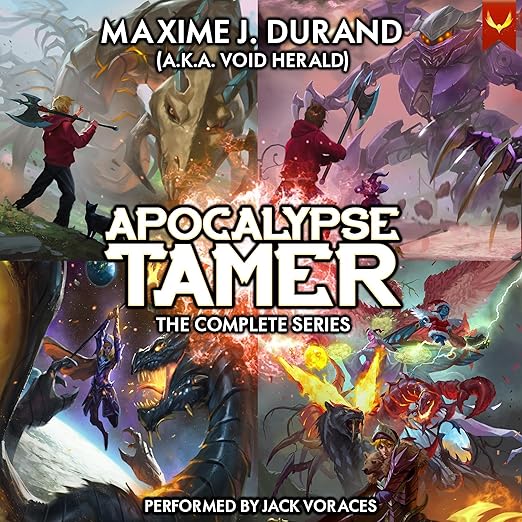
- Voice: Jack Voraces takes on a comedic, creature-heavy LitRPG cast that demands real voice differentiation, though no reviewer commentary confirms the specific performance.
- Big ideas: System-based survival, found family through monster taming, satire of apocalypse-genre conventions
- Atmosphere: Playful and irreverent, with genuine stakes lurking underneath the jokes
- Worth it?: A strong pick for LitRPG listeners who want comedy and creature-collecting over grim survival, provided they're ready for a seventy-eight-hour commitment.
Basil Bohen sleeps through the System's arrival, which tells you almost everything about the joke at the center of this audiobook. While the rest of humanity scrambles to fight dungeon invaders, ancient gods, and each other for a shot at becoming Earth's new Overgod, Basil opts out of the fight entirely, choosing the obscure Tamer profession so he can talk to his cat, Plato, and eventually a whole menagerie of monsters, instead of grinding through combat like everyone else around him. Apocalypse Tamer: The Complete Series bundles all four books of Maxime J. Durand's LitRPG saga into one seventy-eight-hour, thirty-nine-minute listen, and that runtime alone tells a listener what kind of commitment this box set actually is before a single chapter starts.
How Apocalypse Tamer: The Complete Series Holds Up
Durand, billed here as the bestselling author of Vainqueur the Dragon and The Perfect Run, builds Apocalypse Tamer around a premise that pokes fun at its own genre even while fully committing to it. The System's one instruction, that whoever reaches Level 100 first becomes Earth's new Overgod, sets every other character sprinting toward a violent, competitive endgame. Basil's response is to build a defensible corner of countryside and recruit creatures who would otherwise be trying to kill him. The synopsis is upfront that this is a satirical spin on LitRPG apocalypse fiction blended with the collect-and-train logic of Pokemon and Monster Rancher, and that hybrid is exactly what gives the series its identity across four full books rather than a single novel's worth of jokes.
The Tamer class is the real engine here, and it inverts the genre's usual escalation logic in a way worth sitting with. Most LitRPG protagonists get stronger by fighting harder monsters; Basil gets stronger by building relationships with them, which means the story's tension comes from negotiation, care, and strategy as much as combat. Dungeon diving and battles still happen across the four books, but so does the slower work of building out a livable base and a genuine found-family structure among creatures that would be enemies in almost any other series wearing this genre's label.
The title itself does real work: 'tamer,' not 'hunter,' not 'slayer,' names Basil's whole philosophy in one word, a small but telling signal that Durand builds comedy and worldbuilding around a genre inversion rather than a straightforward power fantasy. Structuring four full books around one steady climb from Level 1 to Level 100 also gives Apocalypse Tamer a shape most single-volume LitRPG entries can't match: side characters, secondary creatures, and Basil's own home base all get room to develop across hundreds of chapters rather than being introduced and resolved inside one book's tighter arc.
Why Apocalypse Tamer: The Complete Series Works as an Audiobook
Jack Voraces carries a cast that includes a talking cat, a rotating menagerie of tamed monsters, and Basil's own dry refusal to play along with the System's stakes, and that combination puts real technical demands on a narrator: differentiating creature voices, landing comedic beats without undercutting the genuine danger underneath them, and keeping a seventy-eight-hour production coherent across four books. No specific listener feedback on Voraces's performance is attached to this listing, so that assessment is a fair genre-fit expectation rather than a confirmed strength, but it is the right register for what this material demands.
The attached reviews lean toward exactly the tone the synopsis promises. One five-star review calls it simply a fantastic series worth the money, and a reviewer using the handle Leo titles their five-star review '10/10' before summing up the whole appeal in one memorable line, 'a Bulgarian's guide to surviving the Dark Souls apocalypse,' a joke that lands because Basil's entire strategy is refusing to fight the way a Dark Souls-style apocalypse story would normally demand. A third reviewer, ryan, praises the 'fun characters and great names' that 'made me laugh often,' which tracks with a series built as much around comic invention as survival stakes.
Weak Spots in Apocalypse Tamer: The Complete Series
Seventy-eight hours and thirty-nine minutes is a serious listening commitment, closer to reading four full novels back to back than sampling a single LitRPG entry, and prospective listeners should treat this bundle as a multi-week project rather than a weekend binge. That length also means the pacing across all four books varies more than a single, tightly edited novel would, since Durand has room to let side plots, secondary creatures, and worldbuilding detail breathe in ways a shorter series simply can't.
Because the whole premise rests on Basil choosing not to fight, listeners expecting escalating, grimdark survival stakes at every turn should recalibrate. The comedy is genuine and frequent, per every attached review, which means moments of real danger sit alongside jokes about cat behavior and creature-collecting logistics rather than unbroken tension. That tonal blend is the series' actual appeal, but it is a different promise than a straight apocalypse thriller makes.
System-message-heavy prose, stat blocks, skill notifications, level-up alerts, is a known challenge for any LitRPG narrator, since those passages have to read as distinct from regular dialogue and description without collapsing into a monotone list. A seventy-eight-hour production built on that structural demand means listeners should expect the genre's show-your-work mechanics, level thresholds, class abilities, creature stat comparisons, in real volume, not as occasional garnish.
The synopsis centers Basil individually, but one five-star reviewer's aside, hoping 'the Bohens have a great life out there,' hints at a family dimension beyond just its protagonist, suggesting Basil's story stays connected to people he cares about even as the System reshapes the entire world around him rather than isolating him as a lone survivor. Listeners parsing genre labels closely should also note the listing carries a single Fantasy tag, technically accurate but broad enough to undersell just how mechanically specific the LitRPG systems, levels, classes, stat progression, actually are throughout all four books, closer to a structured game system than loose magical fantasy.
The Right Listener for Apocalypse Tamer: The Complete Series
LitRPG and GameLit listeners who enjoy system mechanics and level-based progression will find plenty here, and the specific overlay of creature-taming and found-family bonds gives this series a distinct identity within a crowded subgenre. Anyone with fondness for Pokemon or Monster Rancher's core loop, collecting, bonding with, and training creatures rather than simply defeating them, has an unusually direct entry point into this particular corner of LitRPG fiction, even without prior familiarity with Durand's other series.
Fans of progression fantasy who care as much about the found-family cast a protagonist accumulates as the power spike itself, Plato the cat included, are particularly well served, since Basil's tamed creatures function as a genuine ensemble rather than disposable pets.
Readers who want their apocalypse fiction to stay relentlessly grim from start to finish, without comic relief diluting the danger, are likely to find Basil's live-and-let-live philosophy an odd fit for what the System Invasion premise otherwise sets up, since taming monsters into a peaceable menagerie is a fundamentally lower-stakes choice than nearly every other character in the story is making around him.
Before You Listen
How long is the Apocalypse Tamer: The Complete Series audiobook?
At seventy-eight hours and thirty-nine minutes, this bundle covers all four books in Maxime J. Durand's series in one continuous listen, close to a full work week of listening time back to back.
Do I need to know Pokemon or Monster Rancher to enjoy this audiobook?
No. The synopsis nods to both as tonal touchstones for the taming mechanic, but the System Invasion premise and Basil's Tamer class are explained from the ground up for listeners new to creature-collection stories.
Does the audiobook lean more toward comedy or serious survival stakes?
Both, but comedy leads, based on the synopsis and listener reviews: expect laughs and inventive creature names alongside the genuine tension of a worldwide race to Level 100.