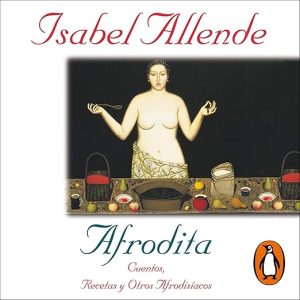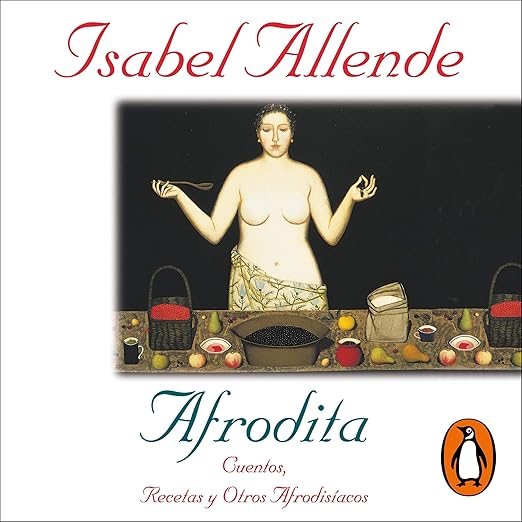
Isabel Allende spent thirty years, by her own account, avoiding a subject she eventually decided belonged at the center of a healthy life: pleasure, specifically the intertwined pleasures of food and sex. Aphrodite, her genre-crossing 1998 essay collection now available as an 11-hour Spanish-language audiobook, blends personal memoir, historical anecdote, world folklore, and actual recipes into a single sustained meditation on desire, and it is a genuinely different kind of book than either the erotica tag or the Sex Instruction subcategory attached to this listing suggests. This is Allende writing as herself, candidly and often very funny, not constructing fiction or delivering clinical instruction.
Regret as Confession, History as Evidence
Allende opens with a confession worth translating directly: she regrets, she writes, the delicious dishes she turned down out of vanity as much as she regrets the lovemaking she let pass by while attending to chores or clinging to a kind of puritanical restraint, since sexuality, in her framing, is a component of good health, a spark for creativity, and part of the soul's own path. That confessional, unguarded register runs through the whole collection, and it is precisely what her reviewers respond to. Adriana calls the book 'deliciosamente fantastico', deliciously fantastic, praising how it walks the listener through the aphrodisiac world alongside food in an amusing, inviting way that makes you want to keep listening and then go cook something, ideally with someone you love.
The historical material gives the book real substance beyond memoir. Allende moves from Emperor Nero to Catherine the Great to Madame du Barry, tracing recorded aphrodisiac folklore across centuries and continents, and that research gives the personal essay sections a wider frame, this is not just one novelist's private reflections but an attempt to place her own late-arriving embrace of pleasure inside a much longer human tradition of trying to bottle desire.
From Magical Realism to Recipes and Memoir
Allende's reputation as one of the defining voices of Latin American magical realism, built across novels like The House of the Spirits and Eva Luna, makes her turn toward direct, nonfiction personal essay genuinely notable. A novelist who spent decades filtering experience through fiction and family saga choosing, in her fifties, to write about her own desire and appetite in first person, with no fictional distance at all, is a real departure worth naming for listeners who know her primarily as a storyteller of other people's multigenerational sagas.
The recipes woven through the collection are a lovely detail on the page and a genuine structural challenge in audio, closer to the workbook-and-exercise tension found elsewhere in nonfiction: a listener cannot glance down at exact measurements and steps mid-drive the way a reader can flip back to a printed page. The historical and personal essay material translates cleanly to listening, but anyone hoping to actually cook from this collection should plan to track down the recipes in text form separately.
The synopsis describes Allende approaching her historical subjects with 'convincing admiration and due irreverence', and that exact balance is worth close reading as the book's defining tonal achievement. She takes Nero's excesses and Catherine the Great's reputation seriously enough to treat them as real historical material worth researching properly, while never losing the sly, knowing humor that keeps the whole collection from tipping into dry academic survey.
Gazitua's Dignified Take on Confessional Material
Javiera Gazitua has built a track record in Spanish-language narration for exactly the kind of high-emotional-impact, memoir-adjacent material this collection provides, reading personal, confessional content with real dignity rather than melodrama. That register suits Allende's own unguarded candor about desire and regret well, even without a title-specific performance note to point to directly, the underlying skill, treating intimate personal material with seriousness rather than titillation, is precisely what this collection needs from its narrator.
Reviewer Guadalupe specifically credits Allende's sense of humor and warmth, the good aftertaste her books consistently leave, as the quality that carries across everything she has written, and that assessment matches Aphrodite closely. The book is genuinely funny in places even while handling frank material, and a narration that can hold both the humor and the sensuality without flattening either is doing exactly what this specific text asks for.
In Spanish Only, and Miscategorized as Erotica
This audiobook is entirely in Spanish, a detail the listing itself notes directly, and it is the single most important purchasing consideration here. Listeners who do not read or understand Spanish will not be able to access this edition at all, and should confirm whether a separate English translation exists as an audiobook before purchasing this specific listing expecting an English-language experience.
The erotica and Sex Instruction genre tags attached to this listing meaningfully mischaracterize the actual content. This is not narrative erotic fiction and not a how-to guide, it is a hybrid memoir, cultural history, and cookbook built around the theme of sensual pleasure, closer in spirit to a literary essay collection than to anything the genre tags imply, and listeners browsing by either label should adjust expectations accordingly.
The original Spanish subtitle translates roughly to 'stories, recipes, and other aphrodisiacs', and that three-part structure, narrative, culinary, and folkloric, is a genuinely accurate promise of what the collection actually delivers rather than a cute marketing flourish. Listeners should expect the book to move fluidly between all three registers within a single chapter rather than sorting them into separate, clearly labeled sections.
One review, from Ydalia Garcia, awards five stars while stating directly that she has not yet listened to the book, simply noting that she likes Allende's other work generally. That is worth naming honestly as a real limitation in how much weight that particular five-star rating can carry, rather than folding it silently into the overall rating picture, even though the underlying sentiment, real trust built from Allende's broader catalog, is a genuine and understandable reason for a longtime reader to feel confident going in.
The book's hybrid structure, part memoir, part history, part actual cookbook, makes it an unusually good candidate for a specific kind of listening context: playing it while actually cooking a meal, letting Allende's voice narrate history and personal reflection while a listener's hands stay busy with something food-related in real time.
Written for Allende's Existing Spanish-Speaking Readers
This is a wonderful fit for Spanish-speaking listeners who already love Allende's fiction and are curious what her voice sounds like turned toward nonfiction and personal reflection, as well as anyone drawn to food writing that treats eating and desire as genuinely connected rather than metaphorically adjacent. Fans of memoir-adjacent essay collections that blend the personal with the historical will find real substance here beyond the surface premise.
Skip this one if you need English-language audio or if you are specifically seeking either narrative erotica or a practical sex-instruction guide, since this delivers neither despite how the listing itself happens to be categorized. For Spanish-speaking listeners drawn to Allende's particular blend of candor, humor, and historical curiosity, though, this remains a genuinely distinctive and rewarding entry in her catalog.