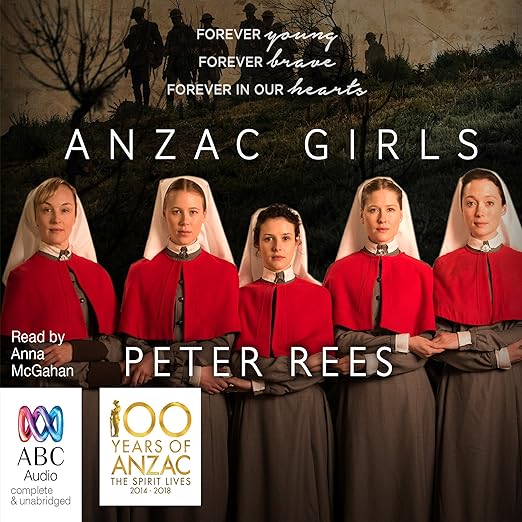
Forty-five Australian and New Zealand nurses died on overseas service by the end of the Great War, and more than two hundred were decorated for the work they did in hospital camps and tent surgeries along some of history's worst battlefronts. Peter Rees builds this audiobook around that largely unrecognized history, drawing on the actual diaries and letters these women left behind rather than relying on secondhand accounts or official military records alone. The book became the basis for a six-part Australian television series, and the synopsis is direct about its central claim: these women left home looking for adventure and romance and instead found themselves facing horrors their civilian lives could never have prepared them for.
Girls in the Title, Women in the Wards
What Rees does especially well, based on the letters and diaries he draws from, is resist turning these women into either saints or symbols. The synopsis promises that friendships and loves get real space alongside the horror of the wards, and that balance is what keeps the book from reading as a pure atrocity catalog. These were young women navigating real relationships, real fear, and real dark humor inside genuinely traumatic circumstances, and the book's commitment to that fuller humanity is what separates it from a more conventional military history.
The book's structure moves through the hospital camps and tent surgeries with enough specificity that individual nurses emerge as distinct people rather than a composite. That specificity is only possible because of the archival work behind it, letters and diaries rather than official reports, and it is worth crediting Rees directly for the research labor that makes this kind of granular, personal history possible at all rather than a more generic account of wartime nursing.
The word 'Anzac' itself, an acronym for the Australian and New Zealand Army Corps formed for the Gallipoli campaign, has become shorthand in both countries for a specific, heavily mythologized kind of wartime courage, one built almost entirely around men in combat. Rees's project is explicitly corrective in this sense: he is not rejecting the Anzac legend so much as insisting it has always been incomplete, built on an accidental gap in whose stories got preserved and celebrated rather than any real difference in the courage involved.
A related tension sits in the book's own title choice: calling these women 'girls' rather than 'nurses' or 'women' mirrors the period's own diminishing language for them, even while the book's actual content insists on their adult competence and authority within brutal medical conditions, a tension Rees seems to use deliberately rather than uncritically inheriting the era's own vocabulary, letting the title itself become a small argument about how history remembers women who serve in wartime.
McGahan's Earned Quietness Across Eleven Hours
Anna McGahan narrates with what amounts to earned quietness, letting the archival material itself, real letters and diaries rather than any invented dialogue, carry its own weight instead of dramatizing it further. That restraint is a genuine method rather than a lack of range: differentiating dozens of individual women's voices drawn from primary sources, sustaining that distinction across nearly eleven hours without letting any single nurse's story blur into the others or into generic wartime narration, is a harder task than voicing a novel's fixed cast of invented characters.
The tonal discipline required here is considerable too. Material this harrowing, field hospitals, battlefield casualties, could easily tip into either melodrama or numbing sameness across a long runtime, and McGahan has to hold a steady emotional register through both the horror and the real moments of friendship and even romance the synopsis promises. Getting that balance right across almost eleven hours is a genuine performance achievement, not a given.
Some of the nurses whose stories the book tells died not from disease or shellfire directly but when the ships carrying them came under attack; hospital ships were targeted more than once during the war despite international protections meant to keep them off-limits, adding a specific, little-known layer of danger to service that many listeners assume was confined to the wards themselves. That detail alone recontextualizes the forty-five deaths cited in the synopsis as something considerably more varied and dangerous than illness or overwork.
Challenging but Glad, and Mistaken About the War
This is genuinely difficult listening material at points, and listeners should know going in that the book does not soften its depiction of wartime medical conditions. One listener review describes it as 'challenging' material they were nonetheless 'glad' to have read, an honest preview of the emotional weight involved, appropriate given the subject rather than a reason to avoid the book, but worth knowing before starting.
One attached review describes the nurses' service as taking place during World War Two, which does not match the synopsis's own repeated framing of the Great War specifically; this audiobook covers the First World War, not the Second, and listeners should rely on the synopsis and the book's actual historical framing rather than that particular review for the correct period.
This book also sits within a broader recent wave of historical work recovering women's specific contributions to major conflicts, work that has real momentum in Australian and New Zealand publishing and television over the past decade. Listeners drawn to this book will likely find a growing shelf of comparable titles worth exploring afterward, though Rees's early, thorough archival work here remains a frequently cited foundation for that broader genre rather than a follower of trends established elsewhere.
Filling the Gap the Combat Anzac Story Left
This audiobook is essential listening for anyone interested in World War One history who has mostly encountered the Anzac story through its combat side; the nursing history here fills a genuine gap in how that period usually gets told. It is also a strong fit for listeners who enjoyed the six-part television adaptation and want to go further than it. Condensing eleven hours of archival research into six television episodes necessarily leaves out most of the individual detail this audiobook preserves, so the show and the book work best as companion pieces rather than the same experience twice. It is equally valuable for listeners generally interested in the history of nursing as a profession, since the demands placed on these women accelerated changes in battlefield medicine and trauma care that shaped nursing practice well beyond the war's end, a legacy the book traces alongside the more personal, individual stories.
Skip it, or prepare accordingly, if you are especially sensitive to graphic wartime medical content, since the book does not shy away from the physical realities of treating catastrophic injuries. Listeners looking for a lighter or more general introduction to World War One might also find this nursing-specific focus narrower than they expected.
Frequently Asked Questions
Is Anzac Girls the same story as the ABC television series, or does the audiobook go further?
The audiobook goes considerably further. Six television episodes cannot hold the individual detail that nearly eleven hours of archival research preserves, so the show and the book work best as companion pieces rather than substitutes.
How graphic is this audiobook about wartime medical injuries?
It does not soften the physical realities of treating catastrophic battlefield injuries in field hospitals and tent surgeries. One listener review specifically describes the material as challenging, an honest preview rather than an overstatement.