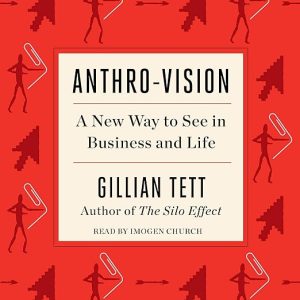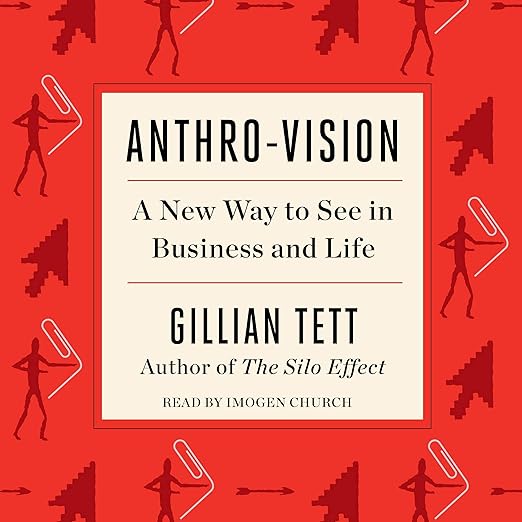
I picked up Anthro-Vision on a Tuesday evening after spending the day in a meeting where every answer to every question was a spreadsheet. Someone had actually printed out a regression model and taped it to the whiteboard. I remember sitting on my couch afterward with a glass of wine, thinking: there has to be a different way to look at this. Gillian Tett apparently thought the same thing, and she had a PhD in anthropology and a career at the Financial Times to back her up.
What struck me first was how confidently Tett wears her dual identity as financial journalist and trained anthropologist. She spent time in Tajikistan studying bride rituals before pivoting to cover Wall Street, and that combination, the capacity to sit inside a culture and observe it without immediately reaching for a model, is exactly what she argues modern organizations are missing. This is not a self-help book about being more empathetic at work. It is a serious, historically grounded argument about why our obsession with quantitative data leaves enormous blind spots, and why the people best equipped to find those blind spots are not the ones running the algorithms.
Tett also addresses a question that rarely surfaces in business literature: why do we resist anthropological thinking even when it demonstrably works? Her answer involves the institutional incentives of large organizations, which reward speed and quantifiability over depth and ambiguity. Anthropological fieldwork is slow. It produces qualitative data that does not fit neatly into quarterly reporting frameworks. The people who would benefit most from lateral vision are often the ones under the most pressure to produce visible, measurable output, which creates a structural disincentive to slow down and observe. This tension runs beneath every chapter and makes the book feel like something more than a business case for a neglected discipline.
Lateral Vision and the 2008 Trading Floor
The core concept Tett introduces is lateral vision: the ability to look sideways, to notice what sits at the periphery of your professional frame. Her strongest examples come from finance. She reconstructs how traders at major banks during the 2008 crisis understood their own risk models but failed entirely to understand the social dynamics that made those models dangerous. Nobody stopped to ask: what are the humans in this system actually doing, and why? The anthropologists, she argues, would have. This is not hindsight smugness, Tett herself wrote warnings about synthetic CDOs years before the collapse, precisely because she applied cultural observation to a domain others treated as pure mathematics.
She extends the argument outward into consumer research, pandemic policy, corporate innovation, and technology. The Intel case is particularly striking: company ethnographers embedded themselves in people's homes to study how families actually used computers, and those observations drove product decisions that market surveys would never have surfaced. The research into how Amazon warehouse workers move through their environment and make micro-decisions, another example Tett deploys, reveals an entire layer of organizational reality invisible to anyone only reading the output data. This is where Tett is at her best: specific, grounded, with real stakes on the line. One reviewer noted that the book is interesting and important but does not close the loop for business readers, and that is a fair point about the later chapters, which get somewhat thinner in their concrete applications. But the diagnostic work is excellent throughout the first two thirds.
Imogen Church, from Tajikistan to General Motors
Church's narration is well-matched to the material. She has a mid-Atlantic clarity that suits academic argument without tipping into lecture mode. When Tett shifts registers, from recounting fieldwork in Tajikistan to dissecting a General Motors organizational failure, Church shifts with her, adjusting energy and pace in ways that feel natural rather than performed. The book runs just under eleven hours, and there were no passages where I felt the narration was fighting the prose. If anything, Church makes some of Tett's more syntactically complex sentences easier to follow aloud than they might read on the page. For a nonfiction title that could easily feel like a symposium recording in the wrong hands, this is a significant achievement.
Three Scenarios That Never Quite Land
The book has its critics, and they are not entirely wrong. One reviewer who identifies as an industrial anthropologist with four decades of experience felt the treatment was too rambling and pointed readers to Tett's earlier work on institutional silos instead. That reader has a point about focus: Tett covers a lot of ground, and some chapters feel like extended essays rather than components of a unified argument. The practical takeaways at the end of each chapter are genuine but sometimes feel like summaries of what you already absorbed rather than new scaffolding. The book's final section, which presents three scenarios for an intangible-rich future, is the weakest structurally, the scenarios are more suggestive than analytically developed. If you come to this wanting a toolkit, you will leave with an outlook instead. For many readers, that shift in perspective is exactly what the book delivers and exactly what they needed. For others, it may feel incomplete.
Skip It If You Want a Field Manual
Listen if you work in strategy, policy, marketing, or any role where you are regularly asked to explain human behavior through quantitative proxies and have begun to suspect the model is missing something important. Tett gives you a vocabulary and a frame for that suspicion, grounded in decades of real fieldwork and journalism. Also recommended for anyone curious about the history of corporate ethnography, the stories about Intel, Nestle, and pandemic response committees are genuinely illuminating, and Fareed Zakaria's endorsement on the cover is not hollow praise. Skip it if you are already well-read in organizational behavior and behavioral economics: you will find the intellectual territory familiar, even if Tett's framing is distinctive. And if you are hoping for a field manual with clear steps, look elsewhere, this is a book about how to see, not what to do once you do.
Do I need a background in anthropology to get value from this audiobook?
No. Tett writes for a general business and policy audience and introduces anthropological concepts through vivid examples rather than academic terminology. Listeners with no prior exposure to the field will find the learning curve gentle.
How does Imogen Church's narration handle the book's mix of academic argument and personal anecdote?
Very well. Church adjusts her register fluidly as the material shifts between fieldwork stories, financial history, and theoretical framing. The narration stays engaging across a nearly eleven-hour runtime.
Is this audiobook more useful for business professionals or general readers?
Both, but it resonates most with listeners who work inside large organizations, whether in business, government, or technology, and have felt the limits of data-only decision-making. General readers curious about behavioral economics and culture will also find it rewarding.
Does Tett address artificial intelligence and how anthropology might push back on AI-driven analysis?
Yes, this thread runs through several chapters. Tett argues that AI and big data systems replicate the same tunnel-vision problem at larger scale, and that anthropological methods offer a corrective by capturing context and meaning that algorithms miss.