Quick Take
- Narrator: One reader carrying a farmyard of speaking parts, from three scheming pigs to a carthorse who believes every word of it.
- Subjects: Revolution and its betrayal, propaganda, rewritten rules, willing complicity
- Tone: Brisk, cold and steadily grimmer
- Bottom line: The text is unimpeachable; this page tells you nothing at all about the recording attached to it.
Blackstone Audio put this Animal Farm out in December 1999, which makes the audiobook older than most of the students it now gets assigned to. Orwell's satire has been quoted so relentlessly that the description opens by pointing out we tend to forget anyone wrote it, and that is a fair place to start. The lines have detached from the book and drifted into general circulation, where they get deployed by people on every side of every argument. Hearing them arrive in sequence, in the order and at the speed the fable actually delivers them, is a different experience from recognizing them on a poster. The shock of the ending depends entirely on the setup, and the setup is precisely what quotation strips away.
Boxer's Death Seals the Slogan's Betrayal
Manor Farm becomes Animal Farm, and the credo goes up on the wall: All Animals Are Created Equal. Napoleon, Squealer, and Snowball emerge from the general cleverness of pigs as leaders of the new arrangement, and the description is precise about how that happens, calling it a subtle evolution with an insidious familiarity to it. Insidious is the correct word, because nothing in the book announces itself as a betrayal while it is underway. The climax is the destruction of Boxer, the carthorse whose entire character is loyalty and whose fate is the moment the fable stops being funny at all. Then the founding slogan acquires its bloodstained postscript about some animals being more equal than others, and the circle closes on a farm standing exactly where it started.
August 3, 2025 brought the most substantial response this page has collected, a four-star from a reader who had given a copy away more than a decade earlier after handing it to a nine-year-old granddaughter, then decided to own it again. The praise goes to the introduction by Tea Obreht, with a warning that it spoils the story and belongs after the last chapter rather than before the first. The complaint is about the binding on the seventy-fifth anniversary paperback, described as poor quality. Neither observation can be made about a recording. Both are exactly the sort of thing an attentive reader supplies, and both belong to a physical object that nobody buying this file will ever hold in their hands.
Cosham's Credit Is All We Know About Squealer's Tone
Fear is what the March 3, 2026 five-star reports, and it puts the reason bluntly: the book is short, and it is frightening because so much of it reads as a description of the present rather than of the past. That is the perennial argument for returning to this one, and it explains why a three-hour commitment keeps outperforming political books ten times its length. The fable does not date because it never named the regime it was about. What Orwell built is a machine rather than a portrait, and every generation supplies its own referents and finds the fit uncomfortably exact. It is also why the ending lands considerably harder at forty than it did at fifteen.
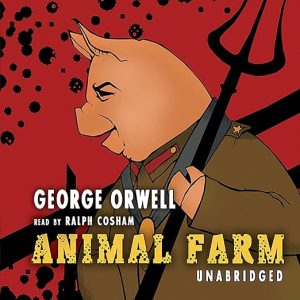
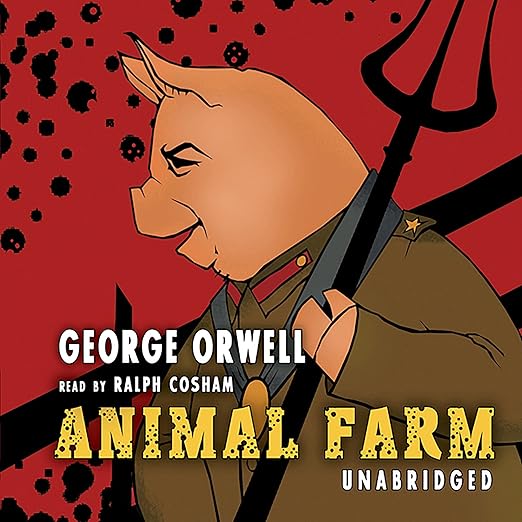
Three hours and eleven minutes is the whole recording, roughly one long afternoon, and that compression is exactly what the satire needs in order to land. Ralph Cosham holds the narrator credit on the 1999 edition, and that is genuinely everything this page will tell you about the performance. Ninety-three ratings, five written responses, and not a syllable among them about how the fable sounds aloud. On a book this short, delivery is close to everything, because the effect depends on a reader who declines to nudge the listener toward the joke. Squealer's speeches in particular can be played as comedy or as something considerably colder, and the choice reshapes the book. Whether that choice was made well here, the record does not say.
Arrived Nice and New, Says a Five-Star Reader
All five written responses are grading a printed edition. A February 24, 2026 five-star reports that the book arrived nice and new, that it is small enough to hold in one hand, and that the text is not too small, which are three observations no listener has ever been in a position to make. That is not a failing on any reader's part, since those are useful things to know if you are buying paper. It is a failing of the page, which has stacked feedback about paper stock and font size underneath an audio product, then let a single average carry across both formats as though they were interchangeable objects.
Two five-star notes share a date, February 3, 2026. One concerns the seventy-fifth anniversary edition and the commentary printed at the front of it, with advice to read the story before turning to that commentary. The other comes from a buyer who bought the book for a school class and states plainly that it has not been read yet, which makes it a five-star vote for an assignment rather than for a text. Ninety-three ratings sit above all of this. Not one response beneath them has anything to do with a recording, so whatever the badge is measuring, it is not the object you would be buying, and the distance between those two things is the whole problem with this listing.
No Commentary, No Essay, Just the Plain Fable
It belongs with the short, hard books you can finish in an evening and think about for a week afterward. Students assigned it will find the audio a genuine help, since the prose is plain and the difficulty sits entirely in the implications rather than in the sentences. Three hours also fits comfortably around a working day, which matters for a text most people are reading against a deadline. Anyone returning to it after twenty years should expect the second half to feel considerably worse than they remember, because the rewriting of the commandments is the part that improves with adult experience and the part classroom discussion tends to hurry past on its way to the moral.
Hold off if you want the critical apparatus. No introduction, commentary, essay, or supplementary material appears anywhere in this listing, and whatever front matter a printed edition carries is not part of what a download delivers. Anyone hoping the review column might help them decide between this recording and another should also look elsewhere, since it offers nothing whatsoever on that question and never has. Nobody on this page has graded the voice you would actually be buying.
Common Questions
Is this audiobook abridged, given how short it runs?
Nothing on the record says abridged, and three hours and eleven minutes is a plausible full length for a book of this size. The description summarizes the complete arc, from the rebellion at Manor Farm through the betrayal of Boxer to the revised slogan at the end, so the recording appears to cover the fable entire.
Does the audiobook include any bonus or scholarly material?
None is listed. The record names no introduction, no appendix, no essay, and no companion PDF, and the runtime leaves very little room for extras in any case. Treat what you are buying as the fable itself, first sentence to last, with nothing wrapped around either end of it.