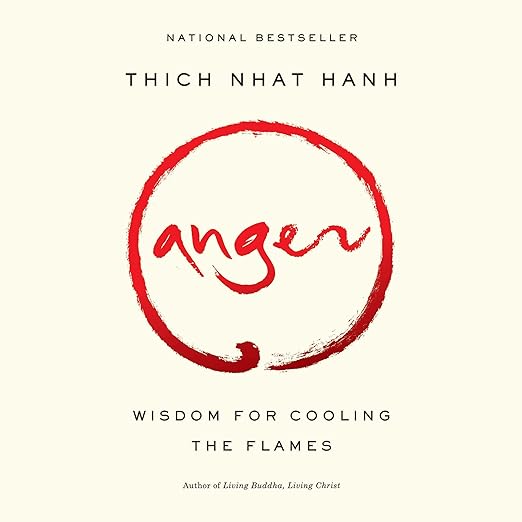
Thich Nhat Hanh wrote Anger with the precision of a doctor describing symptoms and the patience of someone who has sat with those symptoms long enough to stop being afraid of them. Ken McLeod's narration of this audiobook brings a comparable quality of stillness to the reading. I had encountered Nhat Hanh before, in The Miracle of Mindfulness, but Anger feels more urgent and more specific. The Dalai Lama's endorsement, quoted in the synopsis as praising Nhat Hanh's ability to connect personal peace with peace on earth, is not hyperbole. The book earns that framing.
From a Quarrel to a War, Same Logic
Nhat Hanh's starting point is the Buddhist teaching that identifies three states of mind as the source of suffering: wrong knowing, obsessive desire, and anger. Of these, he argues, anger is the most immediately destructive because it acts so quickly. A single moment of it can rupture relationships, harm health, and derail years of practice. The book does not treat anger as something to suppress or deny. It treats it as something to understand, to hold, and to transform. That distinction is the heart of everything Nhat Hanh is offering here.
The structural approach is deceptively simple. Each chapter addresses a specific dimension of anger: its relationship to suffering and compassion, its role in close relationships, its connection to communication, and its presence in the wider social and political world. Nhat Hanh moves between the intimate, how to speak to a partner during a moment of conflict, and the vast, how communities and nations can relate to anger across generations, without the scale shift ever feeling abrupt. The logic that connects a quarrel between spouses and a war between nations is the same in his framework, and he trusts the reader to follow that logic without over-explaining it.
Ken McLeod Reads This With Practiced Familiarity
Ken McLeod is a Tibetan Buddhist translator and teacher, and his relationship to this material is evident in how he reads it. His narration carries the quality of familiarity without over-familiarity, the sense of someone who understands what they are reading rather than simply performing it. For a book whose method depends on slow, careful attention, the audiobook format benefits enormously from a reader who embodies that attention rather than rushing through pages in pursuit of completed chapters.
One reviewer describes returning to this book five or six times, calling it 'just that good.' Another praises Nhat Hanh's ability to present Buddhist philosophy without dogma, in plain English that makes the concepts immediately applicable. Both observations are accurate. The practice Nhat Hanh describes, breathing with anger rather than reacting to it, walking with it rather than suppressing it, and then speaking from a calmer place rather than from the heat of the original feeling, is not complicated. It is simply difficult, and the book is honest about that difficulty without making it seem insurmountable.
The chapters on relationships are particularly strong. Nhat Hanh distinguishes between the content of a conflict and its emotional substrate with the clarity of someone who has mediated many arguments without taking sides. His advice to write a letter when direct speech is too charged, to delay difficult conversations until both parties have returned to some baseline of calm, and to practice deep listening as a separate skill from speaking: all of it is practical in the most precise sense.
Interbeing and the Case for Re-Listening
Nhat Hanh writes from within a Buddhist framework, and while his approach minimizes doctrinal requirements, some of the language carries cultural assumptions that secular readers may occasionally need to translate. The concept of interbeing, his term for the interdependence of all phenomena, is used throughout and may require a moment of conceptual adjustment for listeners who come from a more individualistic psychological tradition. It is worth pausing when the term appears, because the point Nhat Hanh is making with it is usually substantive and not merely decorative.
The book is not long, running under six hours, and some readers have wished for more extended case studies. The examples are vivid but brief, and the book moves through ideas quickly enough that some passages benefit from re-listening. Given the audiobook format, that is easy to manage, and it is worth knowing that this is not a book where passive listening will capture everything.
The audiobook format suits Nhat Hanh's work particularly well because his method depends on repetition and re-encountering. His central teaching does not announce itself once and move on; it circles back through different examples and framings until the point has settled at a level below intellectual understanding. Ken McLeod's reading style, which is patient and unhurried in a way that mirrors the teaching itself, makes the audio version a particularly apt way to receive this material. Listeners who have tried reading Nhat Hanh quickly in print may find the audiobook format reveals dimensions of his prose that the rushed reader misses entirely. The quality of pacing in McLeod's delivery that teaches by example.
Where McLeod's Pacing Mirrors the Practice Itself
This audiobook rewards anyone who recognizes anger as a pattern in their life and wants something more substantive than breathing exercises and productivity tips. It is serious without being inaccessible. The Buddhist framework enhances rather than limits its applicability, and Ken McLeod's narration holds that seriousness with exactly the right degree of warmth.
It works well in audio form specifically because the pace McLeod brings to the reading mirrors the practice the book describes: slow, attentive, and willing to stay with something rather than rush past it. Listeners who have not encountered Nhat Hanh before will find this a useful and memorable entry point. Those who already know his work will find that Anger is one of his most practically focused books, and one of his most urgent.
Do I need a background in Buddhism to follow this audiobook?
No. Nhat Hanh presents Buddhist principles without requiring doctrinal familiarity. The book works through practical, experiential language rather than religious instruction, and multiple reviewers specifically note how accessible the concepts are to non-Buddhist readers.
At under six hours, is this audiobook comprehensive or more of an introduction?
It is more focused than comprehensive, which is a strength rather than a limitation. Nhat Hanh addresses specific dimensions of anger with depth rather than surveying the topic broadly. Multiple reviewers describe returning to it repeatedly, which suggests the material repays more than one listening.