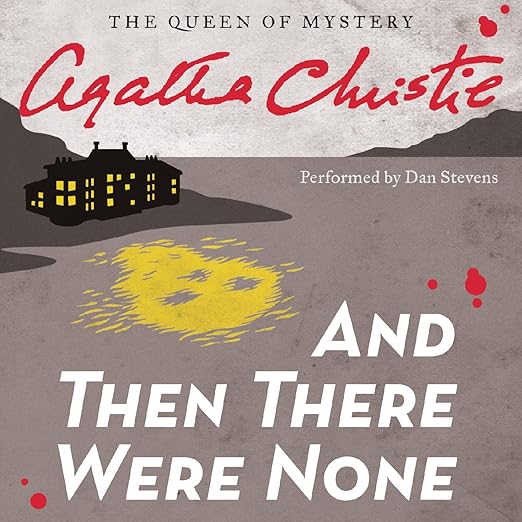
Before You Press Play
- Read by: Dan Stevens is credited with carrying all ten guests alone, and not one written response on the page grades the recording, so judge it from the sample.
- At its heart: Closed-circle mystery, guilt without trial, paranoia, poetic justice.
- Vibe: Airless and accelerating.
- Short version: The cleanest premise in golden-age crime, at a runtime that lets you take it the way it was meant to be taken, in one go.
Ten strangers, one nursery rhyme framed on the wall of every bedroom, and six hours of audiobook in which to work out which of them is doing the killing. The arithmetic of the premise is so clean that it has survived generations of imitation without losing a step.
Nobody on the Island Plays Detective
Christie's setup barely needs restating. An invitation from a host nobody has met, a mansion on an island off the Devon coast, a recording played at dinner that accuses each guest in turn of a secret they were never made to answer for, and a storm that removes the boat. Then the rhyme starts coming true. What keeps this working when the imitations have aged badly is that Christie refuses to give you a detective. Nobody on the island has authority, everybody has a motive to lie, and the reader is left doing the police work alone with a shrinking list. The listing files it under historical fiction, which is a shelving accident rather than a description, since the book was written about its own present and only time turned the house party into a period piece.
Most interesting of the five is an entry that awards top marks and then spends its length complaining. Calling the island a field of red herrings, that entry praises the guessing and then objects to the final chapter, where the whole method is laid out in detail, on the grounds that a magician who explains the trick has destroyed it. I disagree, but the objection is the right one to raise, because it identifies exactly where the book stops being a puzzle and turns into a confession. Whether that landing satisfies you is the difference between four stars and five.
Six Hours Turn Christie's Trap Into One Sitting
Six hours and one minute is the great argument for the audio edition. This is a book designed to be consumed in one gulp, and the runtime makes that possible in a way the paperback never quite did. The chapters are short, the deaths are evenly spaced, and the pressure Christie builds depends on the reader not having time to reason calmly. Listening straight through, ideally in two sittings rather than ten, reproduces the trap she designed. Stopping every night for a week lets you think, and thinking is the enemy here. Six hours is also the length of a long flight or a weekend of chores, which is why this title keeps appearing on lists of books people finished in a single day.
Structure also rewards being spoken. Ten guests, ten accusations, ten verses, and a set of interior monologues that rotate between suspects without announcing whose head you are in. On the page those switches are a typographical convention. Read aloud, they become a question of tone, and the passages where a character reasons their way toward panic are the ones that gain the most. One five-star reader, who ranks it the best whodunit Christie wrote, flags something else worth knowing: the ending here differs from the one in the famous film version, which is a genuine reason to take the book even if you think you know the story.
Another thing audio does well with Christie is the social sorting. Ten strangers with nothing in common but the invitation, each carrying a different education, a different register and a different way of refusing a question, and half the characterization sits in how each one talks. That is performance material, and a single reader covering all ten has more to work with than any dramatization could hand a cast. It also puts the whole weight of the book on one throat, which is the gamble every solo recording of a group novel makes.
Reviewing a Cover You Cannot Download
Do not read the review column before you listen. The lowest grade on this page, a three-star entry from 2017, is a full plot summary that flags its own spoilers in the second line and then walks through the setup, the rhyme and the mechanism at length. On a mystery whose entire value is the not knowing, that entry is a hazard sitting in plain sight above the buy button, and no warning separates it from the ordinary praise around it.
Nothing in the column addresses the recording. Five people have written here and all five are grading a book: one four-star entry is devoted almost entirely to a hardcover collector's edition, its art deco cover, its understated endpapers, its legible typeface and its disappointingly thin paper, with a passing comparison to another Christie title in the same series of reissues. It is a considered review of an object you cannot download. The publisher field compounds the confusion by naming a paperback imprint on an audio product.
One structural warning for listeners specifically. Ten characters arrive at once, in a rush of names, ranks and professions, and you cannot flip back to the guest list or reread the rhyme when a later verse turns out to matter. Give the opening half hour your full attention, or accept that you will spend the middle stretch reconstructing which of them was which. The book expects you to hold ten people in your head; the format gives you no safety net.
Newcomers Should Start Their Christie Here
Newcomers to Christie should start here rather than with the detective novels, and a five-star entry calling it well known and easy going is right on both counts: the prose is plain, the pace is relentless, and no prior familiarity with any series character is required. Crime readers raised on modern thrillers will find the body count generous and the psychology sharper than the reputation suggests. It suits shared listening as well. Two people guessing at a kitchen table, arguing over who has been ruled out and why, is close to the parlor game this was built to be.
Hold off if you need a sympathetic character to travel with, because every person on the island is guilty of something and the book is uninterested in redeeming them. Hold off too if the mechanics of a closed-circle mystery bore you, since the last chapter is essentially a technical document. Clear an evening, put the phone somewhere else, and let the count run down.