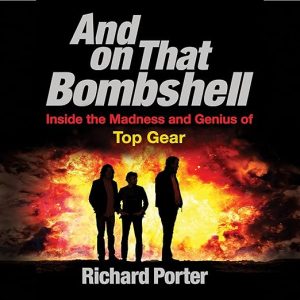
I came to And on That Bombshell as a casual Top Gear viewer rather than a devotee, someone who had watched the Bolivia special and the Vietnam road trip on YouTube, appreciated the craft, but never tracked the series obsessively. I mention this because Richard Porter's memoir rewarded me in a way I did not expect: it works even without encyclopedic knowledge of every episode, because what Porter is really writing about is how television gets made, and how an improbable idea becomes a phenomenon through a combination of genuine talent, institutional chaos, and a great deal of luck.
Porter served as script editor for Top Gear for the entirety of the Clarkson-Hammond-May era: all 22 series and 175 shows, from the uncertain 2002 pilot to the very last recording. That position, not a presenter, not an executive, but the person in the room where words get finalized, gives him a perspective that neither the presenters nor the BBC executives could offer. He was present for almost everything and personally responsible for almost nothing that appeared on screen, which is exactly the vantage point you want from this kind of book.
First, the Big Picture
What distinguishes this memoir from the genre of television tell-alls is Porter's restraint. He is genuinely funny in the same dry, self-deprecating register as the show itself, one reviewer noted that the prose reads much in the same way Clarkson speaks, and that is accurate, but he is not settling scores. He is reconstructing how a program that was supposed to be a modest motoring magazine show for a BBC Two audience ended up being watched in more than two hundred countries. The answer, as Porter tells it, involves decisions that seemed sensible at the time and disasters that became assets in retrospect.
The behind-the-scenes stories here are not the kind that make it into official anniversary specials. Porter writes about the driving monkey incident with the specificity of someone who had to deal with the actual logistics. He covers the diplomatic fallout from the Argentina special with a kind of exhausted candor. The near-fatal crash involving Hammond is handled carefully, present but not sensationalized, which feels right given the circumstances. These are not punchlines. They are the texture of what it actually costs to make ambitious television over thirteen years.
The Best Parts of And on That Bombshell
Ben Elliot's narration carries the material with real skill. He has the timing Porter's writing requires, the jokes land because Elliot understands that the delivery needs to feel casual, not performed. The author's brief spoken introduction establishes Porter's voice before Elliot takes over, which is a sensible structural choice: it reminds you that this is a real person's recollection, not a scripted entertainment product. At eight and a half hours, the pacing is comfortable. The chapter structure is episodic in the best sense, each section has its own shape and you can pause without losing the thread.
One reviewer noted that momentum drops slightly toward the final third of the book, and that is a fair observation. Porter is moving toward the circumstances of Clarkson's departure and the show's end, and the material becomes more constrained, understandably, given that some of those events are still legally and professionally sensitive. But the book earns that limitation through the extraordinary candor of everything that precedes it.
A Few Reservations
Readers looking for a comprehensive analysis of why Top Gear worked culturally, or a serious examination of the show's complex relationship with its critics, will find less here than they might hope. Porter is interested in the stories more than the theory. He knows what happened; he is less focused on explaining the phenomenon in sociological terms. That is a completely legitimate creative choice, but worth setting expectations around.
The book also largely sidesteps the question of what the show got wrong, its occasional lapses in taste, the complaints that accumulated over the years from various communities. Porter's perspective is affectionate, and the criticism is mostly self-directed. If you want a genuinely critical account of Top Gear, this is not that book. What it is, is the most accurate and textured account of what the experience of making it actually felt like from the inside.
The Right Listener for And on That Bombshell
This is straightforward to recommend to anyone who watched the Clarkson-Hammond-May era and wanted to understand how it actually came together. But it also holds up for listeners interested in how television gets made more broadly, the mechanics of creative collaboration, the relationship between a show and its institutional home, the process of building something that outlasts everyone's expectations for it. If you have never seen the show and have no interest in either cars or British television, there is not much here for you. But for the considerable audience that does fit that profile, Porter's memoir is more substantive than the genre usually delivers.
Does Richard Porter pull his punches about Jeremy Clarkson and the circumstances that ended the original Top Gear?
Somewhat, yes, and for understandable reasons given the legal and professional context. Porter is candid about the behind-the-scenes chaos and institutional conflicts throughout the book's timeline, but becomes more measured as it approaches the events of 2015. The earlier material is remarkably open.
Who narrates the audiobook, and does the narration style match the show's humor?
Ben Elliot reads the main text, with Porter himself narrating a brief introduction. Elliot captures the dry, self-deprecating tone of Porter's prose well, reviewers have compared the feel to how Clarkson speaks, and the narration honors that register without overdoing it.
Is this worth listening to if you only have casual familiarity with Top Gear rather than deep knowledge of every series?
Yes. The book's best material is about the mechanics of making television and the improbable journey from uncertain pilot to global phenomenon. That story is accessible and compelling regardless of how many episodes you have seen, though devoted fans will get additional layers of recognition.
Does the audiobook include anything beyond the main text?
Porter reads a spoken introduction himself before Ben Elliot takes over the main narrative. There is no extended interview material or bonus content beyond what the physical book contains.