In Brief
- Voice: Peter Berkrot handles a wide cast of voices with grounded authority; the anthology format means he must shift registers frequently, and he does so without calling attention to the seams.
- Big ideas: Wrongful conviction and the failure of justice, the long aftermath of exoneration, collaboration between literary voices
- Atmosphere: Outraged and sobering, with currents of resilience underneath
- Worth it?: A powerful and structurally inventive examination of America's wrongful conviction crisis, made more urgent by the writers chosen to tell these stories.
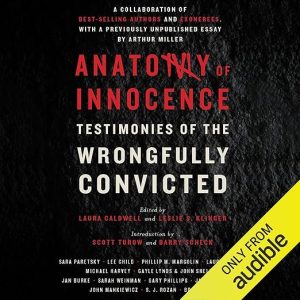
I finished Anatomy of Innocence on a Tuesday evening after what had been an ordinary enough day, and then sat with it for a long time before I could pick up anything else. That's not a response I'd anticipated from an anthology. Collections of this kind usually read in pieces, each story self-contained and then set aside. But editor Laura Caldwell and her remarkable roster of collaborators have built something more cumulative than that. By the end of six hours and twenty-four minutes, the weight of what I'd heard had become genuinely difficult to shake.
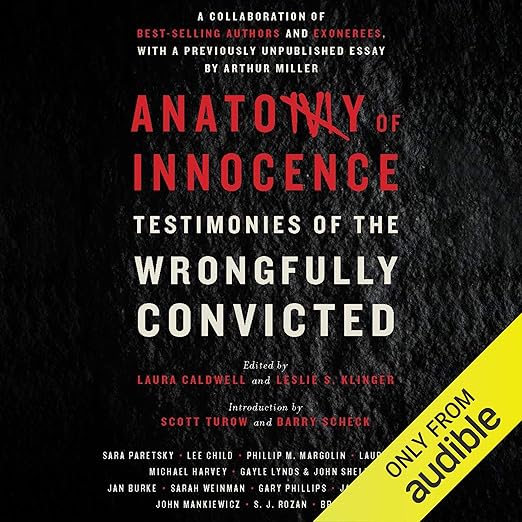
The book was published in 2017 by Audible Studios and narrated by Peter Berkrot. The concept is unusual enough to be worth explaining in full: fourteen exonerated inmates each narrated their experiences to a high-profile crime and thriller writer, who then shaped those testimonies into literary accounts. The lineup includes Lee Child, Sara Paretsky, Laurie R. King, Jan Burke, and SJ Rozan, among others. An additional case is examined in a previously unpublished essay by Arthur Miller. Scott Turow and Barry Scheck contribute the introduction.
What Caldwell has achieved here is harder to pull off than it looks. The anthology format risks unevenness, different writers, different registers, different levels of intimacy, and there is some variation across the fourteen chapters. But the structural decision to pair each exoneree with a crime fiction specialist turns out to be inspired. These are writers who understand pace, stakes, and the texture of procedural detail. When Lee Child traces Kirk Bloodsworth's obsessive reading about the emerging field of DNA testing while sitting on death row, the tension is architectural rather than melodramatic. When SJ Rozan renders Gloria Killian's account of the knock on the door that changed her life, the prose earns its horror through restraint.
The individual stories cover the full landscape of wrongful conviction: false confessions extracted under duress, eyewitness misidentification, prosecutorial misconduct, and the grinding institutional inertia that keeps innocent people locked away long after questions have arisen. One reviewer here described it as a "chilling reminder that our legal system is as flawed as we all are." That's accurate, but the book's real subject is what happens afterward, the scars, the structural difficulties of re-entering a world that moved on without you, and the remarkable fact that so many of the exonerated described here have found ways to continue living with purpose and even hope.
Berkrot Lets the Testimonies Have Their Space
The audio format serves this material particularly well. These are testimonies, first and foremost, accounts delivered by people who were there. Peter Berkrot reads each one with a sober attentiveness that honors the source material without editorializing. He understands that the stories don't need performance; they need space. His pacing is careful and deliberate throughout, and the effect is of someone bearing witness rather than dramatizing.
The collaboration with Arthur Miller, whose essay on an exoneree's case had never been published before this volume, is a particular highlight. Miller's formal literary voice reads differently from the crime writers' contributions, and that contrast actually strengthens the anthology, it's a reminder that wrongful conviction is not just a genre subject but one that has occupied the minds of serious literary writers for generations. His presence here, alongside the thriller and mystery specialists, says something important about the stakes of this subject.
Suffering, Perseverance and Compassion Over Outrage
One reviewer expressed a wish for "a bit more depth" in certain chapters. This is a fair observation about the anthology form in general: some stories receive more space than others, and six hours spread across fifteen accounts means that certain cases feel more sketched than fully rendered. Listeners who come hoping for the extended immersion of a true-crime narrative, the kind of forensic depth that sustains a five-hundred-page book, will find this format operates differently. It's designed for breadth and accumulation rather than depth in any single case.
It's also worth noting that the book's most effective emotional register is not outrage, though that's present, but something more complicated: the chronicling of what one reviewer called "suffering, perseverance, and compassion." The stories here are not uniformly dark. Several exonerated individuals speak with a clarity and generosity toward human frailty that is more unsettling, in some ways, than anger would be.
Crime Writers Turn Testimony Into Literary Craft
This is essential listening for anyone interested in criminal justice, law, and the institutional gaps that produce wrongful convictions. It's equally valuable for fans of the contributing writers who want to see what happens when crime fiction specialists turn their craft toward nonfiction testimony. Listeners who prefer sustained single-narrative nonfiction over anthology structure may find the format fragmentary. But for those open to the mosaic approach, the cumulative effect is considerable, this is one of those rare audiobooks that genuinely changes how you think about a subject you thought you already understood.
Good to Know
Do I need to know about The Innocence Project before listening to this audiobook?
No prior knowledge is needed. The book explains The Innocence Project's mission and methods as part of the narrative, and Scott Turow and Barry Scheck's introduction provides context for first-time listeners. That said, listeners already familiar with wrongful conviction cases will have a richer frame for the specific stories discussed.
How does the anthology format affect the listening experience compared to a standard nonfiction audiobook?
The format means the experience is episodic rather than sustained. Each chapter functions as a self-contained account, and the listening experience is cumulative rather than building toward a single conclusion. Peter Berkrot's narration works hard to maintain tonal consistency across the different writing styles, which helps the anthology feel cohesive.
Does the book spend time on the aftermath of exoneration, or is the focus primarily on the wrongful conviction itself?
Both, but the aftermath gets meaningful attention. Many chapters address what one reviewer called the 'immeasurable consequences' of wrongful conviction, the difficulty of re-entering society, the psychological scars, the strained family relationships. The book is as much about survival and resilience as it is about injustice.