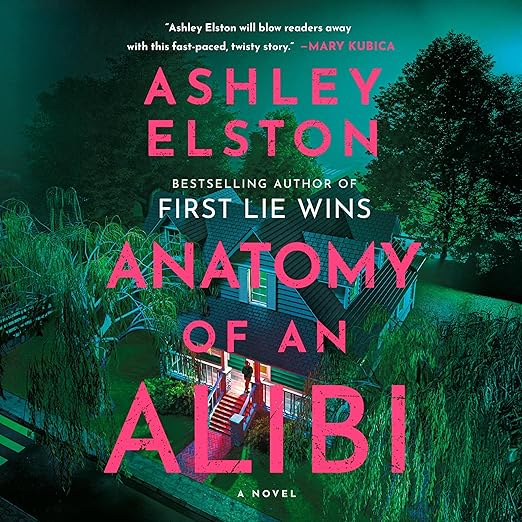
Key Details
- Narrator: MacLeod Andrews is the only voice credited for a story built on two women becoming hard to distinguish, and nobody who wrote in has said how it lands.
- Subjects: Identity swap, generational corruption in a wealthy Louisiana family, a decade-old hit-and-run resurfacing.
- Tone: Tense and quick, with a middle stretch one listener found repetitive.
- Bottom line: The hook is excellent, the middle is where you find out whether the rest of it holds for you.
Where the promotional text opens, at a bar called Chantilly's, the woman on the stool is not the woman the room thinks she is. Red lips, designer heels, a Negroni, and everyone present has decided this is Camille Bayliss. It was Aubrey Price. That reversal drives the entire audiobook, and Penguin Audio has handed nine hours and thirty-nine minutes of it to one narrator, MacLeod Andrews, for a story whose whole premise is two women who have to be hard to tell apart. Whether a single voice makes that a problem or makes it the point is the most interesting question this listing raises.
Two women, one dead husband, one alibi. The pitch really is that compact, and the setup earns the compression. Camille believes her husband has been hiding dirty secrets for years and cannot prove it because he tracks her every move. Aubrey has been haunted for a decade by a night that changed her life and has convinced herself Benjamin Bayliss knows something about it. So they trade places for twelve hours: Aubrey holds Camille's public life while Camille watches Ben. By morning Ben is dead, both women need an airtight alibi, and only one of them has one. Aubrey is introduced as living in a house full of criminals, a line the flap copy drops without explanation and never picks back up.
Anyone paying attention to names will notice the promotional text cannot settle on one for the victim. He is hotshot lawyer Ben in the paragraph about Camille's marriage and Benjamin Bayliss in the paragraph about Aubrey's decade-old grievance, and the two paragraphs never acknowledge each other. In a novel about mistaken identity that almost reads as a joke, but it is worth knowing in advance, because a listener meeting Ben and Benjamin ten minutes apart has no visual cue to connect them. Camille arrives as the daughter of a wealthy Louisiana family, which is the detail Daniella eventually identifies as the real subject of the book. Print hands you the surname in black and white; audio hands you two names and a gap.
MacLeod Andrews Voices Two Women Meant to Blur
Once you get past the murder, the reviewers insist the book is about something else entirely. Daniella, filing four stars in February, is explicit about it: this is not really about Ben's murder, which is only the spark, but about generational corruption, loyalty bought and sold, and how far powerful families will go to protect their own, with a decade-old hit-and-run sitting underneath. That entry opens with a row of four star symbols matching the grade attached to it. Michelle F. describes chapters that alternate viewpoints, giving access to the thoughts and actions of the main characters in turn, and says the connections form slowly without ever feeling rushed.
Whatever else it does, the structure rewards audio if the reading is equal to it. Alternating chapters mean a listener has to track who is speaking with no chapter heading in front of them, and the pleasure of an identity swap depends on believing Aubrey can pass for Camille while never quite becoming her. That is a performance problem before it is a writing problem. Nine hours and thirty-nine minutes is a tight, propulsive length for a thriller, and Vicki A. Risser reports finding it interesting from start to finish and being unable to put it down.
Five Reviewers Never Mention the Narrator's Voice
Most of what the column knows about this book, it does not know about this recording. Five people wrote in between January and March 2026, with not one of them mentioning a voice, a tempo or a performance. On a novel with one credited reader and a plot requiring two women to be confusable, that silence sits exactly on top of the thing a buyer wanted settled. Michelle F. praises the multiple perspectives at length without once saying how they sound. The gap lands precisely where the audio decision was made. A title released in January and written about inside ten days by two of these five has a very fresh column, and freshness usually means the print and audio reactions have not yet pulled apart.
Something in the middle is losing people. Vanessa P, the one dissenting grade at three stars, says it dragged, that things kept getting repeated, and that characters kept appearing who had not been mentioned before, naming Foster as the example. The same review complains that a strand about one character's parents sat in the back seat of the question of who killed Ben. That is a structural objection, not a matter of taste, and it hurts more in audio, where you cannot flip back forty pages to find where somebody was introduced.
This listing is tagged Women's Fiction, which does nobody any favors. The genres attached to it are literature and fiction plus mystery, thriller and suspense, and the plot is a murder with an identity swap at the center. A Women's Fiction shelf label routes this toward readers expecting one thing and away from the readers who want exactly what it delivers. Michelle F., meanwhile, calls the book The Anatomy of an Alibi, adding a definite article the real title does not carry, which is the sort of slip a title acquires when it sounds like a phrase.
Whether the Blur Works Remains Genuinely Unknown
By the reckoning of four of the five who wrote in, this works. Kim Krause loved the twists, loved the title, and got far enough inside Camille to want a sequel leaning romantic. Vicki A. Risser calls Ashley Elston a good writer and could not stop. Daniella and Michelle F. both landed on four stars with their reasons stated. Krause's entry ends in a sentence that comes apart mid-thought, something about a vision of the author wanting to chat, and what it meant is anybody's guess. If you like domestic thrillers where a powerful family is the real antagonist and the killing is a door into it, nine hours and thirty-nine minutes will go quickly.
If you need a thriller to run in a straight line, take Vanessa P's warning seriously, because a book that introduces people late and repeats itself will feel longer in your ears than on paper. If you need to know how MacLeod Andrews handles two women written to blur into each other, nobody on this entry can tell you, and that is the actual risk you are buying. What is not in doubt is the hook. Two women swap places for twelve hours to find out what one man was hiding, and by morning the man is dead and only one of them can prove where she was.
How does a single narrator handle an audiobook built on two women swapping places?
That question stays open. MacLeod Andrews is the only reader credited, and the plot depends on Aubrey Price passing as Camille Bayliss for twelve hours. Not one of the five reactions posted here mentions the performance at all, so the thing a buyer most wants confirmed about this recording is the thing nobody has confirmed.
Is Anatomy of an Alibi connected to First Lie Wins?
Only through authorship. The promotional text bills Ashley Elston as the number one bestselling author of First Lie Wins, which is a marketing line, not a series note. No field here links the two stories, no series title or number is attached, and the plot summarized here stands by itself. Either order works.
Does the audiobook drag in the middle?
One of the five says so. Vanessa P grades it three stars and reports that it dragged, that details kept being repeated, and that people turned up who had not been introduced. Three of the other four mention momentum instead: one says it kept moving, one says the pacing held, one could not put it down.