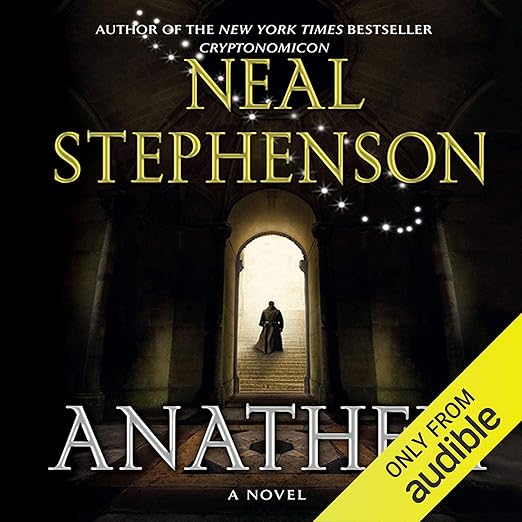
Neal Stephenson's Anathem poses a challenge to the listener that most audiobooks do not attempt: it invents not just a world but an entire philosophical vocabulary, a set of terms that sound almost familiar and then are not, and it asks you to learn that vocabulary through immersion rather than definition. Fraa Erasmus lives in the Concent of Saunt Edhar, a sanctuary for mathematicians and philosophers insulated from the Saecular world by ancient stone and elaborate tradition, and the audiobook drops you inside that sanctuary without a glossary key. The reward for trusting Stephenson's process is one of the most intellectually satisfying science fiction experiences available in any audio format.
Oliver Wyman is essential to why this works. At thirty-two hours and twenty-five minutes, Anathem requires a narrator who can sustain coherence across an enormous cast and an invented register without either exhausting the listener or flattening the material's considerable texture. Wyman gives Erasmus a scholarly warmth that keeps the long expository conversations from becoming lectures. His management of the Concent's ritual language is precise without being stiff, and he handles the female characters, particularly Ala, with enough care that the book's internal social dynamics feel genuinely inhabited rather than merely functional.
What Neal Stephenson Delivers
Reviewers who have worked through Stephenson's body of work bring useful context to this audiobook. One reader came with real doubts, having disliked Cryptonomicon and strongly disliked Seveneves, and found Anathem genuinely engaging: clever and interesting, with a character depth that Stephenson's detractors often cite as lacking in his more technology-driven novels. Another described it as one of the best, most eye-opening books read in a recent five-year period. The spread is wide but the direction is consistent: Anathem rewards the investment it demands.
A first reviewer offered practical advice about getting into the book that is genuinely useful for audiobook listeners to carry in: the opening chapters are dense with vocabulary acquisition and world-building, and the instinct to push through rather than quit at the first moment of disorientation is the correct one. Wyman's narration helps here because his tone signals that the confusion is productive rather than the result of authorial sloppiness. Erasmus does not yet understand his situation fully either, and the shared experience of disorientation is part of the novel's design.
What Neal Stephenson Gets Right
The philosophical conversations at the heart of the book, debates about the nature of mathematics, consciousness, the many-worlds interpretation of quantum mechanics, and the relationship between mind and physical reality, are rendered in Stephenson's invented vocabulary in a way that first defamiliarizes and then illuminates. These conversations are doing genuine philosophical work, exploring whether abstract mathematical objects have independent existence and what that would mean for consciousness, and they land with real force by the midpoint of the audiobook precisely because Stephenson has spent hundreds of pages making the Concent's way of thinking feel natural rather than invented.
The invented lexicon deserves a specific note for prospective audiobook listeners. Stephenson creates terms like fid, ita, and fraa that map onto existing concepts, student, technical worker, brother, without being identical to them, and the novel's philosophical vocabulary similarly reframes existing ideas through unfamiliar terms. Wyman has clearly prepared for this: he pronounces the invented language with consistency and confidence, never stumbling, which means listeners can trust the sonic texture rather than spending cognitive energy decoding whether they heard the word correctly. This is a more significant contribution than it might sound across thirty-two hours.
The shift in the novel's second half, when the mathic community is forced into engagement with the Saecular world by a threat that only an alliance of avout and extras can address, changes the register in ways that can surprise listeners who expected the entire book to remain contemplative. The adventure plotting that enters in the latter third is not a concession to genre expectations. It emerges organically from the philosophical stakes Stephenson has spent the first two-thirds establishing, and it makes the earlier investment feel fully justified.
Where Neal Stephenson Loses Some Ground
The patience required in the early hours is real and substantial. Reviewers who have successfully navigated the book consistently recommend letting the language wash over you rather than stopping to decode every unfamiliar term. In audio format this is actually easier than in print because Wyman's delivery provides tonal cues about whether a passage is explanatory or characterological. The vocabulary becomes genuinely intuitive by the midpoint, and retrospectively the early confusion feels like the experience Stephenson intended rather than an obstacle to be overcome.
The romantic subplot involving Erasmus and Ala is understated by the standards of most science fiction but emotionally real, and it provides a human anchor for the more abstract material. The book's epilogue asks for a final act of intellectual acceptance that some readers have found demanding while others consider it the only possible conclusion. Wyman delivers it with appropriate gravity and without the self-importance that could undercut what Stephenson has built.
Who Should Pick Up Anathem
Anathem is the right audiobook for listeners who want their science fiction to take ideas seriously as the primary material rather than as backdrop for action. Readers who appreciate Greg Egan, Kim Stanley Robinson's more philosophical work, or the harder end of the literary science fiction tradition will find Stephenson's approach recognizable and deeply rewarding. Those who struggled with Seveneves or Cryptonomicon may find the character work here more satisfying, though the commitment to ideas over plot momentum is consistent throughout Stephenson's output. Newcomers to Stephenson who are comfortable with density and the patience it demands should consider starting here rather than with the longer Baroque Cycle, which requires considerably more prior commitment. Anyone with time spent in analytic philosophy or the philosophy of mathematics will find Stephenson's treatment of those disciplines unusually rigorous for fiction, and will recognize specific debates being dramatized in the Concent's extended dialogues.
Questions Listeners Ask
Is the audiobook format a good way to experience Anathem given its invented vocabulary and philosophical density?
Many readers find audio actually helps with the invented language because Oliver Wyman's consistent delivery provides tonal anchoring that printed text cannot replicate. The tradeoff is that you cannot flip back easily to check an unfamiliar term, but Stephenson's strategy of teaching through immersion suits the audio format well once you commit to it.
How long does it take in this audiobook before the invented world of the Concent feels navigable rather than disorienting?
Most listeners report that the vocabulary and social logic become intuitive somewhere in the three-to-five-hour range. The disorientation is front-loaded by design, and Wyman's narration signals clearly when a passage is explanatory versus characterological, which helps listeners calibrate when to let confusion sit and when to pay close attention.
Does Anathem require familiarity with quantum mechanics or philosophy of mathematics to follow?
No formal background is required. Stephenson introduces the relevant ideas through his characters' conversations, and the invented vocabulary actually helps by stripping away preconceptions. Listeners with prior background will recognize specific philosophical positions more readily, but the book is designed to teach what it needs entirely within its own framework.
At over thirty-two hours, does the Anathem audiobook maintain its narrative momentum or does it drag in places?
The pacing is deliberately contemplative in the first two-thirds, which suits the Concent setting and Stephenson's purpose. The novel then shifts into more active plotting in the final portion. Listeners who commit to the book's rhythm consistently report that the change in gear feels earned rather than abrupt, though those who need consistent action from the start will find the early hours demanding.