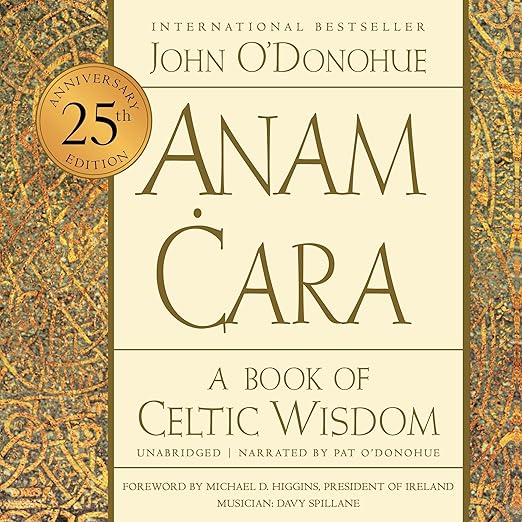
Music credits on a spirituality audiobook usually amount to a line of small print and a few seconds of wash between chapters. This edition names Davy Spillane three times: for producing the reading and the music, for recording it in Ireland at North Atlantic Sound, and for performing and arranging the score. That is an unusual amount of attention paid to how a text of Celtic wisdom actually sounds, and it signals what Sounds True built here for the twenty-fifth year of John O'Donohue's first and most influential book.
What We Made of It
Anam cara is the Celtic phrase for soul friend, as one long-standing response helpfully spells out, and the book takes that idea as a lens for almost everything else: friendship, belonging, solitude, creativity and the imagination. O'Donohue's method is to bring ancient material into contemporary conversation without turning it into either folklore or self-help. The same response calls the book essentially review proof, which is a fair warning about what criticism can do with a text this personal, and an accurate description of how its readers relate to it.
What the anniversary edition adds is context rather than content. A new introduction comes from Michael D. Higgins, the President of Ireland, an afterword from the late author's brother, and further material from the circle of friends around him. For a book whose central subject is the bond between people who recognize each other, framing it with the voices of the people who knew him is a genuinely thoughtful editorial decision rather than a commercial one.
The prose works by accumulation, moving through thresholds, landscape and the rhythms O'Donohue believed we had lost track of in ourselves. At its best it earns its lyricism, and it never quite tips into the generic warmth that sinks most spiritual writing. At its weaker moments the abstraction gets ahead of the argument, and a listener who wants propositions to test will be handed images instead.
Why Anam Cara (Twenty-Fifth Anniversary Edition) Works as an Audiobook
The reading is credited to Pat O'Donohue, the author's brother, who also wrote the afterword. Author narration was never an option here, and the alternative chosen is about as close as an estate can get: a family voice, from the same place, carrying the same accent the sentences were written in. On a book about soul friendship and belonging, that casting is not a marketing gesture. It changes the relationship between the speaker and the material in a way no hired performer could replicate.
Production is the other reason to choose audio over print for this one. Spillane produced and recorded the reading in Ireland and composed, arranged and performed the music, with the score copyrighted in 2022, which makes this a purpose-built audio artifact rather than a text delivered aloud. Spirituality titles are frequently the laziest recordings in the catalog, so a listing that documents its studio, its producer and its composer this precisely is worth taking seriously.
O'Donohue's biography does real work in the writing, and one response lays it out well: a poet and philosopher who shed his identity as a former Catholic priest to search his Celtic roots for answers, and who took his degree in Germany, in German. That combination of mystical instinct and continental philosophical training is exactly why the book avoids the sentimentality of its shelf, and it survives being heard rather than read.
What Might Not Land
Pacing is the honest difficulty, and one of the most useful responses in the pool names it directly: the reader initially found the book hard going, and realized the problem was the attempt to get through it as though it were a guidebook, then slowed down, revisited passages several times and let them settle. Audio pushes in the opposite direction by default. Playback keeps moving, chapters run on, and the format encourages exactly the consumption pattern this book punishes. Plan to rewind on purpose.
The rating display makes no sense as it stands. A 4.7 average is attached to a counter of three ratings, while five separate responses sit visible underneath it, and two of those were filed in 2016 and 2020, years before this 2022 anniversary edition existed. Older print editions have been stacked under one listing, so the score you see is not measuring this recording. One of the entries even admits, in its final line, to padding itself out to reach a required word count.
Consider the register before buying. Celtic spirituality delivered in aphorism and image is a specific taste, and O'Donohue's warmth toward mystery will read as evasion to anyone who wants claims they can argue with. The category label attached to this title, covering other religions, practices and sacred texts, is broad enough to be no guide at all. This is not comparative religion, not scholarship, and not Christian devotional writing, though it borrows the vocabulary of all three.
Who Should Listen to Anam Cara (Twenty-Fifth Anniversary Edition)
Listeners who already keep poetry near the bed will take to this immediately, as will anyone drawn to Irish landscape writing or looking for a spiritual vocabulary that is neither doctrinal nor therapeutic. It suits grief and transition particularly well, since so much of the book concerns thresholds and the people who accompany us across them. A short four-star response from June 2025 gets the practical verdict down to six words, rating it a great read and a good audio experience alike.
Move along if you want structure, exercises, or a sequence of steps, because the book offers a way of paying attention instead. Skeptics of mysticism will find little to hold, and listeners who prefer their nonfiction argued rather than evoked should treat the poetic register as the whole proposition rather than as decoration around one. At eight hours and forty-two minutes it is short enough to sample, and the sample will tell you everything within the first twenty minutes.
Before You Listen
What makes this audiobook different from earlier editions of Anam Cara?
The anniversary edition adds a new introduction by the President of Ireland, Michael D. Higgins, an afterword by the author's brother, and material drawn from O'Donohue's close friends. The audio was produced specifically for this release, with music composed and performed for it rather than borrowed from a library.
Who reads it, and why does that matter?
Pat O'Donohue, the author's brother, who also contributed the afterword. John O'Donohue died before this edition, so author narration was impossible. Given that the book's subject is the bond between people who truly know each other, a sibling's voice carries a relevance no professional casting could manufacture.
Does the audiobook suit listening straight through?
Not especially. The writing rewards slow, repeated passes rather than continuous playback, and eight hours and forty-two minutes of forward motion works against its structure. Short sessions with deliberate rewinds serve it far better than a single run, particularly through the denser material on solitude and death.