- Voice: Donald Corren holds together memoir, physics, and history with real composure across a genuinely wide tonal range.
- Big ideas: analog versus digital computation, historical resistance to technological control, Dyson's own unconventional biography.
- Atmosphere: Dense, non-linear, and intellectually demanding rather than a breezy survey.
- Worth it?: A rewarding but structurally challenging listen for readers already invested in Dyson's earlier arguments, less ideal as a first introduction.
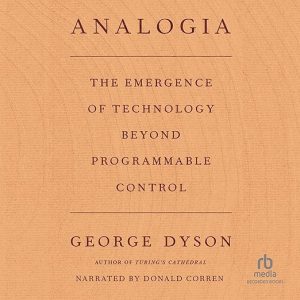
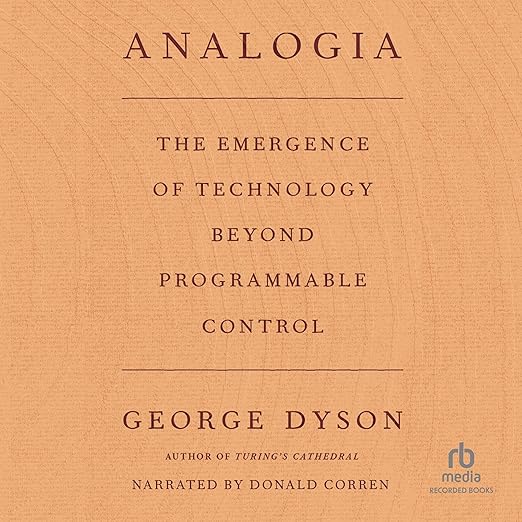
What if the digital revolution was never the inevitable winner it now looks like, only one side of an argument still being settled? That is the question technology historian George Dyson, son of physicist Freeman Dyson, sets out to answer in this audiobook. Dyson opens with a real and specific scene: in 1716, mathematician and philosopher Gottfried Wilhelm Leibniz spent eight days taking the cure alongside Peter the Great at Bad Pyrmont in Saxony, laying groundwork for what Dyson calls a digitally-computed takeover of the world.
Dyson's earlier books, Darwin Among the Machines and Turing's Cathedral, chronicled the people who built Leibniz's dream into reality. Analogia does something different, tracing figures who resisted that same current, including Apache leader Geronimo and physicist Leo Szilard, and weaving that historical thread through Dyson's own unconventional biography, split between Princeton's cutting-edge physics and computer science world and years spent living in the rainforest of the Northwest Coast.
Corren's Wide Range, Memoir to Physics
Narrator Donald Corren is asked to carry an unusually wide tonal range across this single audiobook, personal memoir, theoretical physics, and historical analysis of resistance movements, without letting any one register flatten the others. That range is the whole point of Analogia's structure, and Corren's composure across it is what keeps genuinely difficult material legible rather than exhausting. Reviewer Bill Frezza captures the book's ambition and its risk in one line, calling it 'actually several books weaved into one,' adding that it 'comes across as a meandering mess that deeply buries the lede,' while still finding it 'a delightful read scattered with fascinating factoids, historical anecdotes,' among other qualities he lists.
Reviewer Aran Joseph Canes calls Dyson 'literally a modern day explorer,' noting the book 'can sometimes make you feel like you're lost in the woods yourself,' and specifically credits it with covering 'the Russian colonization of Alaska,' 'nuclear powered space exploration,' and Dyson's own experiences living off the land during his years away from Princeton. That range of subject matter, spanning centuries and continents inside one narrative, is either the book's greatest strength or its central structural risk, depending on how much a given listener wants a tidy through-line.
Leo Szilard's inclusion among the book's central figures of resistance is a pointed choice. Szilard was the physicist who first conceived of the nuclear chain reaction and helped draft the letter that convinced Einstein to warn Roosevelt about atomic weapons, yet he spent much of his later career trying to slow and contain the very technological momentum he had helped set in motion, campaigning against unrestrained weapons development once he understood where it was heading. Placing Szilard alongside Geronimo, a very different kind of historical figure resisting a very different kind of encroaching system, is exactly the sort of unexpected pairing that makes Dyson's argument feel genuinely original rather than a familiar technology-history retread.
Companion Volume for the People Who Said No
Reviewer Tom describes the book as 'tying together topics from memoir, history, and forecast,' and specifically flags the recurring question of 'how would the Apache' respond to encroaching technological control, a thread that runs through the Geronimo material and gives Analogia real philosophical stakes beyond a straightforward technology history. For listeners already familiar with Dyson's earlier books, this functions as the deliberate companion volume, the history of the people who said no.
The book's central argument, that an analog revolution is already underway and that a new generation of machines now operates beyond programmable human control, lands with real weight delivered in continuous audio rather than skimmed in print, since Corren's pacing gives the argument room to build across its historical evidence rather than arriving all at once in a single thesis statement.
For listeners unfamiliar with Dyson's earlier books, a brief orientation helps: Turing's Cathedral told the story of the small team at Princeton's Institute for Advanced Study that built one of the first true digital computers, while Darwin Among the Machines traced the philosophical lineage of self-replicating, evolving machine intelligence back through the nineteenth century. Both books, like Analogia, treat the history of computing as a story of ideas with real consequences rather than a simple parade of inventions, which is the throughline that makes all three books recognizably part of one sustained argument even though Analogia deliberately inverts the earlier books' focus.
George Dyson's own vantage point on Princeton's physics establishment is not that of an outside journalist parachuting in for research purposes. His father, physicist Freeman Dyson, spent decades working at the same storied Princeton institute where Turing's Cathedral's early computer was built, which means George Dyson grew up with genuine proximity to exactly the scientific culture Analogia examines from both inside and outside at once. That dual vantage, insider by upbringing, outsider by having chosen a more historical and philosophical path than his father's own physics career, is part of what gives the book's Princeton sections their particular texture.
Burying the Argument Without Signaling Shifts
Bill Frezza's own review is the clearest warning here: this book genuinely does bury its central argument at times, moving between Princeton physics, Pacific Northwest personal history, and 19th century Apache resistance without always signaling the connective tissue in advance. Listeners expecting a single clean narrative thread, rather than an intentionally non-linear structure held together by theme, should recalibrate expectations before starting.
At 4.2 stars across 82 ratings, this is a more divisive title within Dyson's catalog than his earlier, more tightly structured books, and that division tracks closely with how much a given reader values structural ambition over narrative ease. Listeners new to Dyson specifically should know this is not the most approachable entry point into his work, even though it may be the most intellectually rewarding one for readers already invested in his earlier arguments.
At 9 hours and 42 minutes, Analogia is not an especially long audiobook by nonfiction standards, but the density of its argument, spanning centuries, disciplines, and continents, means the runtime does not map cleanly onto how much real attention the material demands. This is a strong candidate for a second listen, or for listening in shorter, more deliberate sessions rather than one long continuous sitting, given how easily a distracted moment can mean losing track of which historical thread Dyson has returned to.
Historical Precedent Over Silicon Valley Debate
Readers of Dyson's earlier work, technology historians, and listeners drawn to AI-risk arguments framed through deep historical precedent rather than present-day Silicon Valley debate will find genuine depth here, delivered by a narrator capable of holding together memoir, physics, and history without losing the connective argument between them.
A tidy single-throughline narrative never really arrives, and that appears to be by design rather than a flaw to fix. Listeners wanting an introductory, breezy technology-history primer, or a book that resolves cleanly into one argument stated early and reinforced simply, should choose a different, more conventionally structured title instead.
Do I need to have read George Dyson's earlier books before this audiobook?
It helps but is not strictly required. Analogia functions as a thematic companion to Darwin Among the Machines and Turing's Cathedral, tracing the people who resisted the digital future those books chronicled, so familiarity with Dyson's earlier arguments deepens the experience.
Who narrates the Analogia audiobook?
Donald Corren narrates, handling the book's shifts between personal memoir, theoretical physics, and historical analysis with the composure the material's wide tonal range requires.