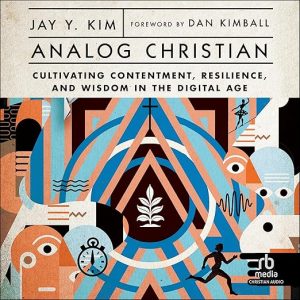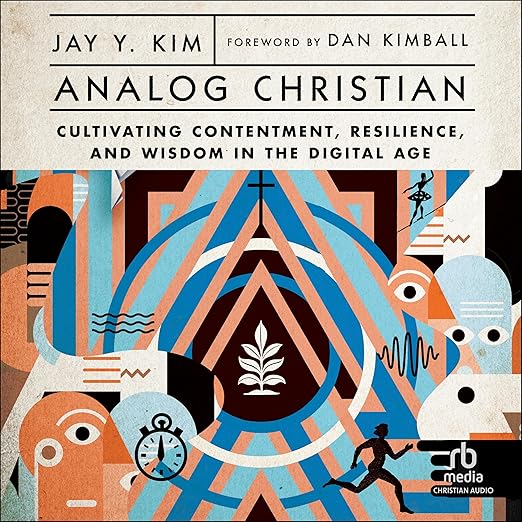
Digital scrolling gets the theological treatment in Analog Christian, and Jay Y. Kim narrates his own case for practicing faith at odds with the feedback loops built into a smartphone. Kim is a pastor, and that pulpit cadence is audible from the first chapter, measured, direct, built for a listener used to being spoken to rather than lectured at. This audiobook follows his earlier book Analog Church, which applied a similar critique to congregational life; here the target widens to discipleship itself, contentment, resilience, and what he calls wisdom, qualities he argues the attention economy is specifically engineered to erode in anyone who spends enough time inside it.
Fruit of the Spirit Meets a Tough Read
Kim's argument runs through three registers, theological claim, cultural diagnosis, and personal confession, and his self-narration keeps all three legible because he clearly knows which one he is in at any given moment. Reviewer Derek Atkins frames Kim's answer to compulsive internet use as practicing 'the fruit of the Spirit,' starting with 'love, joy' and continuing through virtues the review does not get to finish listing before it cuts off. Atkins also mentions borrowing the book from a public library before deciding he needed his own copy, a small but telling detail about how this material tends to land: casual curiosity converting into something closer to ownership, which is a meaningful signal for a six-hour spiritual-formation book competing for attention against the very apps it critiques.
Not every listener will find the read easy going. Mark Personius rated it four stars and summed up the experience in two words: 'tough read!' That is a fair warning about density, not quality. Kim writes like someone used to structuring an argument for people who will sit with it across a week of sermons, not skim it between meetings, and six continuous audio hours compress that structure into a fairly demanding stretch of listening. Yoshi's review, written while the book was still in progress during a self-imposed Lenten break from social media, captures the more immediate payoff, finding the material 'encouraging in the reasons for staying away or limiting social media use' and reporting already feeling 'more present and content.'
Kim's Own Speaking Voice Gives the Argument Authority
The strongest case for the audio edition specifically is that Kim is teaching a practice, not just describing a theory, and hearing a pastor deliver his own material in something close to his actual speaking voice gives the content a different kind of authority than reading it silently would. A book arguing for patience, presence, and resistance to constant stimulation benefits from a narrator who is not rushing through the argument to hit a runtime target; Kim's own delivery has the unhurried quality the book is asking its readers to cultivate, which is a rare case of form matching content rather than working against it.
Real value also comes from how the book updates Kim's earlier argument in Analog Church for an individual rather than institutional scale. Where that first book asked what digital culture does to a congregation, this one asks what it does to a single person's capacity for contentment, resilience, and wisdom, three qualities that are harder to fake in a memoir-adjacent spiritual book than broad institutional critique is. Listeners who found Analog Church compelling get a natural continuation here; listeners new to Kim get a self-contained argument that does not require the earlier book as a prerequisite, since he restates the core diagnosis before building on it.
It is also worth situating Kim's book against the broader shelf of digital-attention critiques it is implicitly answering. Where a secular bestseller like Cal Newport's Digital Minimalism argues for reclaiming attention mostly on productivity and wellbeing grounds, Kim's entire case rests on a theological claim about what constant stimulation does to a person's capacity for contentment and communion, a narrower but deeper argument that secular equivalents do not attempt to make. Listeners who have already tried productivity-framed digital detox advice and found it thin will likely find Kim's spiritual framing addresses a different, more foundational layer of the same underlying problem.
Chapter-Length Arguments Built for Weekly Group Study
This is explicitly a Christian discipleship book, not a secular productivity or digital-minimalism guide, and its outward tech-focused framing, oriented toward practical knowledge and innovation rather than faith, undersells how theologically grounded the actual content actually is. Kim's answers to distraction and dissatisfaction are drawn from scripture and Christian practice specifically, not from neuroscience or behavioral design principles, so listeners hoping for a secular guide to phone habits in the mold of a general digital-wellness book will find themselves in a more explicitly faith-centered argument than the tech-adjacent framing might suggest.
The density Mark Personius flagged is worth taking seriously as a planning consideration. This is not a book built for background listening during a commute if you want to retain the argument; Kim builds each chapter as a sustained case rather than a series of standalone tips, and six hours of that structure rewards focused listening more than passive listening. Pairing it with a notebook, or at minimum a willingness to replay sections, will serve listeners better than treating it as ambient audio.
The six hours break into chapter-length arguments that would work well for a small group or weekly study format, one chapter a week, discussion questions drawn from Kim's own framing, rather than a single continuous binge, and listeners planning to use it that way should know the audio format supports easy chapter navigation for exactly this kind of paced, communal listening.
Kim's chapters tend to build toward a specific practical turn rather than staying purely diagnostic, naming a concrete daily practice or scriptural anchor before moving on, which makes the book easier to act on than a pure cultural-critique title would be. The tradeoff for audio listeners is that those practical turns are easy to miss if attention drifts, since no page exists to flag and no margin exists to scribble in, so listeners who benefit from a physical takeaway list may want to pair the audiobook with note-taking rather than passive listening alone.
Christians Wrestling With Their Relationship to Screens
Christians wrestling with their own relationship to screens, social media, and constant availability are the clearest audience, particularly anyone who found Kim's earlier Analog Church persuasive and wants the same diagnostic sharpness applied to personal discipleship rather than church life. Pastors and small-group leaders looking for discussion material will also find plenty to work with here, since Kim's chapter-by-chapter structure lends itself naturally to being broken into weekly conversation.
Readers hunting for a secular digital-detox guide, or anyone outside a Christian framework looking for behavior-change tactics without the theological scaffolding, should look elsewhere, since faith is not incidental here but the entire argument's foundation. A breezy, list-driven self-help listening experience is also not on offer; anyone expecting that instead of a sustained, sermon-paced argument may find six hours of this density genuinely taxing, exactly as Personius warned.
Good to Know
Is this audiobook a sequel to Jay Kim's Analog Church?
It is a companion rather than a strict sequel. Analog Church examined digital culture's effect on congregations; Analog Christian applies the same critique to individual discipleship, and Kim restates the core diagnosis so new listeners do not need the earlier book first.
Does this audiobook require a Christian faith background to follow?
Yes, the arguments are built on scripture and Christian practice throughout, so listeners looking for a secular digital-wellness guide without faith content should look elsewhere.
Is Analog Christian narrated by the author?
Yes, Jay Kim narrates his own book, and his background as a pastor gives the audiobook a measured, sermon-like pacing that suits the material's demand for patience.
Is this a light, easy-listening audiobook for a commute?
Not really. One reviewer specifically called it a tough read despite praising it, and the sustained chapter-length arguments reward focused listening over background play.