- Performance: Nick Podehl brings his established LitRPG and fantasy credentials to bear here. His ability to differentiate a large cast while maintaining narrative momentum over 14-plus hours is exactly what a third-volume series installment needs, and Orrin's internal voice benefits particularly from Podehl's skill at calibrating the gap between a character's self-presentation and actual emotional state.
- What it covers: Institutional politics as personal test, the gap between heroism as identity and heroism as action, loyalty under coercion
- Feel: Fast and witty, with genuine stakes underneath the academy-setting humor
- Our call: An Education in Magical Affairs raises the stakes from the first two I'm Not the Hero volumes by moving Orrin into full protagonist territory, and at 14 hours Podehl keeps the academy setting from ever becoming static.
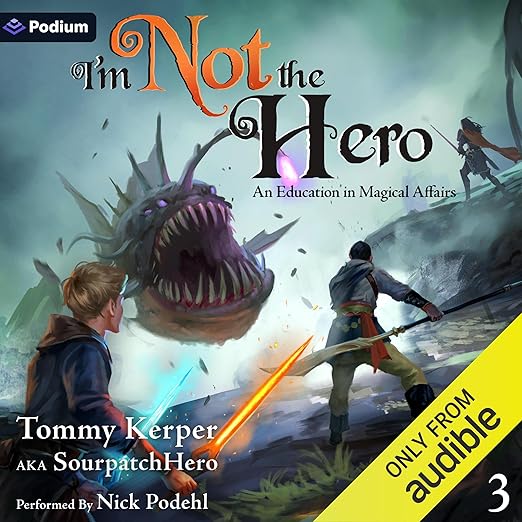
An Education in Magical Affairs: An Isekai LitRPG is the third audiobook in SourpatchHero's I'm Not the Hero series, narrated by Nick Podehl, and the premise of this installment is a recognizable genre pleasure: the magic school as crucible. Orrin, who arrived in the RPG-like reality of the earlier books as the definitive dead weight and has been steadily accumulating powers no one had heard of, has ended up a prisoner of Odrana's ruler and her scheming mother Anabella. The terms of his release: infiltrate an elite magical academy, befriend influential students, and help maneuver Anabella back into power. Orrin has been enrolled in the worst possible kind of school, one where the coursework is espionage and the grading system involves attempted murder.
Reviewer Maria Rapoza described the I'm Not the Hero series as one that starts good and gets better as it goes along, and specifically recommended starting with book one. That is genuinely important advice for this third volume. An Education in Magical Affairs is not a standalone entry and assumes familiarity with Orrin's arc from the first two books. Reviewer Marcus called it well-written with believable characters and noted the character growth, which is the series' real claim to quality among LitRPG offerings. Podehl is the narrative engine that makes the 14 hours and 36 minutes move. His delivery of Orrin's self-aware internal commentary is the audiobook's most reliable pleasure.
How An Education in Magical Affairs: An Isekai LitRPG Holds Up
The academy setting is a good structural choice for this volume because it gives the series permission to slow down in the best way. The first two books in I'm Not the Hero are largely kinetic: Orrin and Daniel are moving through a world they are still learning to read, and the plot operates at the pace of the next immediate threat. The academy puts Orrin in a context where the threats are institutional and social rather than purely physical, which creates space for the character work that distinguishes this series from the genre's less ambitious entries. SourpatchHero uses the infiltration premise to create a situation where Orrin cannot simply fight his way out. He has to be smarter, more socially agile, and more genuinely strategic than he has needed to be before.
The Anabella manipulation subplot gives the volume its overarching tension: Orrin knows he is being used, knows the terms of his release are not neutral, and is playing a very long game inside a system he does not fully understand while trying to avoid the fate of simply becoming a pawn. Podehl's narration handles this double-consciousness well. The voice in Orrin's head that is assessing what is actually happening is slightly different in register from the voice he presents to the academy's students and faculty, and that distinction is consistent across 14 hours without becoming labored.
The series has over 600,000 views on Royal Road, which is a meaningful signal about the web-serial community's assessment of SourpatchHero's writing. Web serials that translate successfully to full audiobook format often do so because their chapter-level plotting is strong. Each unit provides enough forward momentum to make the daily or weekly release cadence work, and that same quality translates to audio as a pacing asset. The chapters in this volume have the tightness of writing that had to earn its audience incrementally, and Podehl's consistent delivery amplifies that quality.
The Daniel subplot, Orrin's athletic, natural-born-hero best friend who is somewhere in the world trying to find him, creates a sustained background tension that the academy's immediate concerns can periodically displace but cannot resolve. That delayed gratification is handled well by SourpatchHero. The contrast between Orrin's contained, chess-like situation and Daniel's more action-forward search provides tonal variety without breaking the volume's structural coherence. Podehl gives Daniel's sections a slightly different energy than Orrin's, which helps listeners track the parallel narrative strands without confusion.
Weak Spots in An Education in Magical Affairs: An Isekai LitRPG
The academy social dynamics are more interesting than the setting initially suggests. SourpatchHero is doing something specific with the magic-stratified hierarchy of the school: the students who are most certain of their status are the most easily manipulated by someone who understands the system from outside. Orrin's outsider knowledge, what an academy education looks like from Earth, what adolescent social competition looks like when you are not inside its ideology, gives him leverage that his assigned mission cannot anticipate. Those passages, where Orrin's anomalous perspective becomes an actual asset, are the volume's most intellectually satisfying sections.
The action sequences in the second half of the book arrive at a pace that rewards the patience of the setup sections. SourpatchHero uses the academy's genuine danger to keep the stakes from deflating into mere social drama, and the summary line in the synopsis, less bullying and more attempted murder, is not just comedy framing but a structural promise about where the volume is heading. Podehl's delivery accelerates through these sequences with the practiced efficiency of someone who has narrated enough LitRPG to know exactly how to sustain momentum without losing the character-level detail that makes the action mean something.
The Right Listener for An Education in Magical Affairs: An Isekai LitRPG
Start with book one. The I'm Not the Hero series has a specific character arc: the progressive inversion of Orrin's role from sidekick to genuine protagonist, which loses most of its power if you enter at volume three. For listeners who have already completed the first two books, this installment is exactly the progression the series has been building toward. Nick Podehl's involvement is a reliable quality signal for LitRPG listeners who track narrator-to-series fit. His work here is consistent with his best fantasy performances. Those who are new to LitRPG but curious about the genre would do better to start with a more self-contained entry point than this third volume in an ongoing series. The isekai framing and RPG-mechanics vocabulary assume genre familiarity that first-time LitRPG listeners may not have.
Questions Listeners Ask
Is An Education in Magical Affairs: An Isekai LitRPG accessible as a first audiobook in the series, or must you start from book one?
You should start from book one, I'm Not the Hero. The character arc that this volume develops, specifically Orrin's evolution from dead weight to protagonist with unique powers, depends entirely on the setup from the first two books. Entering at book three will lose both the emotional investment and the narrative context for Orrin's current situation.
How does Nick Podehl's narration handle the isekai premise and the RPG-system elements in this audiobook?
Podehl is an experienced LitRPG narrator and handles the system terminology and progression mechanics naturally rather than awkwardly. His real skill here is in Orrin's first-person voice: the internal commentary that tracks the gap between what Orrin is doing and what he is thinking, which is central to the series' humor and its character depth.
Does the academy setting in this audiobook feel like a digression from the series' larger stakes, or does it advance the main arc?
It advances the main arc significantly. The infiltration mission Orrin undertakes is directly tied to the power dynamics established in earlier books, and the skills and relationships he develops in the academy have consequences beyond the volume's own plot. The school setting slows the pace by design, in a good way, to develop character depth that the more kinetic early volumes did not have space for.
At 14 hours and 36 minutes, does the audiobook maintain its pacing throughout, or are there slow sections?
The setup sections in the first third are more deliberate than the action-heavy second half. SourpatchHero is establishing the academy's social hierarchy and the terms of Orrin's mission before deploying them. Listeners patient with character-building and institutional worldbuilding will find the pacing rewarding. Those who need immediate action momentum may find the early academy chapters slower relative to the later sequences.