Quick Take
- Performance: Stephen Hoye delivers Cowen's contrarian arguments with steady, authoritative clarity - well matched to the book's confident, analytical voice.
- What it covers: Food economics, culinary skepticism, globalization and taste
- Feel: Intellectually provocative and conversational
- Our call: A genuinely useful guide to eating well for less, wrapped in economics that will sharpen how you read a restaurant menu forever.
I finished this one while walking back from a strip-mall Vietnamese place that a friend had been dismissing for years as 'sketchy.' Tyler Cowen would have approved of both the restaurant and my friend's eventual conversion. There is something immediately useful about listening to an economist dismantle your assumptions about what makes food good, expensive, or trustworthy - and then applying those ideas in real time the moment you step off the sidewalk into the kind of place that has laminated menus and no atmosphere whatsoever.
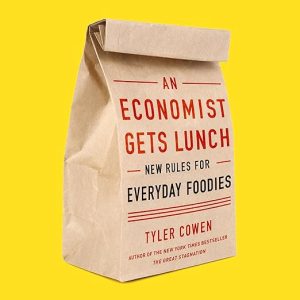
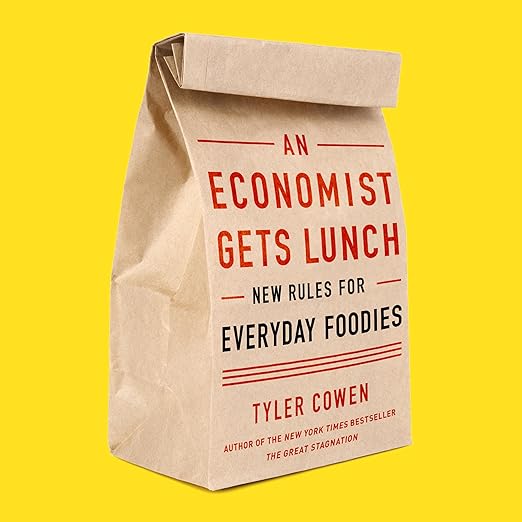
Tyler Cowen is an economist at George Mason University and one of the most widely read bloggers on food and economics. By 2012, when this audiobook was published, he had already accumulated a following through his Marginal Revolution blog and his broader reputation as a thinker who applies economic frameworks to things that economists typically leave alone. An Economist Gets Lunch is his sustained argument that almost everything the American food establishment believes about quality, sustainability, and value is either wrong or badly distorted.
Strip Malls Beat Michelin on Cowen's Logic
The book's central provocation is that food snobbery is actively harmful - not just socially irritating but destructive to entrepreneurship, innovation, and the quality of the food supply itself. Cowen argues that Americans have been taught to associate high prices, formal atmospheres, and locavore credentials with good food, and that this association is mostly a marketing success story rather than a culinary reality. The places with the best food, he argues, are often cheap, ethnically specific, and located in strip malls - where rent is low, competition is fierce, and the clientele is demanding in ways that Michelin inspectors are not.
This is genuinely useful. A reviewer who describes themselves as already a fan of Cowen's DC restaurant blog notes that the book works through why American food deteriorated in the mid-twentieth century, why immigration is one of the most important variables in restaurant quality, how to find good food in other countries, and how to navigate grocery stores with economic intelligence. That's a substantial program, and Cowen delivers it with the combination of provocation and empirical grounding that characterizes his best work.
Hoye's Steady Authority Suits an Economist's Essays
The audio format suits Cowen's conversational essay style well. Stephen Hoye reads with consistent authority - not flashy, but exactly right for an intellectual argument delivered in confident paragraphs. At just over ten hours, the listening time is proportional to a serious book of ideas, and Hoye's pacing keeps the density of the economic reasoning from becoming oppressive.
The most enduring value is the framework rather than the specific recommendations. One reviewer makes this point explicitly: the goal is to give the listener a lens for drawing their own conclusions, not to hand down verdicts. Why are restaurants full of beautiful, happy people often disappointing? Because they're optimizing for ambiance and social performance, not food. Why is airport food better than airplane food? Economics of captivity and competition. Why do high-wage countries tend to have expensive restaurants that aren't necessarily better? Because labor costs dominate. These are genuinely transferable insights.
Repeated Ideas and a Travelogue Detour
The critical notes in the reviews are worth taking seriously. One listener found the book "too focused on where to eat when traveling rather than the economics of food," and there is truth to that - the travelogue sections on Central America, Mexico, and Asia are vivid but occasionally feel like a detour from the central argument. Another reviewer found many ideas repeated, which is fair: Cowen tends to circle back to his core thesis from multiple angles rather than building a linear argument.
The book also has an assumption baked into it that some listeners may find limiting: it presumes mobility and a willingness to eat in unfamiliar contexts. Cowen's advice about where to find good food is genuinely good, but it helps if you're the kind of person who reads neighborhood demographics as restaurant tips and has no anxiety about ordering from a menu you can't entirely decipher. If you are, this book will feel like a revelation. If you prefer the shorthand of professional critics and recognizable environments, it may feel more like an argument with you than a guide for you.
Economics Curious and Food Curious Overlap Here
This is for curious eaters who want to understand the structural forces shaping what ends up on their plate. It's for anyone who has suspected that the expensive restaurant was not worth it but couldn't articulate why. It's for food-curious listeners who also read economics, or economics-curious listeners who also care about food - the Venn diagram overlap Cowen is specifically writing for.
It's less suited to listeners seeking pure culinary pleasure: there are no recipes, no evocative descriptions of ingredients, no sensory prose. Cowen is analyzing the food world, not celebrating it. If you want something that makes you want to cook or eat, this is the wrong book. If you want something that changes how you choose where to eat for the rest of your life, it may be exactly right.
Good to Know
Do you need an economics background to follow Tyler Cowen's arguments?
No. Cowen writes for a general audience and avoids technical jargon. The economic concepts he uses - competition, incentives, price signals, labor costs - are explained in plain terms. A reviewer explicitly praises the book as blending conventional price theory with behavioral economics in a way accessible to non-specialists.
Is An Economist Gets Lunch primarily a restaurant guide or a work of food policy?
Both, but the blend can feel uneven. The book moves between specific restaurant-finding advice (including country-by-country recommendations), broader food policy arguments about agriculture and sustainability, and economic theory about what determines food quality. Listeners expecting a tight single focus may find the scope a bit sprawling.
Does Stephen Hoye's narration handle the analytical passages well?
Yes. Hoye brings a consistent, measured authority to the material that suits an economics-flavored essay. He doesn't inject drama or humor where the text doesn't call for it, which is the right call for this kind of writing. The narration is functional and clear rather than theatrical.
How does this book compare to Michael Pollan's food writing for someone deciding between them?
They are almost perfectly opposed. Pollan celebrates the local, the seasonal, and the artisanal; Cowen systematically challenges the assumptions behind those preferences. Listeners who have read Pollan will find Cowen's counterarguments thought-provoking. Listeners who haven't will get the contrarian position without the foil, which still works but lands differently.