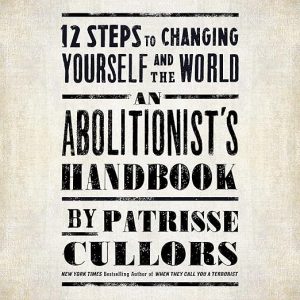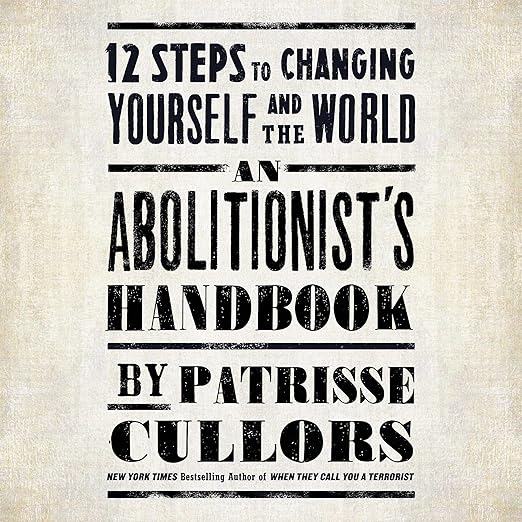
An Abolitionist's Handbook audiobook, written and narrated in key passages by Patrisse Cullors, arrives as one of the more practically oriented books to emerge from the contemporary abolitionist movement. Cullors, a co-founder of Black Lives Matter, is not writing theory here. She is writing a working guide, and the distinction matters enormously for how this audiobook sits in the body of literature on criminal justice reform and community transformation. Ariel Blake handles the primary narration across the book's dense, chapter-driven structure, with Cullors herself voicing the sections that carry the most autobiographical weight.
The audio version has a structural advantage over the print edition that is worth flagging immediately: this production includes an introduction written and read by Prentis Hemphill, as well as an exclusive bonus conversation between Cullors and adrienne maree brown that does not exist in print form. That conversation alone is worth the price of the audiobook for listeners already familiar with either writer's work. Brown's questioning pushes Cullors on some of the more aspirational claims in the text, and Cullors responds with a candor that does not always make it into the polished prose of the main chapters.
Cullors frames her eleven chapters around specific abolitionist skills rather than abstract principles. Having courageous conversations, practicing active forgiveness, moving away from cancel culture, cultivating non-harm, and organizing local governments toward abolition are not treated as ideals to aspire toward but as practices with concrete steps attached. Each chapter ends with reflection questions, and reviewer Ambre Nulph noted that this structure made the book feel like a course rather than a manifesto, which is exactly Cullors' intent. She is explicit that this handbook was designed for use in community organizing settings and book study groups, and the audio format supports that function because individual chapters are short enough to listen to in a single session before discussion.
The treatment of reparations stands out as one of the more substantive sections. Cullors does not limit her definition to financial transfer but extends it to include land, community infrastructure, psychological restoration, and cultural restitution. She draws on specific examples from her own organizing experience and from historical precedent, which gives the discussion a grounded quality that purely theoretical treatments of reparations often lack. Reviewer L. Finley noted using this book to introduce these practices into a workplace culture, and that application signals something important about the book's ambition: Cullors is writing for practitioners across multiple contexts, not only for street-level organizers.
Ariel Blake's Precision in Cullors' Nuanced Passages
Ariel Blake's narration is the right instrument for this text. AudioFile's assessment of Blake's voice as bold is accurate, but it undersells the precision she brings to Cullors' more nuanced passages. When Cullors writes about the psychological toll of sustained activism and the necessity of self-care not as indulgence but as political practice, Blake carries the weight of that distinction without dramatizing it. The difference between reading those passages and hearing them performed is real. There is an intimacy to the audio version that the print edition, with its workbook-like structure, cannot fully replicate.
The bonus conversation with adrienne maree brown deserves particular attention. Brown is one of the sharpest interlocutors in contemporary social movement literature, and her questions are not softballs. The exchange covers Cullors' own relationship to failure within activist work, the tension between visionary frameworks and immediate material needs, and the personal cost of public organizing. For listeners who have found Cullors' public persona sometimes more polished than confessional, this conversation offers a different register entirely.
Transformative Justice Terms That Assume Prior Context
Listeners coming to this book without prior engagement in abolitionist discourse will encounter some vocabulary and conceptual framing that assumes familiarity with the field. Terms like transformative justice and restorative accountability are used with precision but not always with extensive definition, which can make the early chapters feel like they require a primer. Cullors acknowledges this by providing historical context for the abolition movement in the United States, but that context is woven through the text rather than front-loaded, so some listeners may want to pause and explore relevant background material before completing the book.
The book's breadth is also occasionally a tension. Eleven chapters covering everything from inter-community conflict to government organizing means that each topic receives less depth than a single-subject work would allow. The chapter on organizing local governments toward abolition, in particular, moves quickly through territory that could sustain an entire book on its own. Reviewer Miste Anders-Clemons was struck by how the text ultimately centers personal accountability before communal action, which is an accurate observation and either a strength or a limitation depending on what you come looking for.
Why the Audio Edition Is the Definitive One
This audiobook is well suited for people already engaged in community organizing who want a structured framework for deepening their practice, and for educators or facilitators who need a curriculum-ready resource that can be consumed and discussed in chapters. The audio version is the definitive edition of this text specifically because of the Prentis Hemphill introduction and the adrienne maree brown bonus conversation, both of which are exclusive to this format and neither of which feels like a marketing add-on. Hemphill's introduction in particular sets a tone that situates the book within a broader lineage of abolitionist writing that the main text's chapter structure does not explicitly map. It is also a strong entry point for readers curious about abolition who want something more actionable than academic theory. Listeners seeking a neutral introduction to debates around criminal justice reform rather than a practitioner's guide should know that Cullors writes from inside the movement, with the conviction and the partial view that entails. The audio-exclusive content with adrienne maree brown makes this version the definitive edition of the text.