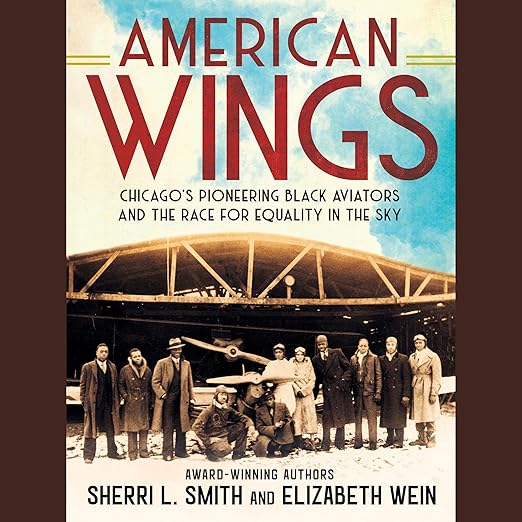
Sherri L. Smith holds the only author credit on this listing, and the description promises two writers. It opens by naming the acclaimed author of Flygirl and the bestselling author of Code Name Verity, which is plainly two people, while the credit field carries a single name. Whoever assembled the page dropped a collaborator somewhere along the way. Worth knowing at the outset, because American Wings behaves like a co-written book and the audiobook carries that doubled quality: two hands moving one group of real people through the years between the world wars, when aviation fever caught the entire country and Jim Crow made certain that Black Americans could not simply walk up and buy a lesson. Listening Library's recording runs eight hours and forty-five minutes with Karen Murray reading.
Aviation between the wars was expensive, exclusionary and genuinely thrilling, and the book keeps all three facts in play at once. Its subjects are four specific people: Cornelius Coffey and Johnny Robinson, both skilled auto mechanics; Janet Harmon Bragg, a nurse; and Willa Brown, a teacher and social worker. They built a flying club, then their own airfield on Chicago's South Side, then a school that trained Black and white students together while the United States military was still segregated. The January 2024 report gets at why it works, calling the nonfiction anything but boring and crediting the book with running the story straight through, from the struggle to be taken seriously as mechanics to flying out to find supporters.
Eleven ratings produced the 4.3 this listing displays, and all four written reports underneath carry five stars. Both facts cannot be typical of the same pool. If those four fives are among the eleven, the remaining seven votes have to average well under four to pull the total down that far, which means a real minority disliked the book and left no explanation behind. Nothing on the page indicates what the objection was. Read the written column as the enthusiastic end of a split rather than as a consensus, and calibrate expectations accordingly.
Why Listen to American Wings
Chicago's South Side is the book's real setting and its strongest argument. The December 2024 report frames the stakes correctly: in the early 1900s aviation was among the most exciting things happening anywhere on Earth, and in the United States potential pilots of color were relentlessly prevented from chasing it. Bessie Coleman had to move to France to earn her wings, a fact the description drops early and lets sit. What Coffey and Robinson did instead was refuse to leave. They built the infrastructure where they already stood, which makes for a different kind of story than the lone-genius biography this material could easily have turned into.
Smith and the uncredited co-author write in a register that suits reading aloud, which is not a given for archival history. The prose stays conversational and unhurried, closer to somebody telling you the story than to a historian building a case, and it moves the way fiction moves. For an eight-hour listen aimed at teenagers, that is close to the whole ballgame. Karen Murray has four principals to keep distinct using nothing but voice, with no cast list, no photographs and no chapter heading anyone can see, and a conversational text gives a reader far more to work with than a chronology of licenses and airfields ever would.
What to Watch For in American Wings
Back matter is the thing to weigh before buying the audio, and one report does the counting for you. Writing in February 2024, it puts the official page count at 376 and notes that just over 100 of those pages go to an authors' note, source notes, a list of resources and an index. That is better than a quarter of the book. In print you can dip into it or skip it at a glance. In audio it either gets read to you, in which case a serious chunk of the running time is bibliography, or it quietly vanishes, in which case the sourcing that makes this credible history is missing from the product you bought. Eight hours and forty-five minutes hints at the second outcome, though the page never says. That same report is also the only place on this listing where the second author appears at all, crediting the writing duo of Sherri L. Smith and Elizabeth Wein.
Listening Library aims this at teenagers and the material mostly earns that placement, but the tag reading Biographies undersells what the book is doing. This is institutional history with four lives threaded through it: how a club becomes an airfield, how an airfield becomes a school, how a school becomes an argument that integration works in practice. Younger listeners expecting a single hero's arc will notice the frame keeps widening. The description's closing line, a cover photo credit to the Smithsonian National Air and Space Museum, is one more print artifact left on an audio page, crediting an image nobody listening will ever see.
Recommended For
Teenagers who like their history with people in it are the intended audience and the right one. So is any adult who arrived through the Flygirl and Code Name Verity connection, since both novels work the same territory. The March 2024 report is useful for setting expectations. It opens by pointing out that the 1920s and 1930s can fairly be called the golden age of aviation, that the country and arguably the world went a little crazy for anything that could get off the ground, and that flying has always been expensive, licenses and rentals included, before adding the weight of being Black in an era of blatant and accepted racism well beyond the South.
Steer clear if you want cockpit adventure, because the flying is the goal here rather than the content, and long stretches concern money, permits, mechanics' certificates and school administration. Steer clear too if you need the source notes, since the running time hints that they did not make the trip into audio. What you are left with is a warmly written account of four people who built their own airfield instead of waiting for permission, at a length a teenager will actually finish, carrying a quiet reminder that Bessie Coleman had to cross an ocean to earn her wings at all.
Frequently Asked Questions
Why does the American Wings audiobook listing credit only one author?
That looks like a metadata gap rather than a fact about the book. The description itself promises a pair of writers, one known for Flygirl and one for Code Name Verity, and a report further down the page names Elizabeth Wein as the second of them. Only the first name reaches the credit field.
How long is the audiobook, and does it include the source notes?
Eight hours and forty-five minutes from Listening Library, released in January 2024. A report on the page counts 376 printed pages with just over 100 of them devoted to back matter, and the running time suggests the recording covers the narrative rather than the notes and index.