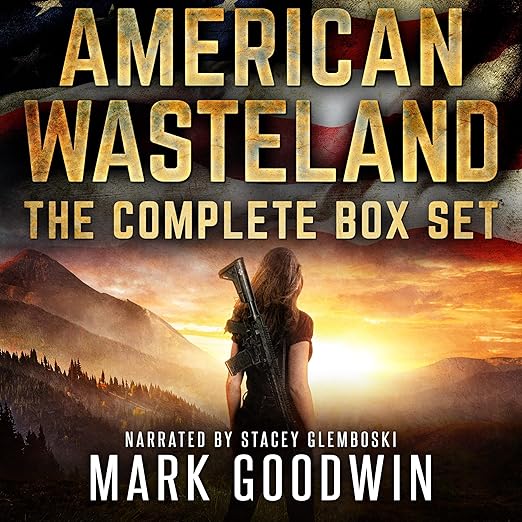
American Wasteland arrived on my radar because of the overlap between its premise and Ted Koppel's Lights Out, which I had listened to recently. Both deal with cyberattacks on the US power grid and the collapse that follows. The similarity ends there. Koppel's book is journalism. Mark Goodwin's complete box set is survivalist fiction with a specific political worldview embedded in every chapter, and it announces this clearly in its own description: if you are offended by conservative principles and references to Scripture, this book might not be for you.
That transparency is worth acknowledging. Goodwin is not pretending to a neutrality he does not have. Jennifer Martin, the small Atlanta restaurant owner at the center of the story, navigates a world where government overreach has crippled the economy, where a purge of patriots from the military has weakened American defense, and where a cyber-attack blamed on election skeptics is actually a government operation to divide the country. This is a specific political imagination, and the story is built entirely within it.
The Verdict, Briefly
Within its intended genre, the box set has genuine momentum. Reviewers describe characters that feel real and twists that sustain attention across the full twenty-one hours. The survival mechanics are handled with enough detail to satisfy readers who come to the genre for practical prepper content alongside the fiction. Goodwin notes in his description that no profanity and no sex scenes are present, which is a deliberate choice that reflects his target audience's preferences rather than a limitation.
The most pointed criticism comes from a reviewer named Diana who started the book genuinely interested and lost faith in Jennifer's character arc: she becomes a tactician, dead shot, and stone cold killer after reading a few books, which the reviewer found implausible given her starting point as a young, inexperienced restaurant owner. This is a legitimate structural observation. The protagonist's transformation from civilian to armed resistance leader happens faster than the narrative earns, and that acceleration is a tension in survivalist fiction more broadly.
Why Listen to American Wasteland: The Complete Box Set
For readers who are already invested in the prepper fiction space and who share the book's general political assumptions, the twenty-one-hour box set offers substantial content at no cost via Audible membership. The complete box format means the story resolves rather than ending on a cliffhanger, which is a practical advantage. Reviewers who share Goodwin's worldview describe the fictional events as close to current reality in ways they find both validating and alarming.
Stacey Glemboski's narration is consistent if unremarkable. The pacing of survivalist fiction tends toward action and dialogue rather than interiority, and Glemboski handles both competently. There is nothing in the narration that undermines the material, which is the appropriate standard for a genre-driven box set of this kind.
Points to Consider
The political content is not incidental. The grid collapse is framed explicitly as government conspiracy. The military purge of patriots and conservatives is presented as established fact within the story's world. The election integrity subplot is central to the plot's logic. Readers who find these premises implausible or troubling will struggle to engage with the narrative on its own terms because the narrative cannot be separated from them.
Goodwin's publisher note flagging potential objections is an unusual choice that functions both as disclosure and as an in-group signal. The book knows its audience and is written for them. This is not a criticism but a description that allows readers to make an informed choice about whether this is the right listening environment for them.
Who Should Pick Up American Wasteland: The Complete Box Set
Readers of conservative survivalist fiction who want a long, plot-driven grid-down story with no profanity and no sexual content will find exactly what they are looking for here. Preppers interested in fiction that dramatizes the community survival dynamics of a long-term blackout scenario will find material that speaks to their concerns. Fans of Mark Goodwin's other work will recognize his narrative voice and thematic commitments.
Readers who approach the current political moment differently from Goodwin, or who want their post-collapse fiction to work from different premises, will find this frustrating at the level of its basic assumptions rather than its execution. The box set is not for everyone, and its author knows this.
Questions Listeners Ask
How does the female protagonist's character arc develop across the complete box set?
Jennifer Martin begins the series as a small restaurant owner blindsided by both a conspiracy and a figure from her past. Across the complete box set her arc moves toward active resistance leadership. One reviewer found the transformation to tactician and marksman implausibly rapid given her civilian starting point. Other readers found the character arc compelling and the survival dynamics believable within the genre's conventions.
How does American Wasteland compare to other grid-down survivalist fiction like One Second After?
American Wasteland shares the genre's core premise, a cyber-caused blackout triggering societal collapse, but adds an explicit conspiracy layer and a more overtly political framework. Forstchen's One Second After is also conservative in its values but less explicitly partisan in its scenario. Goodwin's series operates closer to current political flashpoints, which some readers will find more relevant and others more limiting.