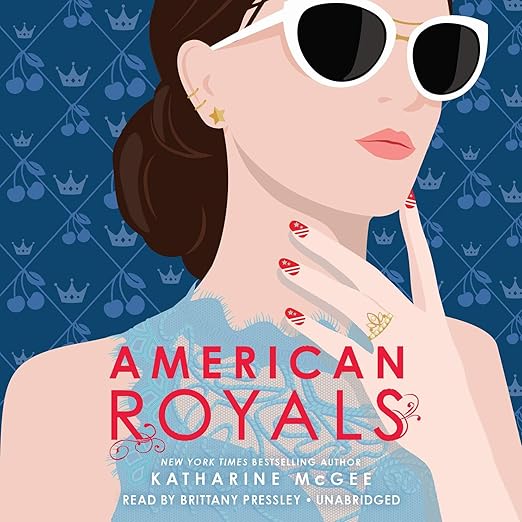
Alternate history usually arrives with treaties and battle maps. This audiobook arrives with a palace press office. The premise is one clean change to the record: America wins its independence, offers General George Washington a crown, and the offer is accepted. Two and a half centuries later the House of Washington still sits on the throne, and Katharine McGee spends nearly fourteen hours on what that inheritance costs the family holding it rather than on what it did to the country. Whether the trade appeals is really the whole question here, because the political machinery exists to generate romantic obstacles rather than the other way around. The book is not interested in constitutional consequence. It is interested in what a hereditary job does to three siblings who never applied for it.
Two princesses, one crown, and a rule change that reorders everybody's future: that is the setup, and it is a strong one. Princess Beatrice is the heir, groomed toward becoming America's first queen regnant, and the duty she embraced her entire life turns airless the closer it gets. Princess Samantha is the spare, ignored except when she breaks something, and she has arranged her whole personality around that neglect. Prince Jefferson, Samantha's twin, would have stood first in line a generation earlier and now sits third, adored by a country that expects nothing from him at all. Each position produces its own distinct kind of damage.
Beatrice gets the succession plot, Samantha gets the transgression plot, and the country gets to watch both. One response fixes on the alternate history itself and gets closer to why the book works than any plot summary manages: the small adjustments to the record are the pleasure, a democratic nation redirected into a monarchy by a single accepted offer, with consequences rippling forward through two and a half centuries of invented protocol. McGee is careful with that texture. The romance runs on familiar rails and knows it, but the world underneath has been built patiently enough that the rails feel like they run through somewhere specific. That specificity keeps the invented protocol from reading as set dressing, and it is the main thing separating this from any other palace romance on the shelf.
What Works
Succession law does the plotting here, which is more interesting than it sounds. New rules of inheritance are what demoted Jefferson and elevated Beatrice, and every romantic problem in the book traces back to a legal position rather than to a misunderstanding that a conversation would fix. Samantha's off-limits boy is off-limits because of who she is. Beatrice's duty suffocates because the line now ends with her. The response that counts the viewpoints describes the effect from the inside: four intertwined perspectives, each connected to the royal family in some way, with national adoration functioning as permanent surveillance rather than as reward.
Four points of view is a heavy load for a first book, and this one carries it by keeping each one narrow. Nobody is granted the kind of interiority that would slow the others down, which is a design decision with real costs. Listeners who want depth over momentum will feel the shallowness; listeners who want the soap to keep moving will not notice it. Nearly fourteen hours is long for young adult romance, and the length comes from breadth rather than from any single thread being developed unusually far. The book would rather show you four rooms of a palace than one room properly. For a first volume, that breadth is a defensible bet, since the narrower threads have somewhere to go later. It still means the emotional payoffs land at a shallower depth than the page count implies.
What to Watch For in American Royals
Brittany Pressley is the only voice credited for a book running four viewpoints across thirteen hours and fifty-three minutes, and that is the production fact worth weighing before purchase. A solo reader has to keep Beatrice, Samantha, and the outsiders distinguishable through voice alone, with no visible chapter heading to help a listener reorient after a switch. One response admits to worrying about precisely that at the start, then concedes the weaving is handled cleanly enough to cause no confusion. That observation concerns the writing rather than the reading, but it names the exact problem a single narration has to solve across this runtime.
Responses on this listing arrive from four different marketplaces, and two of the five are not in English at all, one written in Italian and the other in French. Both are positive. Neither is usable by an English-speaking buyer trying to judge a specific recording, which leaves three responses doing the work of five. Nine ratings support the 4.3 shown at the top, a very thin base for a title with this profile, and pooling across territories and editions thins it further. Read the score as a rough signal of goodwill and nothing more precise than that. Anyone deciding on nearly fourteen hours deserves better evidence than nine pooled ratings, and the three responses readable in English do more useful work than the number ever manages.
Who It's For
Alternate-history readers who want the counterfactual taken seriously should adjust expectations first, because the monarchy here is a setting rather than an argument and the book spends its energy on who is involved with whom inside it. What it delivers reliably is a court soap with rules. Anyone drawn to the idea of following a royal family through protocol, press, and an unforgiving succession statute will find nearly fourteen hours of exactly that, complete with an heir, a spare, a twin, and a legal change that keeps generating fresh problems for all three of them without ever needing a villain.
If the comparison the description makes with a certain prestige drama about a real monarchy is what drew you in, the register here is lighter and considerably younger than that. Look elsewhere if love triangles wear on you, because this book carries more than one and treats them as architecture rather than as a phase to be resolved. It will disappoint anyone who needs a self-contained story, since the record files this as book one of a continuing series. Otherwise it is a confident, unembarrassed piece of court romance that knows exactly what it is selling. That confidence is a large part of the appeal, since books which apologize for their own premise are considerably harder to spend fourteen hours inside.
Frequently Asked Questions
How long is the American Royals audiobook?
Thirteen hours and fifty-three minutes, published by Listening Library on September 3, 2019, with Brittany Pressley credited as narrator. That runtime sits at the long end for young adult romance and reflects the number of viewpoints the book carries rather than any unusual density in the plot.
Does the audiobook use a full cast for the different points of view?
No. Brittany Pressley is the sole credited reader, and no additional cast appears anywhere in the record. All viewpoints are handled by one reader across the full runtime, so any distinction between the princesses is a matter of vocal choice rather than of casting.