
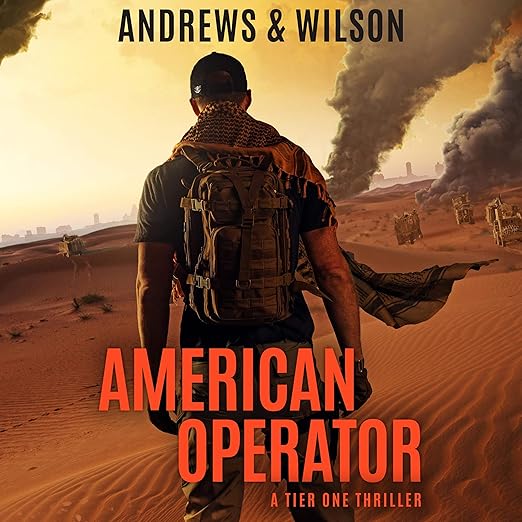
- Read by: Ray Porter is the sole credit on twelve hours that never pause long enough to reintroduce a faction, an agency or an acronym.
- At its heart: Hostage rescue, black-ops tradecraft, an operator living under a dead man's name, mercenary rivalry
- Vibe: Fast, procedural, grimmer than the pace suggests
- Short version: Strong fourth installment for series readers, and a workable entry point if you can accept a summarized backstory.
Ember, the black ops task force at the center of this series, gets its fourth outing here, and the American Operator audiobook runs twelve hours and fifteen minutes without once slowing down to explain itself. A shocking attack in Ankara opens it. The US Ambassador to Turkey is dead, his chief of staff is in the hands of terrorists, and the woman being dragged across a border is not the diplomat her passport says she is.
Is American Operator Worth Your Time?
Amanda Allen being undercover CIA is the hinge the whole plot swings on, and the book uses it well. A kidnapped staffer is a diplomatic problem. A kidnapped case officer is a countdown, because everything she knows has a shelf life measured against her breaking point. The President and the DNI hand the problem to Ember, Ember hands it to John Dempsey, and Dempsey goes into Syria with a team that loses its communications almost immediately.
Geography comes across better in a five-star filed two days after publication than in the jacket copy: Turkey, Syria and Russia stacked on top of one another, an Ember mission already running in the Adriatic when the call comes, and a supporting bench named on the page as Grimes, Munns, Latif and Martin. That response also flags the thing that makes book four feel current, describing a plot it calls possibly prescient. Anyone reading the news in the years since will know what it means.
Opposition is the other reason this installment works. Instead of a faceless cell, the book fields a legendary mercenary built to match Dempsey move for move, which turns the back half into something closer to a duel than a rescue. It also keeps the stakes from inflating into nonsense. Nobody is threatening a city with a suitcase device; the argument is about who controls the ground.
The Best Parts of American Operator
Ray Porter reads it, and the pool contains exactly one verdict on that. A five-star filed in September 2025 calls the book easy to listen to and hard to put down, then adds a line about loving the narrator, misspelling the word in the process. Take it for what it is: one listener, seven years after release, still buying the series in audio and naming the reading as part of why. That single line is the entire recorded verdict on the reading, seven years of sales notwithstanding.
What the format does add is momentum. Twelve hours of operational sequence, most of it in close third person on Dempsey, is the kind of material that survives being listened to while doing something else, because the plot restates its own stakes at intervals. The chapters are short. The cuts between the hostage line and the rescue line are clean. A listener who loses ten minutes to traffic noise loses very little.
Series continuity is the other argument. Dempsey has been running under a dead man's name since the first book, cut off from a wife and a son who believe he was killed, and book four keeps that cost in the room even while the shooting starts. The result is a thriller with a genuinely sad center, which is rarer in this shelf than the covers suggest. By volume four the disappearance has stopped being a revelation and become a condition, absorbed into the operational routine, which is a harder thing to dramatize than grief and a more interesting one to spend twelve hours beside.
Before You Commit to American Operator
Whoever counted five ratings here did not count these five. The page displays 4.7, and five whole-star votes land on 4.6 at a total of 23 and on 4.8 at a total of 24, with nothing available between them. No combination of five ratings produces 4.7 at all. The five grades printed underneath run five, five, four, five, five, which totals 24 and lands on 4.8, one rung above the figure at the top of the listing. Small samples make this visible; larger ones hide it.
Keeping the players straight is the honest complaint, and the page's only four-star makes it in February 2020: plenty of intrigue and quick movement, undercut by the difficulty of tracking all the factions, groups and sets of initials operating in that part of the world. The response generously blames itself. It should not, and in audio the problem is worse, because a page lets you flip back to the paragraph where an acronym was introduced and a recording does not. No glossary accompanies this listing.
Two pieces of the metadata do not match the book. The description credits the Wall Street Journal bestselling authors of Tier One, plural, while the byline names a single person, so a co-writer is missing from the credit line rather than from the writing itself. The genre field then files a counterterrorism thriller under literature and fiction with a Genre Fiction tag, which is where thrillers go to be overlooked.
Should You Listen to American Operator?
Series readers get the most, and readers of military and intelligence fiction generally will find the tradecraft handled without the lecturing that sinks a lot of this shelf. An August 2025 five-star describes being addicted to this writer while admitting the prose runs wordy at times and calling it informative anyway, which is a fair summary of the deal on offer: procedure and detail in exchange for pace.
Anyone who wants a locked-room puzzle or a spy novel about ambiguity should look elsewhere, since the moral questions here are settled early and the rest is execution. Newcomers can follow the rescue plot without the earlier books, but Dempsey's dead-man backstory arrives as summary rather than as story, and summary is a thin substitute for the three volumes that built it.
Questions Listeners Ask
Does American Operator end the Tier One story or set up another book?
It sets up more. The Ankara rescue resolves inside these twelve hours, but the listing marks this as the fourth installment of an ongoing series, and the publisher's own summary ends on a challenge rather than a conclusion. Expect a closed case and an open arc when the file runs out.
Does the American Operator audiobook justify twelve hours?
Mostly. The runtime goes on operational detail rather than subplot, and the book cuts steadily between the captive and the rescue team, so the pace holds. Listeners who skim descriptive passages in print will notice the passages they would have skimmed, since a recording plays them at full length.
How much military and agency jargon does the American Operator audiobook throw at you?
A steady amount. Task force names, agency initials and regional factions arrive without a glossary, and the book expects you to hold them. Context usually rescues you within a paragraph or two, but anyone new to the genre should expect to lose a few acronyms along the way.
Is Amanda Allen only there to be rescued?
No, and the description says so directly: she is a case officer under diplomatic cover, and the publisher frames her as a pawn in a much larger game rather than the objective. The rescue is the frame, and what her captors are actually doing turns out to matter more.







