Before You Press Play
- Narrator: Sophie Eastlake carries a full political-thriller-meets-erotica cast solo across twelve-plus hours with real range.
- Subjects: Political power, nontraditional relationships, an Arthurian myth retold
- Tone: Tense, explicit, and emotionally heightened
- Bottom line: A satisfying, explicit trilogy closer for readers already invested, not a place to start the series.
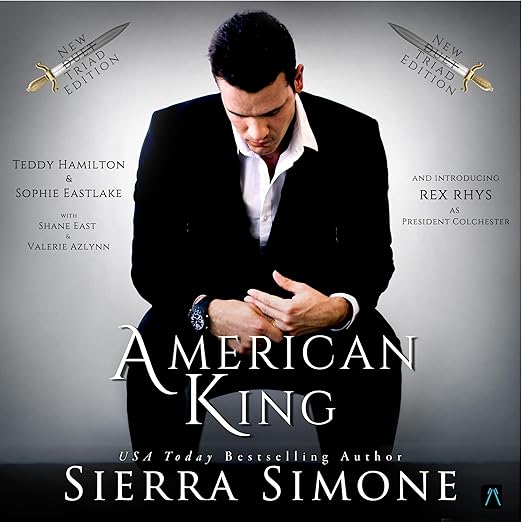
Maxen 'Ash' Colchester sits in the Oval Office at the start of this audiobook as a sitting president running for reelection against the very man he loves, a scenario that only makes sense once you know this is the third and final book in Sierra Simone's New Camelot trilogy, a contemporary, explicitly erotic retelling of the King Arthur legend transplanted into modern American politics. Ash, First Lady Greer, and former vice president Embry form the throuple at the center of the series, an Arthur-Guinevere-Lancelot triangle reimagined with real political stakes attached, and this closing volume picks up after Embry's departure from the ticket, with Ash and Greer forced to run without him, and eventually against him. 'Long live the king' is how the story ends, and this audiobook means that more literally than you would expect.
Sophie Eastlake Carries Three Voices Solo
Sophie Eastlake narrates the full twelve-plus hours solo, carrying three distinct central voices, Ash's guarded political calculation, Greer's own complicated loyalty, and Embry's absence weighing over every scene he is not physically in, along with a full supporting cast of political staffers and family. That is a real vocal-range demand for a single narrator, and reviewers respond to the finished performance as binge-worthy, with one calling the trilogy dramatically eloquent and endearing, with an erotic sharp edge, which is a fair summary of what Eastlake has to sell: genuine political tension and genuine emotional vulnerability sitting right next to explicit content, sometimes within the same scene. Holding that tonal range together without either side undercutting the other is the real test of this narration, and by most listener accounts, it holds.
The Arthurian scaffolding gives the whole trilogy more structure than a typical political romance would have on its own. One reviewer, initially skeptical, described the setup as odd, a modern story built on a myth she had assumed was pure legend rather than something meant to feel grounded in a real presidency, but still found the central relationship's emotional stakes fully convincing once she settled into the premise. That tension between mythic framework and contemporary political detail, campaign strategy, reelection math, actual policy stakes, is what separates this from a more conventional romance trilogy, and Simone clearly wrote it for readers willing to take the King Arthur conceit seriously rather than as a light gimmick.
Ash's Fatal Flaw as Tragic Hero
Simone frames Ash explicitly as a tragic hero with a fatal flaw baked in since birth, and that framing gives real weight to a book that could otherwise coast purely on its premise's novelty. The stakes by this third volume are enormous and entirely personal at once: a presidential reelection campaign, a fractured three-way relationship playing out under public scrutiny, and the genuine possibility that love was always going to be the end of this particular story for all three of them. One reviewer who came to the trilogy already primed by Simone's reputation for risque storytelling from an earlier book still called the finished trilogy more impressive than expected, scandalous, witty, and angsty in roughly equal measure.
Love and Heartache Resolve in the Final Volume
On the explicit content itself, the book's own description and its reader reviews are consistent and upfront: this is erotica first, with real heat throughout, not a romance with occasional spice scattered through occasional chapters. One reviewer specifically called the sex scenes 'really hot' while still taking the emotional core of the three-way relationship seriously rather than treating the explicit content as separate from the story. Another reader, closing out the trilogy with this final volume, praised how thoroughly Simone ties up the whole arc: 'love, heartache, completion,' in her words, landing as a satisfying resolution rather than a rushed ending after two earlier books' worth of built-up tension.
Narrating explicit content well is its own distinct skill, separate from handling dialogue or action, and it is worth calling out directly rather than assuming it happens automatically. The pacing has to slow without dragging, the emotional register has to stay connected to whichever relationship dynamic is actually driving a given scene, guilt, hunger, tenderness, jealousy, and the performance has to commit fully without tipping into parody. Eastlake's reviews suggest she clears that bar consistently across a genuinely wide range of registers within the throuple's dynamic, which matters more here than in a simpler two-person romance, since every scene has to track which two, or which three, of the central relationships are actually active in that moment.
Starting Here Would Spoil the Payoff
Starting with this book instead of the first two in the trilogy would genuinely spoil the emotional payoff Simone has spent two prior volumes building toward, and it would also mean missing the character development that makes the throuple's dynamic between Ash, Greer, and Embry make sense by this point. This is a conclusion, not an entry point, and the story itself assumes real familiarity with everything that happened before Embry's departure from the ticket. Anyone new to the series should treat this strictly as book three and plan accordingly, since the emotional and political stakes here depend entirely on investment built up across the earlier two installments, not on anything this closing volume pauses to re-explain.
The rating count on this specific listing is thin, just a handful of reviews so far, which is worth naming plainly even though every review currently attached rates it highly. The throuple structure this trilogy is built around is also, by the reviews' own admission, a genuinely odd setup on first exposure, a modern presidency built around a reimagined Arthurian love triangle is not a premise every romance reader will take seriously right away. Readers who need their central relationship structure to feel immediately plausible rather than earning that plausibility gradually may need real patience through the earlier books before this one lands the way it is designed to.
Political Stakes Layered Under the Relationship Drama
Readers already invested in Sierra Simone's New Camelot trilogy, and in her wider reputation for combining genuinely explicit content with real emotional and narrative ambition, are the clear audience for this closing volume. Fans of political romance who want actual campaign stakes and policy tension layered under the relationship drama, rather than politics used as pure set dressing, will find that balance well handled here. Listeners drawn to nontraditional relationship structures in romance, and to mythological retellings that commit fully to their premise rather than treating it as a light gimmick, should find this a genuinely satisfying, if unconventional, trilogy closer.
Explicit heat and a nontraditional three-way commitment structure are not for every reader, and starting here out of series order would undercut both the emotional payoff and the basic sense the setup is meant to make. Anyone uncomfortable with erotica-level explicit content mixed directly into a story's central emotional beats, rather than kept separate from them, should look elsewhere regardless of how the political-thriller elements might otherwise appeal. And readers who prefer their romance premises grounded in straightforward realism, rather than a myth-inflected contemporary retelling this committed to its own conceit, may find the whole New Camelot concept a harder sell than the writing quality alone would suggest.
Do I need to listen to the first two New Camelot books before this audiobook?
Yes. American King is the third and final book in the trilogy, and starting here would spoil the emotional and political arc built across the earlier two installments.
How explicit is this audiobook?
Very. This is erotica first, with substantial explicit content throughout, not a romance with occasional spice scattered through otherwise clean chapters.
Does Sophie Eastlake voice all three main characters in this audiobook?
Yes, she narrates solo across the full runtime, handling Ash, Greer, Embry, and a supporting political cast without a multi-narrator cast.
Is the King Arthur connection in this audiobook subtle, or central to the story?
It is central. The series is explicitly titled New Camelot and reimagines the Arthur-Guinevere-Lancelot dynamic as a modern American presidency, a detail that shapes the whole trilogy's structure.