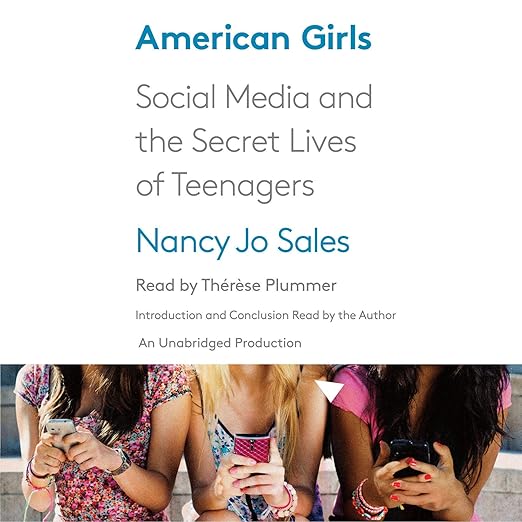
Nancy Jo Sales spent years traveling the country for American Girls, interviewing more than two hundred girls between the ages of thirteen and nineteen, and the cumulative weight of that fieldwork is audible in nearly every chapter of this audiobook. Narrated by Thérèse Plummer and running nearly fifteen hours, this New York Times bestseller reads less like a polemical argument than like a sustained act of documentary listening - Sales following girls through their phones, their group chats, their anxieties, and their sometimes shocking matter-of-factness about what is being asked of them online.
From Florida to Kentucky, Not Just the Coasts
The book's organizing argument is that Instagram, Kik, Ask.fm, Tinder, and YouTube - the dominant platforms at the time of writing - have not simply changed the texture of adolescent social life but have restructured it around a set of norms that many adults are entirely unaware of. Sales is not a technophobe; she is a reporter, and her method is to let the girls speak. The result is a book that several reviewers describe as physically difficult to listen to, particularly the sections documenting the casual exchange of nude photographs, the normalization of pornographic aesthetics in everyday teen interaction, and the virulence of online slut-shaming. Sales does not sensationalize any of this. She describes it, cites the research around it, and asks how it got this far.
What distinguishes American Girls from similar technology-panic books is its class and geographic range. Sales did not interview girls only in affluent coastal cities - she went to Florida, Arizona, Texas, Kentucky, and small towns across the country, and what she found was that the dynamics she documents transcend household income and region. That breadth strengthens the argument considerably and prevents the usual objection that this is a problem for wealthy, hyper-connected urban families. One reviewer working in education describes feeling distressed at what the book taught them about modern teen culture and the normalization of destructive behaviors - an institutional reaction, not just a parental one.
Plummer Modulates to Honor Real Girls' Voices
Plummer's narration is one of this audiobook's genuine assets. Her vocal texture carries appropriate weight for material this serious - she is not dramatic or emotive in a way that editorializes, but neither does she flatten the girls' voices into mere data points. In passages where Sales reproduces direct quotes from interviews, Plummer modulates just enough to remind you that these are real young women speaking, not abstractions. At fourteen hours and fifty minutes, the book is a significant time investment, but the structure - organized by geography and theme rather than chronologically - means individual chapters hold up as discrete listening units if a listener needs to pause and return.
The audiobook's 2016 publication date is worth noting. The specific platforms Sales documents have shifted - Ask.fm has largely faded, TikTok did not yet exist, and the influencer economy she describes in early form has since grown substantially larger. But the underlying dynamics she identifies - the way social media monetizes female self-presentation and normalizes male entitlement to female imagery - have intensified rather than receded. Parents encountering this audiobook today will find it less a historical document than a baseline against which to measure how much further things have moved.
Physically Sick Reviews Miss the Diagnostic Half
The book's most uncomfortable chapters deal with what Sales calls the pornification of teen culture - the ways in which pornographic conventions have migrated from adult content into mainstream social media aesthetics and into girls' own understanding of how they are expected to present themselves. Sales is careful to distinguish between girls who have genuinely internalized these norms and girls who are performing compliance while feeling violated by it, and that distinction matters enormously for how adults respond. The chapter on feminist empowerment rhetoric is also worth close attention - Sales challenges the way certain strands of feminist language have been co-opted to justify exhibitionistic behavior that leaves girls more exposed rather than more powerful.
One reviewer describes the book as leaving them physically sick. That is not a reason to skip it. It is a reason to listen with a notebook nearby, because Sales does not simply document the problem - she interviews researchers, psychologists, and educators who have been trying to develop responses, and those threads of the book are as important as the more lurid material that tends to get quoted in reviews. The book's value is fundamentally diagnostic and it is genuinely excellent at that function, raising questions that parents and educators can carry into real conversations with teenagers.
Essential Context for Parents and School Counselors
Parents of daughters who are in or approaching adolescence will find this audiobook essential context for conversations they will need to have. School counselors, teachers, and administrators who work with teenage girls will recognize the landscape Sales describes and find language for dynamics they may have observed without being able to name. Readers who want to understand the political economy of platforms and how it shapes gender norms will also find substantial material here. The audiobook is not recommended for listeners who want a solution manual - Sales is a journalist, not a policy advocate, and the book's power is diagnostic rather than prescriptive. It is also not easy listening: the language is at times explicit, the situations described are often distressing, and the implications for how girls are experiencing adolescence right now are impossible to dismiss.
- Voice: Thérèse Plummer brings an authoritative journalistic register to Nancy Jo Sales's reported text; her delivery handles both clinical analysis and raw interview material with consistent composure, which serves the often disturbing content well.
- Big ideas: social media and adolescent identity, hypersexualization of girlhood, online harassment and self-worth
- Atmosphere: Urgent and unsettling
- Worth it?: For parents, educators, and anyone working with teenage girls, this audiobook delivers a well-reported account of digital adolescence that has only grown more relevant since its publication.