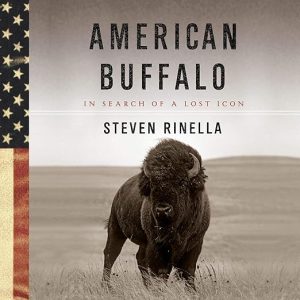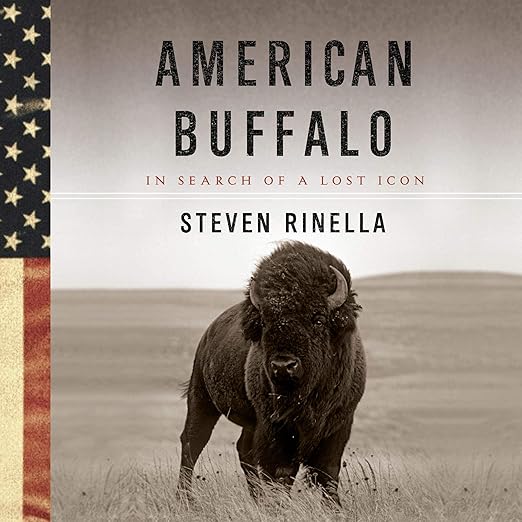
I finished American Buffalo on a long Saturday walk, listening through headphones in a park that is as far from the Alaskan wilderness as it's possible to get while still being outdoors. That incongruity turned out not to matter at all. Steven Rinella's narration of his own book pulls you completely out of your surroundings in the way that very few audiobooks manage. By the time he was describing the grizzly bears trailing his raft, I had stopped noticing the park entirely.
The premise is both simple and, once you understand what Rinella is doing with it, ambitious. In 2005, he won a lottery permit to hunt wild buffalo in Alaska, one of roughly two percent of applicants who do, and fewer than twenty percent of those hunters actually succeed. Rinella succeeds, and the hunt, involving a snow-covered mountainside, grizzly bears, a raft trip with the meat, and a brush with hypothermia, forms the narrative spine of the book. But Rinella is using that spine to hold up something considerably larger: a history of the American buffalo from the Bering Land Bridge to the present, and a meditation on what the animal's near-extinction and partial recovery tells us about the American relationship with wilderness.
Is American Buffalo Worth Your Time?
Rinella's particular gift is for moving between scales without losing the reader. One paragraph covers the Detroit Carbon Works, a nineteenth-century bone processing facility that manufactured bone meal, black dye, and fine china from millions of tons of buffalo bones. The next is back on the mountain. The transition never feels jerky because Rinella is always clear about why the historical detour matters to the immediate story. He wants you to understand what the buffalo meant, across fourteen thousand years of North American human life, in order to feel what Rinella himself feels when he stands at the end of a hunt that was statistically unlikely to succeed.
The range of historical material here is impressive. Rinella visits buffalo jumps where Native American hunters ran herds over cliffs, traces the animal's role in the formation of national identity, follows Black Diamond to his fate in Manhattan after serving as the model for the American nickel, and attends to the early conservation efforts that pulled bison back from the edge of extinction in the late nineteenth century. All of this is woven into an adventure narrative without any of it feeling like a lecture inserted for educational purposes.
The Best Parts of American Buffalo
Rinella hosting The Wild Within on Travel Channel is context for why his narration works so well. He's a practiced oral storyteller, and the rhythms of American Buffalo on the page translate naturally into spoken prose. The adventure sections have urgency without breathlessness. The historical sections maintain the same conversational register rather than shifting into a documentary voice. Several listeners note the book as one of those they did not want to put down, and that quality is significantly enhanced by having the author's own voice deliver it.
The book also benefits from Rinella's obvious affection for the natural world combined with his refusal to be sentimental about hunting. He is not writing an apologia for blood sports, nor is he writing a conventional conservationist narrative. His position, that hunting is part of a long human relationship with wild animals and that the buffalo's story is inseparable from the history of hunters across cultures, is held with enough nuance that readers who don't hunt are unlikely to feel excluded or lectured. The ethical dimension is present throughout but never delivered as a verdict.
Before You Commit to American Buffalo
The structural interweaving, jumping between the 2005 hunt and the historical material, can take a chapter or two to settle into. Listeners who prefer linear narratives may find the early alternations slightly disorienting before the pattern becomes clear. Stick with it. Once the historical and contemporary threads are both established, the movement between them is one of the book's genuine pleasures rather than a source of confusion.
Also worth noting: the natural history content is detailed and specific. This is not popular science at its most simplified. Rinella writes about buffalo biology, migration patterns, the ecology of the plains, and the politics of contemporary bison management with the specificity of someone who has researched deeply. Listeners who want the adventure story and find the natural history sections slow may find themselves wanting to skip ahead. Resisting that impulse rewards patience. The history and biology are what give the hunt its meaning.
Should You Listen to American Buffalo?
Anyone who responded to books like Peter Heller's The Dog Stars or Tim Cahill's travel writing will find Rinella working in a related register, the kind of outdoor narrative that insists on the full context of a landscape rather than just the adventure within it. Hunters will recognize the specificity of Rinella's technical observations about the Alaska wilderness, but non-hunters who care about natural history and American history will find the book equally accessible. This is not a niche book for a niche audience. Readers who have followed Rinella's podcasting and television work will find this is where his thinking is most sustained and his voice most fully developed. Those who want purely plot-driven adventure without the historical density should look elsewhere, but they'd be missing what makes this book worth the hours.
How does Rinella balance the adventure narrative with the historical research?
The structural alternation between his 2005 hunt and the historical material can take a chapter to settle into, but once established it's one of the book's strengths. The history is never a detour. It's always building toward a fuller understanding of what the hunt means.
Is Rinella's self-narration consistent in quality throughout the nearly eight-hour runtime?
Very much so. He's a practiced storyteller from his television work, and his voice maintains the same conversational authority through both the adventure sections and the denser natural history passages. There's no sign of fatigue or inconsistency across the runtime.
How current is the conservation and ecological information given the book's 2019 reissue date?
The core historical material is timeless. The information on contemporary bison recovery and land management reflects conditions as of Rinella's original research, so readers with specific interest in current bison population status should supplement with more recent sources.