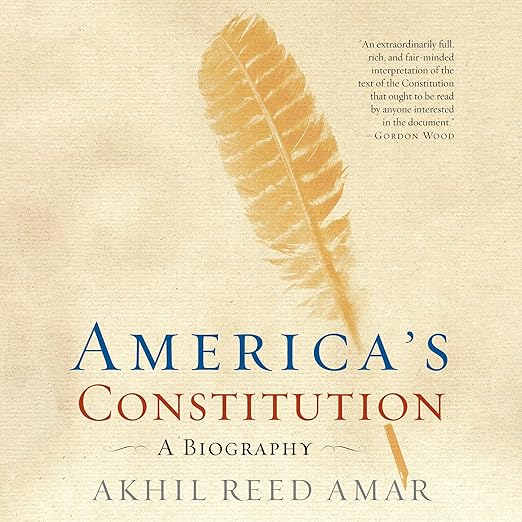
Akhil Reed Amar's America's Constitution arrives with one of the stronger cases for the audiobook format that constitutional scholarship has produced: at twenty-three hours narrated by Steve Hendrickson, it demands a sustained commitment, and it repays that commitment with a substantially richer understanding of the founding document than any shorter treatment can provide. The book's central claim, stated directly in the opening chapters, is that the Constitution deserves to be treated as a biography rather than a collection of clauses, and that understanding what it says requires understanding why it says it, which in turn requires understanding the political, legal, and moral world its framers inhabited.
Amar is a liberal constitutionalist, and his interpretive choices, while scrupulously grounded in historical evidence, reflect that position. He is particularly energetic in arguing that the Constitution has been more democratic than is conventionally understood, and equally energetic in documenting its slavocratic dimensions. The three-fifths clause, he shows, gave slaveholding states disproportionate political power that kept Virginia slaveholders in the presidency all but four of the Republic's first thirty-six years, and proslavery forces eventually came to dominate much of the federal government before Lincoln's election. These arguments are well-evidenced and important, but they are arguments, not neutral description, and listeners should engage with them as such rather than treating the book as a purely objective reference.
Reviewer Lola describes the book as full of interesting and fun details, which is an accurate characterization of Amar's style at its best. He genuinely delights in constitutional puzzles. Why must a president be at least thirty-five? What does the electoral college actually accomplish and why was it designed that way? Is there anything in the Constitution that cannot be amended? He takes these questions seriously and provides answers that are more complicated and more interesting than the conventional wisdom suggests. Reviewer Joseph Ryan notes that the book focuses sharply on the ideas and debates contemporary to each clause's adoption, which gives the historical account a tight causal logic.
One example of Amar's approach at its most useful: his treatment of the Bill of Rights. The conventional understanding is that the Bill of Rights protects individual liberties against federal overreach. Amar complicates this substantially by noting that the First, Second, Ninth, and Tenth Amendments were partly designed to protect states and the people acting within states rather than simply individual persons, and that the entire framing of rights as individual has been read backward into the founding from later interpretive decisions. Whether or not a reader accepts that argument in full, it is the kind of reading that makes the original text strange again in productive ways, forcing a closer engagement with what specific words in specific political contexts actually meant.
Hendrickson's Consistency Across Twenty-Three Dense Hours
Steve Hendrickson's narration across twenty-three hours is a genuine achievement in professional consistency. Amar's prose is dense with proper names, historical events, legal terminology, and cross-references to specific constitutional clauses, and Hendrickson maintains the thread through all of it. He reads with a measured authority that never becomes monotonous, managing the shifts between close textual analysis and broader historical narrative without losing the listener's place in the argument. At twenty-three hours, the audiobook demands sustained attention, but Hendrickson's pacing rewards it.
Reviewer Robert C. Goldszer, who came to the book through a book club, notes that Amar's research and descriptions are excellent though occasionally over-detailed. That assessment reflects the book's genuine character: it is comprehensive almost to a fault, and listeners who want the argument without the full scholarly apparatus may find sections of close reading more granular than they need. But for those willing to follow Amar all the way through, the cumulative effect is a substantially richer understanding of the document than any shorter treatment can provide.
For listeners who find dense constitutional history tiring in print but engage more effectively with audio, Hendrickson's narration provides a consistent through-line that makes extended sections on specific clauses easier to follow. The twenty-three-hour commitment is real, but the audio format has an advantage over print here: you cannot easily skip ahead in ways that break the cumulative argument, which means listeners tend to absorb more of the connective tissue between Amar's major points than readers who skim might.
Borrowed Language Complicates the Founding Genius Myth
The sections on the We the People formulation are particularly worth attention. Amar demonstrates that much of the Constitution's language was lifted from existing American legal texts, including earlier state constitutions, which complicates the myth of singular founding genius while also illuminating the document's genuine continuity with colonial legal traditions. The tension he identifies between the Constitution's democratic aspirations and its slavocratic structures is one of the book's most important arguments, and one that readers of standard constitutional history often miss because the document is usually discussed in either celebratory or critical terms rather than as the contradictory text it was from the start.
The electoral college sections are especially useful for contemporary readers, given ongoing debates about that institution. Amar's historical account of why it was designed as it was, which has more to do with practical political compromises than with principled anti-democratic design, provides context that much current commentary lacks. Whether or not readers accept his interpretation, his historical case is carefully assembled and worth considering on its own terms.
Law Students and Civics Educators Get Depth
History readers, law students, civics educators, and anyone who wants to understand the Constitution as a historical document rather than an abstraction will find this audiobook genuinely rewarding. The twenty-three-hour length is a real commitment, but it is well-spent. Listeners who want a brief overview or a politically neutral description of constitutional provisions will find the depth and interpretive specificity more than they are looking for. For those who engage with it fully, America's Constitution provides the kind of foundational reorientation toward the founding document that few books in any format achieve.
Questions Listeners Ask
Is America's Constitution audiobook suitable for general readers or is it primarily for legal scholars?
Amar explicitly writes for educated general readers rather than specialists. He explains legal concepts in accessible terms, though the book is comprehensive enough that some sections require sustained attention. No legal training is necessary.
How does Steve Hendrickson's narration hold up across the 23-hour runtime of this audiobook?
Impressively well. He maintains consistent pacing and authority through dense historical and legal argument, manages the shifts between close textual analysis and broader narrative, and handles the volume of proper names and dates without stumbling.
Does the audiobook of America's Constitution present a particular political interpretation of the document?
Amar is a liberal constitutionalist and his interpretive framework reflects that. His historical evidence is solid, but his emphasis on the Constitution's democratic dimensions alongside its slavocratic ones reflects a reading that is not politically neutral. Listeners should engage with the argument rather than treating it as pure description.
Can listeners skip sections of the America's Constitution audiobook, or does it need to be heard in order?
The book works best in order because Amar builds his argument cumulatively, with later sections referring back to earlier ones. That said, chapters on specific constitutional topics including the electoral college, the amendment process, and the presidency requirements can be productive as standalone listens for those with particular areas of interest.