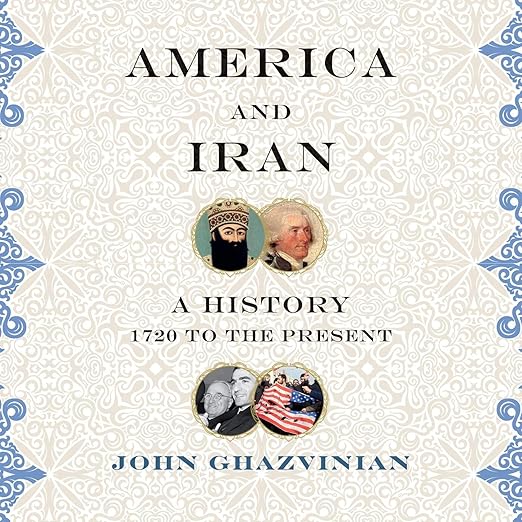
- Narration: Fred Sanders delivers twenty-seven hours of dense archival history with clean, unhurried clarity that never over-dramatizes the material.
- Themes: two centuries of US-Iran diplomacy, missed opportunities for partnership, archival history from both sides.
- Mood: sweeping and scholarly, sobering by its later chapters.
- Verdict: an essential, archivally rich history let down slightly by more editorial closing chapters, still well worth the long commitment for anyone serious about the subject.
Thomas Jefferson admired Persia enough to study its ancient governance, and John Ghazvinian opens this audiobook's sweeping history of American-Iranian relations there, two centuries before either country would think of the other as an enemy. America and Iran runs twenty-seven hours and eleven minutes, narrated by Fred Sanders, and was named a New York Times Notable Book of the Year for a reason: this is archival history researched on both sides of a relationship most listeners have only ever encountered from one side of it.
Ghazvinian's Four-Season Framework for Two Centuries
Ghazvinian, an Iranian-born, Oxford-educated historian, organizes the whole sprawling account around a four-season structure: a spring of mutual fascination, a summer of early diplomatic interaction, an autumn of close strategic partnership, and a long winter of mutual hatred that listeners will recognize as the relationship's current state. That framing device does real work across twenty-seven hours, giving a reader a way to track where in the arc any given chapter sits.
The New York Times itself called the book 'delightfully readable, genuinely informative' in its own review, and reviewer Mike J backed that up with specifics, noting that a large portion of the material draws on new scholarship from Iranian Foreign Ministry archives that Ghazvinian personally accessed on multiple research trips to Iran, access rarely granted to Western historians.
Ghazvinian's specific vantage point, an Iranian-born historian trained at Oxford, shows up in how evenhandedly the book treats both governments' decisions across two centuries. He is equally willing to document American miscalculations and Iranian ones, which is part of what makes the archival sections land as history rather than advocacy for either side, even before the later chapters shift tone.
The New York Times' own description called the book 'hugely ambitious,' and twenty-seven hours is the honest cost of that ambition: Ghazvinian is not writing a survey of a handful of key incidents but a continuous account spanning from eighteenth-century diplomatic curiosity through the 1979 revolution and into the recent decades of open hostility, without skipping the quieter, less dramatic middle periods most popular histories would compress or cut entirely.
Fred Sanders' pacing gives listeners room to absorb names and dates without the narration ever feeling like a rushed recitation of facts, a small but important quality across a runtime this long.
More than one reviewer specifically praised how readable the prose stays despite the density of names, dates, and shifting administrations packed into nearly every chapter, a real asset across a runtime this long.
Missed Chances a New Archive Brings to Light
Reviewer theroofbroker read the entire book in under a week and described it as reshaping their understanding of just how many chances for a workable diplomatic partnership were missed across two centuries, which is the book's real argument: this relationship did not have to end in mutual hatred, and Ghazvinian traces the specific decisions on both sides that closed off better outcomes.
Fred Sanders narrates the long run with clean, accessible delivery that keeps dense archival material moving without over-dramatizing it, which matters enormously across a twenty-seven-hour listen. The book covers named diplomats, shifting administrations, and multiple historical periods, and a narrator who lets the material carry its own weight rather than performing urgency into every chapter is the right choice for something this long and research-dense.
Mike J's review specifically credited the opening third of the book with functioning almost as new scholarship in its own right, built on Foreign Ministry records and other Iranian government sources Ghazvinian accessed through repeated personal trips to the country, material that simply has not been available to most English-language historians covering this relationship before now.
Theroofbroker specifically praised how the book catalogs the missed opportunities for a workable partnership across the full two centuries, not just the more commonly cited flashpoints, giving listeners a fuller sense of just how many smaller off-ramps existed before the relationship hardened into its current state.
Where the Final Chapters Turn Into Commentary
More than one reviewer flagged the same soft spot: the book's final chapters, covering the most recent decades of the relationship, shift in tone from careful archival history into something closer to current-events commentary. Reviewer Alef Jim called the earlier sections a must-read but noted the later material 'ends up becoming more of a current affairs article and a tad biased,' and theroofbroker separately observed the book treats the current Iranian government with more sympathy than some readers will expect.
That is worth knowing going in: the deep archival work in the first two-thirds is the book's strongest material and its most novel contribution, while the closing stretch reads more like informed opinion journalism. Neither reviewer suggested skipping it, but both suggested adjusting expectations once the narrative reaches the present day.
Alef Jim's review title put it plainly: 'a must-read if you skip the last few chapters,' which is about as direct a piece of listener guidance as a review can offer. The same reviewer called the book overall an engaging, essential read for anyone interested in politics, history, world affairs, and foreign policy, with the caveat about the later chapters standing as the one real qualification to an otherwise strong recommendation.
This is not a book to half-listen to during other tasks; the density of named officials, shifting administrations on both sides, and overlapping historical periods rewards focused attention, and listeners who drift in and out risk losing track of exactly which decade or administration a given chapter is covering.
Twenty-Seven Hours Rewards Patient History Students
Anyone trying to understand how the United States and Iran arrived at open hostility, especially readers who only know the relationship through recent headlines, will find the historical grounding here genuinely rare, particularly the access to Iranian-side archives that most English-language histories simply do not have.
Students of foreign policy and diplomatic history specifically will get the most out of the archival methodology here, since Ghazvinian's access to primary source material on both sides is the book's most genuinely novel contribution to a subject most readers only encounter through news coverage of the present moment.
General history listeners without a specific prior interest in the Middle East should not be scared off either; Ghazvinian writes for an audience that may be encountering most of this history for the first time, building context rather than assuming specialist background knowledge.
Balance is the one thing to calibrate expectations around for the last two or three decades of coverage specifically; at least two reviewers felt those closing chapters lean more interpretive than the archival sections before them, and twenty-seven hours is a serious commitment that rewards patience more than a casual browse through recent Middle East history would.
Does this audiobook rely on new historical research, or does it retell familiar accounts of US-Iran relations?
It leans heavily on new scholarship, including Iranian Foreign Ministry archives that author John Ghazvinian accessed on personal research trips to Iran, access most Western historians covering this topic have not had.
Is this audiobook biased toward one side of the US-Iran relationship?
Reviewers are split on the closing chapters specifically. At least two listeners felt the sections covering recent decades read as more sympathetic to the current Iranian government and closer to opinion journalism than the tightly archival earlier chapters.
How does narrator Fred Sanders handle a twenty-seven-hour history audiobook like this one?
With clean, accessible delivery that keeps dense archival detail moving without unnecessary dramatization, which suits a listen this long and lets the historical material carry its own weight.
What does the four-season structure mentioned in this audiobook's description actually mean?
Ghazvinian organizes two centuries of US-Iran history into a spring of mutual admiration, a summer of early cooperation, an autumn of close strategic alliance, and a winter of the mutual hostility that defines the relationship today, giving listeners a throughline across a very long book.