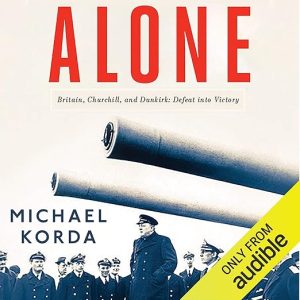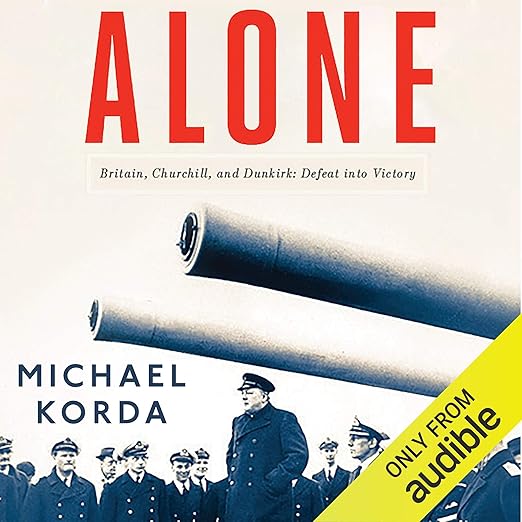
Michael Korda's Alone occupies a specific and valuable niche in Second World War history: it is written by someone who was there as a child and who spent a career as a military historian afterward. The subject is May 1940, the month the German war machine dismantled the Allied position in France and Belgium, when Churchill became prime minister on May 10 as the Wehrmacht crossed into France in force, and when the British Expeditionary Force ended up stranded on the beach at Dunkirk. This audiobook is narrated by John Lee and runs twelve hours and fifty-eight minutes. It exists alongside a substantial body of Dunkirk writing, but it offers something most of that writing cannot: a narrator who was six years old when these events happened, carrying his passport on a string around his neck, watching the BBC bulletins every night while preparing to be evacuated to Canada on an ocean liner full of children.
The Verdict, Briefly
Korda is the best-selling author of Clouds of Glory, and the structural sophistication he brought to that biography of Robert E. Lee is visible here. One reviewer, working from a framework of five analytical lenses, including the political-strategic, operational, tactical, personal, and artistic, argued that this book covers all five with genuine rigor, which is accurate. The result is a history that refuses to reduce Dunkirk to either pure military disaster or pure miracle. The Maginot Line's collapse is explained at the strategic level; the experiences of soldiers on the beach are rendered at the personal level; and the extraordinary improvised flotilla, including Dutch barges, fishing boats, yachts, rowboats, and vessels of every type that could cross the Channel, is described with the controlled astonishment its improbability warrants. Over 300,000 men rescued from a beach by what Korda calls "the most unlikely flotilla" in British naval history: that sentence requires the historical context to feel as improbable as it actually was.
John Lee's narration is a significant contributor to the book's authority in audio form. His voice carries the weight of British historiographical tradition without ever becoming pompous, and his pacing through the operational history sections is calibrated for listeners who may not have military backgrounds. The twelve-hour runtime moves quickly under his delivery, a tribute both to Lee's performance and to Korda's prose, which one reviewer described as "conversational" in a way that makes "reading a pleasure and relaxation" even through heavy material.
The Best Parts of Alone
The personal strand, Korda's memoir of his glamorous film family in pre-Blitz London, his stage actress mother, his father Vincent who would shortly receive an Academy Award for art direction, the devoted Nanny Low who recited evening prayers with the young Michael, and the BBC bulletins that could not quite mask "the impending catastrophe," gives the audiobook something rare in military history: genuine intimacy at the domestic level. This is not a soldier recounting combat but a child recounting the texture of approaching catastrophe with the retrospective analytical intelligence of someone who later became a military historian. The passport on a string. The ocean liner full of evacuated children. The detail that Michael listened to the BBC every night is the detail that carries the book's emotional weight in ways the operational history cannot replicate.
That personal strand does not compete with the historical analysis. It anchors it. Korda's glamorous movie family, his father's professional success in the same months that France was falling, these details make the period concrete and specific in ways that pure operational history leaves abstract. A reviewer who described finding the book "enlightening" captures the response: this is a writer whose personal relationship to the material produces something that purely research-based histories cannot achieve.
Points to Consider
The book's title names Britain's diplomatic position after the fall of France and the Low Countries: suddenly the only nation with both the will and the geographic position to resist Hitler. Korda develops this isolation carefully, covering the political disintegration of Chamberlain's government, Churchill's emergence from political exile on May 10, the American position of armed neutrality, and the speed with which the strategic situation collapsed from "the Maginot Line is as firmly fixed as the Pyramids" to the BEF stranded on a beach in under a month. The strategic account is grounded well enough that listeners without deep military history backgrounds can follow the operational logic. The comparison to Alistair Horne's "To Lose a Battle" mentioned by one reviewer is useful calibration: Horne's account of the fall of France is the standard scholarly treatment, rigorous and comprehensive. Korda's is more personal, more readable, and serves different purposes.
The months that followed Dunkirk, including Churchill's renewed call for courage and the transformation of those returned soldiers from a defeated force into something else, are handled with the appropriate sense of historical pivot. Korda does not indulge in triumphalism about the rescue. He understands it as a strategic reprieve rather than a victory, and the book's final chapters hold that complexity: "even the most calamitous defeats can become the most legendary victories" only when the retreat itself has a kind of historical grace, and Korda is careful about what that grace cost.
Who Should Listen to Alone
Readers with existing interest in Second World War history who want a personal as well as analytical account of the 1940 crisis will find this audiobook exceptionally rewarding. John Lee's narration makes the twelve-hour runtime pass efficiently. He is one of the most reliable voices in serious historical nonfiction, and his performance here is strong. Listeners who have seen Christopher Nolan's film Dunkirk and want the strategic context the film's narrow focus could not accommodate will find this a natural companion. Those wanting a purely military operational history should supplement with Horne or Anthony Beevor, but Korda is the right starting point for the story's human dimension. The memoir strand is not a distraction from the history; it is the history's best argument for why May 1940 mattered beyond the order of battle.
The Short Version
- Performance: John Lee brings the measured authority of a veteran British narrator to Korda's dual-register text; the historiographical sections gain weight from his delivery, and the childhood memoir passages benefit from his ability to modulate without tipping into sentimentality.
- What it covers: The fall of France, Churchill's ascension, the miracle of Dunkirk
- Feel: Grave, intimate, and historically dense
- Our call: One of the more compelling accounts of May 1940 available in audio; Korda's combination of personal memory and military history gives it a texture that purely analytical accounts cannot replicate.
Do I need prior knowledge of World War II history to follow this audiobook?
General familiarity with the war's outlines helps but is not required. Korda explains the strategic situation clearly enough for listeners without deep background. The political context, including Chamberlain's decline and Churchill's rise to the prime ministership on May 10, is developed within the text rather than assumed.
How does John Lee's narration suit Korda's writing style in this audiobook?
Very well. Lee's measured British delivery matches Korda's register, serious without being dry and authoritative without being distant. The memoir passages and the operational history sections require different tonal weights, and Lee shifts between them with the practiced skill of a narrator who has spent decades in serious historical nonfiction.
Is this audiobook primarily about Dunkirk itself or does it cover the broader 1940 context?
Both equally. Korda devotes substantial attention to the political and strategic context leading to Dunkirk, including the fall of France, the Belgian and Dutch capitulations, the Maginot Line's failure, and Churchill's ascension, before arriving at the evacuation. The beach and the flotilla are the climax but not the exclusive subject.