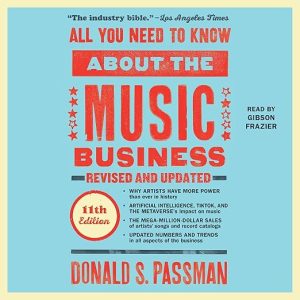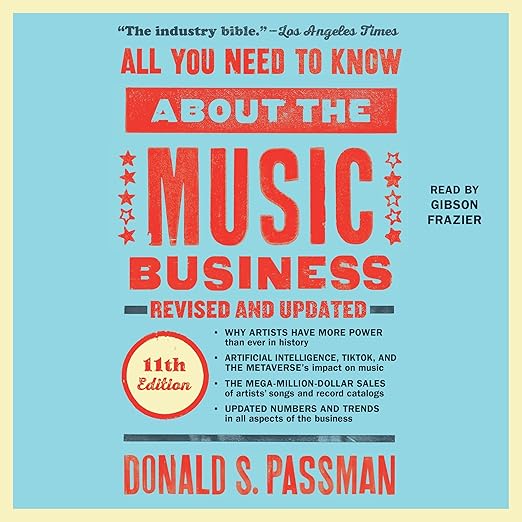
My relationship with All You Need to Know About the Music Business is long enough that I remember reading an earlier edition as a student, parsing its sections on record deals and publishing agreements with a highlighter and a great deal of anxiety about the industry I was trying to understand. That was a different edition, a different music business, and a different era of the internet. When I came back to this eleventh edition via audiobook, narrated by Gibson Frazier, I was struck first by how much has changed and then by how much Passman has kept pace with it.
Twenty-two hours is a significant listening commitment. This is not a book you hear casually. But for anyone who needs to operate in the music business, it is a commitment that repays itself many times over.
Streaming Changed Everything Since the Wax Cylinder
The Los Angeles Times called this the industry bible when it was considerably younger than it is now, and the description has adhered across eleven editions for a reason. Passman is a veteran music lawyer who writes from the inside of the industry rather than from a scholar's distance. His explanations of contract structures, royalty calculations, publishing splits, and the mechanics of touring revenue have the specificity of someone who has negotiated these agreements rather than merely analyzed them.
What distinguishes the eleventh edition is its accounting of the streaming transformation. Passman describes this as the most profound change in the music business since the days of wax cylinders and piano rolls, and that framing is not hyperbole. For the first time in the history of recorded music, monetization is not tied to selling a physical or digital unit. It is tied to streams. The business logic that follows from that shift, and Passman's explanation of how artists can now reach listeners without a record company gatekeeper, is the core new argument of this edition.
The reviewer D'Monterrio Gibson's review captures what makes this work as a reference: it covers contracts, royalties, publishing, touring, and modern industry realities in a clear and practical way, and is written as a long-term resource rather than a quick read. That last phrase is crucial. This is the kind of book you return to as your circumstances change, not one you absorb once and put aside.
Frazier Keeps Twenty-Two Hours of Contracts Clear
The narration challenge here is considerable. Music industry contracts are dense with terminology, with percentages and points and rights categories that blur together if a narrator does not maintain consistent differentiation between concepts. Gibson Frazier's delivery keeps the listener oriented through material that could easily become indistinguishable if paced poorly. He does not dramatize the content. He delivers it with the kind of reliable authority that a reference work requires, moving through dense passages without losing the forward motion that keeps a twenty-two-hour listen from becoming a test of endurance.
The reviewer D. Williams, who bought this for his daughter heading toward a career in the industry, notes that the book is written as if addressed to an artist, with advice on how to choose professionals to work with. Frazier honors that address, maintaining a voice that feels like counsel rather than recitation. For a book about navigating relationships with managers, lawyers, agents, and labels, the conversational tone of the delivery matters.
TikTok and AI Outpace Any Printed Edition
The reviewer who gave four stars raises what is probably the honest limitation of any print-cycle reference in a fast-moving field: the industry is changing faster than these books can keep up with. The laws around music created by AI, the marketing dynamics driven by TikTok, the evolving economics of catalog sales are all addressed in this edition, but several of those areas were in active flux at the time of publication and have continued to evolve since.
Passman is direct about this in his framing. He covers the massive influence of TikTok and the mega-million-dollar sales of artists' catalogs, he discusses music in Web3 and the Metaverse, and he addresses the AI question as it stood in 2023. The fundamental structures he explains, how publishing rights work, how record deal advances are recouped, how touring revenue splits function, are durable enough to remain useful even as specific platform dynamics shift. The framework is more permanent than the examples.
Mandatory for Artists, Optional for Curious Fans
The reviewer Keicy Rafael Beltre Feliz, identifying as a filmmaker venturing into music production, found this an invaluable resource. The reviewer Diana Zimmerman calls it essential for anyone in the music industry. Both are right, and so is the person who observed that it will not keep pace with the continuously changing landscape. These assessments are simultaneously true.
If you are an artist, songwriter, producer, manager, or anyone else whose livelihood connects to music rights and royalties, this audiobook is close to mandatory. If you are a fan who wants to understand how the industry that produces the music you love actually functions, it is accessible enough to reward the investment. If you want a quick orientation rather than a comprehensive reference, the twenty-two-hour runtime will feel like more than you need.
- Voice: Gibson Frazier handles twenty-two-plus hours of dense contractual and industry material with a practiced clarity that keeps this from becoming a legal lecture
- Big ideas: music industry contracts and royalties, the streaming economy, TikTok and artist autonomy in the digital age
- Atmosphere: Authoritative and practical, with genuine enthusiasm for the industry it describes
- Worth it?: The eleventh edition of the definitive industry reference earns its title honestly, though the format demands an active listener rather than a passive one.
Common Questions
Does this audiobook work as a study resource, or does the twenty-two-hour length make it difficult to use as reference material?
Reviewer D'Monterrio Gibson describes it explicitly as a long-term resource meant to be revisited as your career or knowledge grows, rather than read once and set aside. As an audiobook, it works better for understanding the landscape than for looking up specific contract terms quickly. Having a print or ebook version alongside for reference use is the approach that maximizes both formats' strengths.
Passman covers music created by AI in this edition. How much depth does that section have?
The AI discussion reflects what was known and legally established as of the 2023 publication date. Reviewer commentary suggests the fundamental coverage is solid but that the field has continued to evolve faster than print-cycle publishing can accommodate. The section is useful for understanding the questions and frameworks in play, less useful for current legal specifics.
Is this book relevant for independent artists who are not pursuing major label deals?
Passman specifically addresses the current moment as one where artists have more power and more direct access to audiences than at any prior point in music history. The streaming section and the TikTok discussion are particularly relevant to independent artists. The contract sections on major label deals remain important even for independents who may eventually encounter those structures.