There are books that make you want to read slowly, and there are books that make you incapable of it. All You Have to Do is the second kind. I started listening on a weekday evening intending to get through the first chapter and went two hours deep before I put it down, less because I could not stop and more because I needed time to think about what I had just heard. Autumn Allen's debut YA novel is one of those books that asks something of its reader rather than simply providing entertainment, and it earns that ask on every page.
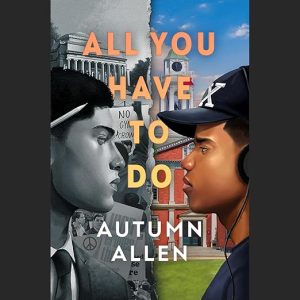
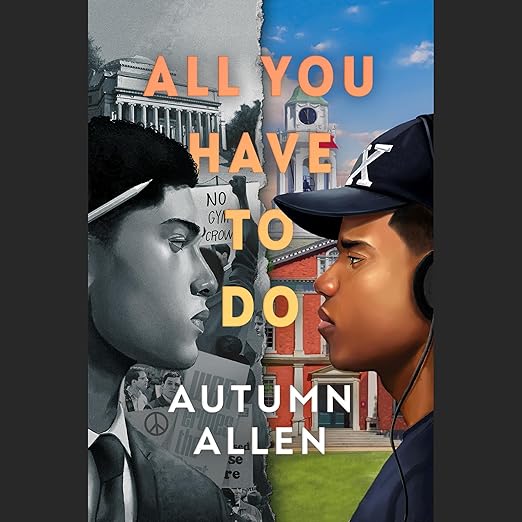
The dual timeline is the engine of the novel. In April 1968, in the days after Martin Luther King Jr.'s assassination, Kevin joins a protest that shuts down his Ivy League campus. In September 1995, amid controversy over the Million Man March, Gibran challenges the see-no-color hypocrisy of his prestigious New England prep school. These two young Black men, related by blood and separated by nearly three decades, are navigating institutions that present themselves as progressive while encoding systems that work against them. The parallels are not subtle, and they are not meant to be.
Where This One Lands
What distinguishes this novel from a thematic exercise is that Kevin and Gibran are fully realized people rather than vessels for historical argument. Reviewers consistently note loving both characters equally and admiring how they were strong, driven, and resilient. One reader, though, found Gibran a little too brash at times, a fair observation. Gibran moves through the world with a particular kind of 1990s Black prep school indignation that is historically authentic but occasionally reads as self-defeating in ways that the novel does not always interrogate. Kevin, by contrast, carries a quieter certainty that some listeners found easier to inhabit.
Allen clearly did her research. One reviewer notes being fascinated by the historical events mentioned in both timelines and having to look things up, which is exactly the effect a dual historical narrative should have. The Columbia University protest of 1968 is not a commonly taught event, and Allen's rendering of it gives the novel a factual weight that grounds its emotional argument.
Why All You Have To Do Works as an Audiobook
Nile Bullock's narration is one of the real pleasures of the audiobook experience here. The challenge of a dual-timeline novel in audio is that the listener needs to feel the shift between eras without visual cues. Bullock achieves this through subtle calibration of pace and emotional register, conveying Kevin's measured gravity and Gibran's combustible urgency as distinct rather than interchangeable. At eleven hours and forty-six minutes, this is a substantial listen, but the length gives Allen room to develop both timelines without either feeling shortchanged.
One reader called this not a relaxing read but a powerful one, and that is precisely right. This is not background listening. It rewards full attention and returns it with interest.
What Gives Us Pause
A few readers note that the dual timeline took time to settle into, which is a natural feature of this narrative structure rather than a flaw. The connections between Kevin and Gibran are held back deliberately, and the patience required to let that unfold is part of the reading experience. Listeners who find dual timelines disorienting should be prepared to sit with that discomfort, because the payoff is worth it.
The novel is also historically dense in ways that will reward curious readers who supplement with their own research. Allen assumes a certain baseline of historical knowledge that younger listeners may not have, which is arguably a feature rather than a bug. This is a book that wants to send people to the library.
Who Should Pick Up All You Have To Do
This audiobook belongs in high school history and English classes, in the hands of teenagers who think they already understand the civil rights movement and need to encounter it again from a different angle, and with adult readers who enjoy YA done with genuine literary ambition. It is particularly strong for listeners interested in the specific mechanics of racism within elite institutions, a subject rarely examined with this much precision in fiction aimed at young people. Those who find morally complex protagonists frustrating should know that neither Kevin nor Gibran is a straightforward hero, and the novel is better for it.
Key Details
- Narration: Nile Bullock handles both Kevin's 1968 voice and Gibran's 1995 perspective with conviction, navigating the emotional registers of two different historical moments without flattening them into each other.
- Themes: Racism in elite academic institutions, generational inheritance, Black identity under institutional pressure
- Mood: Urgent, historically grounded, and emotionally demanding
- Verdict: A powerful dual-timeline debut that takes its subject matter seriously, with two protagonists whose imperfections make their arcs feel earned.