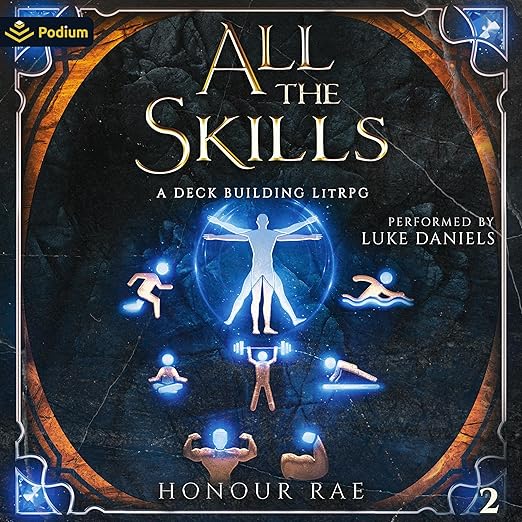
I was skeptical going into this one. LitRPG as a genre has a structural problem that most titles never solve: the mechanics exist to serve the story, but they too often consume it instead, turning what should be narrative momentum into a series of stat screens and upgrade notifications. I came to All the Skills 2 having read enough of the genre to know its pitfalls, and I stayed for sixteen and a half hours, which is its own argument in the book's favor.
Honour Rae is an indie author who built this series through Royal Road before it arrived in its final form on audio via Podium. That origin matters. The Royal Road readership is demanding and fast to disengage, survival there requires that the story actually work on its own terms, not just that the power fantasy deliver its dopamine on schedule. What Rae brings to this second installment is a genuine understanding of stakes, specifically the kind that come from relationships and competing loyalties rather than just from the next boss fight.
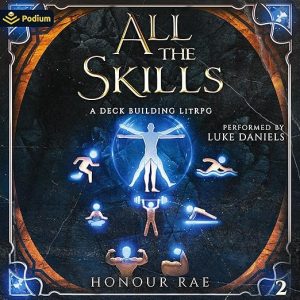
A Closer Look at All the Skills 2: A Deck Building LitRPG
The core setup has Arthur equipped with two powerful cards, Master of Skills and the newly acquired Master of Body Enhancement, and trying to figure out how they interact while also preparing for a dragon egg bonding competition that will pit him against the best card-wielders of his generation, including his cousin Penn. Rae structures the book in four sections, and the balance across them is uneven: the first two sections are stronger than the back half, with the second half relying slightly too much on extended competition sequences. But the central relationship tension between Arthur and Penn is genuinely well-handled, and the decision to keep Arthur's various lies and thefts in play throughout rather than resolving them cleanly gives the book a moral complexity that the genre rarely bothers with. One reviewer noted that what Arthur does in this book is for keeps, there are no convenient resets.
Luke Daniels is one of the best narrators working in fantasy audio, and he brings exactly the right energy to Arthur: enthusiastic without being frantic, capable of carrying the quieter character moments without flattening them. At 16 hours and 32 minutes, this is a long listen, but Daniels makes the runtime feel earned rather than bloated. The world-building around the card system is imaginative without requiring prior genre fluency, as one reviewer put it, nothing could be further from the truth when they feared the book would feel like reading a Magic: The Gathering novel. The mechanics are intuitive, and Rae integrates them into action sequences rather than pausing the story to explain them.
Things to Know Before Starting All the Skills 2: A Deck Building LitRPG
This is book two of a series. Rae's publisher notes the series should be listened to in order, and that guidance is correct, the character dynamics and card-system context from book one are assumed rather than re-explained. New listeners who start here will follow the broad plot but miss the weight of several key relationship developments. The pacing in the third and fourth sections becomes somewhat repetitive for listeners who are less interested in competition mechanics and more invested in the Arthur-Penn dynamic. And while the writing quality is genuinely above genre average, this is still a power-fantasy structure at its core: the pleasures are specific and not universal.
Who Honour Rae Is Writing For
LitRPG readers who have completed book one should come to this immediately, the 4.8 rating is an accurate reflection of what the existing audience thinks, and Luke Daniels's narration elevates the material. Fantasy listeners who are LitRPG-curious but genre-skeptical might do well to start with book one and see if the card mechanics appeal before committing to 33 combined hours. Genre veterans who have grown frustrated with stat-heavy, story-light series will find Rae's approach refreshingly character-grounded. If you need your fantasy entirely free of game systems, this is not the series for you.
Common Questions
Can I start the series with book two, or do I need to listen to book one first?
You really need book one first. The card system, Arthur's core relationships, and the full weight of the cousin Penn dynamic all require the context established in the first book. Starting here will leave you following plot but missing the emotional stakes.
How intrusive are the LitRPG game mechanics for someone who dislikes the genre?
Less intrusive than most. Rae integrates the mechanics into action sequences rather than pausing for stat screens, and multiple reviewers note the book works as a standalone fantasy story even without the LitRPG elements. That said, the card system is central to every major plot development, so you can't tune it out entirely.
Does Luke Daniels's narration work for a story with this many characters and competing card-wielder factions?
Very well. Daniels is experienced with complex fantasy casts and he keeps the competition sequences energized without letting the character moments collapse into action noise. He's an ideal narrator for this kind of material.
Is there a romantic subplot or is this primarily action and power-progression focused?
Primarily action and power-progression, with the most significant emotional thread being the relationship between Arthur and his cousin Penn. There are interpersonal dynamics throughout, but this is not a romance-forward series.