Titus Crown Faces Charon County's Simmering Violence
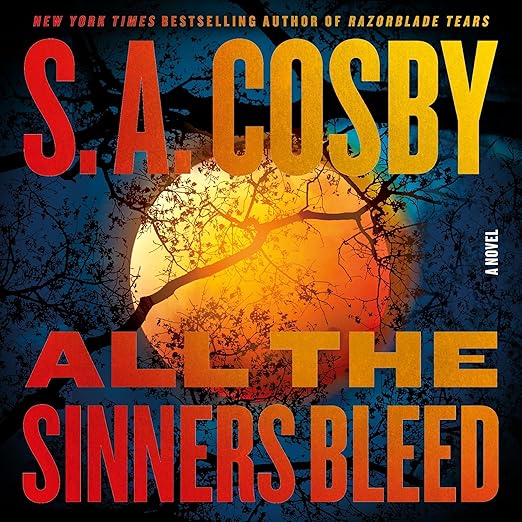
What does Charon County, Virginia owe its first Black sheriff, and what does he owe it back? S.A. Cosby opens this audiobook with Titus Crown already in crisis: a year into his tenure, a school teacher has been killed, the shooter is dead, and Titus is standing at the threshold of something much worse beneath the surface of a county that has been simmering toward violence for decades. The audiobook edition, narrated by Adam Lazarre-White, won the 2024 Audie Award for Thriller/Suspense and an AudioFile Earphones Award, which signals not just quality but a specific kind of quality: this is a performance that amplifies a novel already operating at the edge of the genre's capabilities.
Cosby is writing Southern Gothic crime fiction, and All the Sinners Bleed is the fullest expression of what that means in his work. Charon is a county where the FBI background Titus carries is simultaneously his greatest asset and his deepest alienation, he knows how serial killers operate, he knows how to read patterns, and he knows that the town that elected him still harbors people who would prefer a different face in the sheriff's office. The serial killer investigation, the far-right group seeking a Confederate history parade, the church connection, the secret from Titus's own past: these are not separate plot threads. Cosby builds them into a single, suffocating atmosphere of community under strain, and the novel's power comes from the way that atmosphere refuses to separate its constituent parts into categories of public and private, past and present.
Lazarre-White Inhabits Titus Without Performing Him
Adam Lazarre-White's performance is the reason this audiobook won the Audie. AudioFile's assessment that he masterfully portrays people of multiple races, old and young, while delivering Cosby's reflections on family, grief, and faith with genuine introspection is accurate and does not adequately prepare you for the experience. Lazarre-White inhabits Titus without performing him, the internal reflections, the weight of what Titus knows and conceals, the moments of genuine spiritual uncertainty feel lived-in rather than read aloud. That distinction matters across thirteen-plus hours; many narrators can sustain a character voice, but holding a character's interiority consistently for that duration is a different level of craft.
The narration also handles Cosby's dialogue across a diverse cast of rural Virginia characters, congregation members, far-right agitators, deputies, potential witnesses, without the caricature that often undermines Southern-set fiction when narrators prioritize regional accent over character humanity. One reviewer came in never having read Southern Gothic fiction and found the writing transported them fully into a world they had never visited. Lazarre-White's performance is the mechanism by which that transport happens in audio, and it is among the finest narrator-to-material matches in recent crime audiobook production.
The Violence Against Children Is Never Gratuitous
The crimes in this book are not abstract. Cosby writes the violence with specificity and weight, and listeners should know before starting that the serial killer's crimes against children are depicted with an intensity that multiple reviewers describe as genuinely difficult to sit with. The book earns these moments, they are not gratuitous, they serve the narrative's argument about what violence does to a community across generations, but they are not softened for accessibility. One reviewer noted that the crimes depicted are tough to read through but chose to continue anyway, and that the book's quality justified the difficulty. That trade-off is real and listeners should assess it for themselves before beginning.
The political and social dimensions of the novel are fully embedded in the plot rather than appended as commentary. The far-right group, the Confederate history parade, the racial dynamics of Charon County under a Black sheriff who carries an FBI clearance and a community's complicated history simultaneously, these are not external concerns that Cosby introduces and then sets aside. They are the environment in which the murder investigation occurs, and the novel's sustained power comes precisely from refusing to separate the serial killer story from the community history that shapes and enables it.
Why the Audiobook Suits Cosby's Rhythmic Prose
It is also worth noting the audiobook as the specific format for experiencing Cosby's prose. His writing has a rhythm that benefits from being heard rather than read, the sentences vary in length and cadence in ways that are more apparent in performance, and Lazarre-White's delivery brings out the musicality of the prose without making it feel mannered. Cosby describes himself as working in the tradition of writers who use genre to expose social reality, and that tradition has always had a relationship with oral storytelling. Hearing this novel read aloud activates something in the text that silent reading does not fully reach.
For Crime Readers Who Want Morally Serious Fiction
This audiobook is for listeners who want crime fiction that carries genuine literary weight, where the mystery plot and the social critique are inseparable, and where the protagonist's internal life is as compelling as the external investigation. The Washington Post's description of Cosby as one of the most muscular, distinctive, grab-you-by-both-ears voices in American crime fiction is the right frame: this is visceral, precisely observed, and morally serious fiction that uses the thriller structure to investigate something larger than any single case.
Listeners who want crime fiction in a lighter register, or who find graphic violence involving children too difficult to engage with, should approach with caution. But for those willing to meet the book where it is, Adam Lazarre-White's Audie-winning performance and Cosby's unflinching prose make this one of the stronger crime audiobook experiences of recent years.
At a Glance
- Narrator: Adam Lazarre-White won the 2024 Audie Award for this performance, and it is fully deserved, he inhabits Titus Crown with an interiority that elevates already exceptional source material.
- Subjects: racial justice, Southern Gothic atmosphere, faith and violence in community
- Tone: Dense and atmospheric, morally serious with sustained dread
- Bottom line: A rare crime audiobook where narration and prose operate at the same level of ambition, essential listening for the genre, but not for the faint-hearted.
Frequently Asked Questions
Is All the Sinners Bleed audiobook appropriate for listeners who typically avoid graphic crime fiction?
Probably not. The serial killer's crimes against children are depicted with specificity and moral weight that several reviewers describe as genuinely difficult to absorb. The book treats this content seriously rather than sensationally, but it does not soften or elide the darkness.
Does the audiobook require familiarity with S.A. Cosby's earlier work?
No. All the Sinners Bleed is a standalone novel with new characters and a new setting. Listeners who have read Blacktop Wasteland or Razorblade Tears will recognize Cosby's narrative approach but the book stands fully on its own.
What makes Adam Lazarre-White's narration stand out in this audiobook?
His performance differentiates across race, age, and class without sacrificing character humanity to accent. More significantly, he carries Titus Crown's internal life, the grief, the faith, the professional instincts warring with personal secrets, with a weight that makes the reflective sections as compelling as the thriller plot. The Audie Award reflects genuine distinction, not just technical competence.
Is the racial and political content in this audiobook handled with nuance or does it feel didactic?
It is woven into the plot rather than delivered as commentary. The far-right group, the Confederate history dispute, Titus's isolation as the first Black sheriff in Charon County, these shape the story's atmosphere and constraints rather than pausing it for argument. Cosby trusts listeners to understand the stakes without explicit instruction.