Before You Press Play
- Narrator: Dario Dossena reads the Italian translation for SPERLING KUPFER, so the voice on offer is not the one an English-language buyer expects.
- Subjects: Abduction and captivity, inherited grievance, an investigation years later
- Tone: Airless, dark and relentless
- Bottom line: A legitimate buy for Italian speakers and a trap for anyone who clicked the English title by accident.
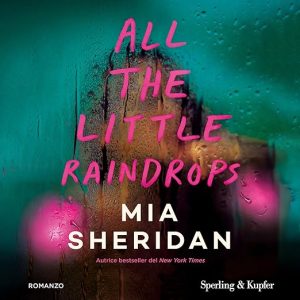
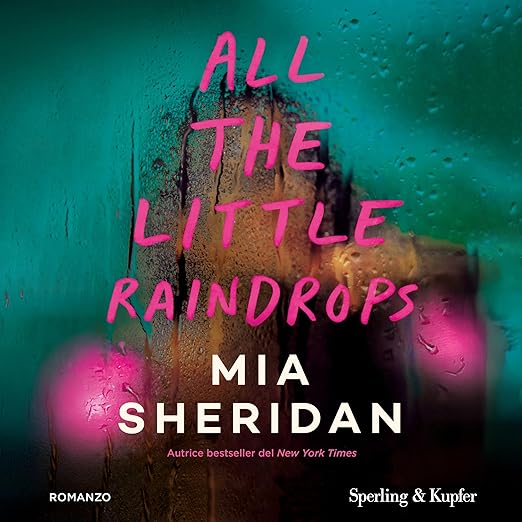
Something is badly wrong with the language credit on this audiobook, and any buyer should know about it before spending a cent. The title on the page is English. Almost nothing else is. The publisher is SPERLING KUPFER, the language line reads Italian, the description runs entirely in Italian, and Dario Dossena is the reader. What sits behind this listing is the Italian translation of Mia Sheridan's novel, sold under the original English title.
How All the Little Raindrops Holds Up
This premise is strong enough to survive any packaging problem. During spring break of their final year of high school, Noelle Meyer and Evan Sinclair are taken. Neither knows who chose them or why, but a dark link already binds the two of them: years earlier, Evan's father killed Noelle's mother and destroyed that family. They are locked in separate cells, in a place where time does not exist and light itself is used as a weapon.
Escape does not end it, which is where the book becomes genuinely interesting. Years afterward Evan, now working as a private investigator, discovers that the game never stopped and that their abduction was one of many. The two go after the only name that might explain everything, a man who calls himself il Collezionista. Structurally that gives you a captivity narrative and an investigation running off the same wound, which is harder than either half alone.
Who produced the Italian text is exactly what none of this tells you. No translator is credited anywhere on the listing, which is common practice and still a shame, because on a novel whose first half depends on claustrophobia and sensory deprivation the prose choices carry the whole effect. Thirteen and a half hours of translated writing is a translator's performance as much as an author's, and that person is invisible here.
Why All the Little Raindrops Works as an Audiobook
The captivity sequence is why this novel found readers in the first place. Two teenagers in separate cells, unable to see one another, forced into a relationship assembled entirely out of sound, and carrying the worst possible shared history between them. Manipulation, pain and cruel tests, in the description's own terms. Audio is arguably the right medium for exactly that, since the listener is also working in the dark with nothing but a voice for company.
Inherited grievance is what raises this above a survival thriller. Noelle has every reason to hate the person in the next cell, and staying alive requires setting that reason aside for as long as it takes. Whether the book earns the reconciliation or simply requires it is the question the second half must answer, and the fact that both characters are still working the same case years later suggests nothing gets resolved cheaply. Forgiveness that has to survive an investigation is a harder thing to write than forgiveness that arrives at the end of a rescue.
As an Italian recording this carries real value for the right buyer. Dario Dossena reads the full text for SPERLING KUPFER, and Italian-language thriller audio is thinner on the ground than the English equivalent. Anyone building a listening habit in the language could do considerably worse than a propulsive genre novel whose plot pulls hard enough to drag you past every word you do not yet know.
Weak Spots in All the Little Raindrops
The language mismatch is the headline problem here, and not a small one. Someone searching for All the Little Raindrops in English will land here, see a familiar title, a familiar author name and a cover, and can very easily buy a recording in a language they do not read. The language is stated on the listing, but the title does the opposite work, and nothing else on the page corrects the impression.
Written responses do not exist here at all. Five ratings produced the 4.8 average and not one buyer left a sentence behind, which on a translation released in December 2025 is unsurprising and still unhelpful. That average has exactly one possible composition: four top marks and a four, since any other combination lands somewhere else entirely. Five people liked it enough to click a rating. Nobody said why.
The content is heavier than the marketing suggests. Abduction of minors, extended captivity, psychological manipulation, and the deliberate use of light and darkness as instruments against two people who cannot see each other. The description warns that the horror threatens to destroy them a second time, and that warning is fair. Listeners who avoid captivity narratives should avoid this one, because the format makes the sensory material land harder rather than softer.
The Right Listener for All the Little Raindrops
Italian speakers are the audience, straightforwardly, along with confident learners who want a thriller carrying enough momentum to pull them past the words they have to guess at. Genre fiction is the best possible material for that, because plot pressure does most of the teaching. If you read the language comfortably and like dual-timeline thrillers with a serious moral problem sitting at the center, this is an entirely legitimate purchase.
The obvious disqualifier is not speaking the language. Anyone who wants Mia Sheridan's English text needs the edition with an English-language publisher and an English-language reader, because this is not that edition and nothing on this page will stop you making the mistake. Beyond that, anyone who avoids abduction plots or extended captivity should skip it whichever language they happen to read.
Judged on its own terms this looks like a solid translation of a well-liked thriller, given a full-length reading and a small group of satisfied buyers. Judged as a listing it functions as a trap for the unwary, and that is the more useful thing to say about it. Check the language line first, then decide whether you want the story at all.