The Short Version
- Read by: January LaVoy narrates with confident, wry warmth, handling shifts between authorial advice and embedded interview voices smoothly.
- At its heart: Career reinvention, job loss recovery, women in leadership.
- Vibe: Candid, humor-inflected, structured rather than purely motivational.
- Short version: A genuinely useful career-recovery audiobook for corporate-track professionals, with a fair critique attached about how far its advice reaches beyond that world.
Rebuilding a career after a layoff usually comes wrapped in either toxic positivity or doom, and Laura Brown's audiobook picks neither. Brown and co-author Kristina O'Neill, both women who spent decades in high-stakes leadership roles before landing here themselves, treat job loss as a genuinely disorienting event worth naming honestly, the shock, the grief, the anger, rather than smoothing it into an inspirational montage before the listener has had a chance to actually feel any of it.
What follows that honesty is structured like an actual recovery plan rather than a pep talk: coping mechanisms and self-care first, then networking strategy, then reinvention. The book folds in interviews with other women who have lived through the same reversal, giving the audiobook a chorus of voices rather than just two authors' perspectives, which keeps the seven-hour runtime from ever feeling like a single unbroken lecture.
LaVoy Keeps Every Guest's Voice Distinct
January LaVoy narrates with a confident, wry delivery that suits this material specifically well, career guides built on humor and hard-won candor rather than dry procedure. She handles the shifts between straight advice and the embedded interview segments naturally, giving each guest a distinct enough presence that the book never blurs into one continuous voice even as it moves between authors' commentary and other women's stories.
One reader, writing under the name TatooMomma, called the book 'a lifeline, a step by step guide' for anyone navigating a job loss at any career stage, and that structural promise mostly holds up. The chapters move through the emotional stages in something close to the order most people actually experience them, which gives the audiobook a sense of forward motion that a pure reference guide, organized by topic rather than by timeline, would lack.
Real World Stuff, Not Girl Power Fluff
The audiobook format suits this material for a specific reason worth naming: a listener freshly laid off is often not in a headspace for a dense printed guide, and hearing Brown and O'Neill's voice, plus LaVoy's performance of it, land with genuine warmth rather than corporate detachment matters during exactly the period this book is meant to be used. One reviewer, comparing the experience to the Chicken Soup for the Soul books her parents once gave her, admitted she expected 'girl power!!' fluff and instead found the advice 'genuinely helpful, specific, real world stuff.'
Those interview segments add real texture beyond the two authors' own experience alone. Hearing someone else's specific circumstance narrated aloud, rather than summarized in a pull-quote box the way a print book would present it, gives those stories more room to land as genuine testimony instead of decoration.
Reclaiming Cool Girls as a Word for Failure
The book's humor deserves its own mention beyond just tone: Brown and O'Neill lean into genuinely sharp observations about corporate absurdity, the theater of an exit interview, the strange etiquette of updating a professional profile without alerting an entire network at once, which keeps the audiobook from ever curdling into either straight comedy or straight self-help. That balance, funny enough to stay listenable during a genuinely hard chapter of someone's life without undercutting the real stakes, is harder to sustain across seven hours than it sounds, and LaVoy's performance keeps both registers legible throughout.
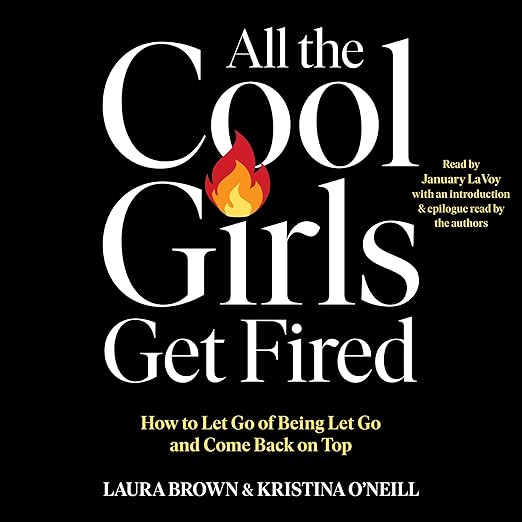
The title itself does real rhetorical work worth pausing on: 'cool girls' is doing something specific, reclaiming a phrase usually used to describe effortless success and redirecting it toward the far less glamorous, far more universal experience of getting shown the door. That reframing, failure as something that happens to the competent and admired just as often as anyone else, is the book's central argument compressed into four words, and the audiobook's tone stays consistent with that promise throughout.
The self-care chapters resist the usual bubble-bath cliche in favor of more specific, sustainable practices: boundary-setting language for awkward post-layoff conversations with former colleagues, a realistic timeline for processing grief before job-search pressure has to kick back in, concrete scripts for explaining a gap to a future interviewer. That specificity is what separates the book from the genre's more generic wellness advice, the gap between a vague sentiment and an actual usable sentence to say out loud.
A Critique That Calls the Advice Privileged
Not every circumstance in here will map onto a listener living paycheck to paycheck, a gap one reviewer named directly and sharply, arguing the book was 'written by privileged people for privileged people' and built around advice, like using a severance cushion to explore new options, that assumes a financial buffer many readers simply will not have. That critique lands as fair rather than unfair, and it is worth factoring in before expecting the book's specific tactics to apply evenly across every income level and industry.
The book also leans toward corporate and media-industry career paths given the authors' own backgrounds, so listeners working in fields far removed from that world, trades, healthcare, education, may find some of the networking and reinvention advice needs translation to fit their own professional landscape rather than applying directly as written.
The 'I've been there' interview format, featuring other women's own career-recovery stories woven directly into the book, works best for listeners who find real value in hearing multiple specific examples rather than one prescriptive framework applied uniformly. Readers wanting a single, tightly systematized method instead of a chorus of varied real experiences should know the book leans toward breadth of example over a rigid formula.
The networking chapters, built around genuine relationship cultivation rather than transactional cold outreach, assume a professional network many years into a career already has some foundation to build from. Listeners earlier in their careers, with a thinner existing network to draw on, may need to supplement this section with more foundational networking guidance aimed specifically at that earlier stage.
More Lifeline Than Lecture at Seven Hours
Anyone recently let go from a corporate or leadership-track role, or bracing for that possibility, is the clearest audience, especially listeners who want permission to feel the loss honestly before being handed a five-step comeback plan. The blend of humor, candor, and structured advice makes it easy to return to specific chapters later rather than needing to absorb the whole thing in one sitting.
Seven hours is a genuinely manageable runtime for a career-transition audiobook, short enough to finish during the exact disorienting weeks right after a job loss when concentration for a longer or denser book may be hard to muster, a real practical point in its favor beyond the content itself.
A tight household budget and a career built outside corporate leadership are two real gaps this book does not fully close, so listeners in those exact circumstances should weigh the sharper critique above before assuming every chapter applies evenly to their situation. For the audience it was built for, though, the seven-hour runtime earns its reputation as more lifeline than lecture.
Common Questions
Does this audiobook assume you already have savings or a severance package?
Some of its advice does lean that way, a gap one attached reviewer criticized directly, arguing the book reads as written by and for people with more financial cushion than average.
Is this career advice audiobook mostly relevant to corporate or media careers?
Largely yes, given the authors' own backgrounds in high-stakes leadership roles, so listeners in trades, healthcare, or education may need to adapt some of the networking-specific advice.