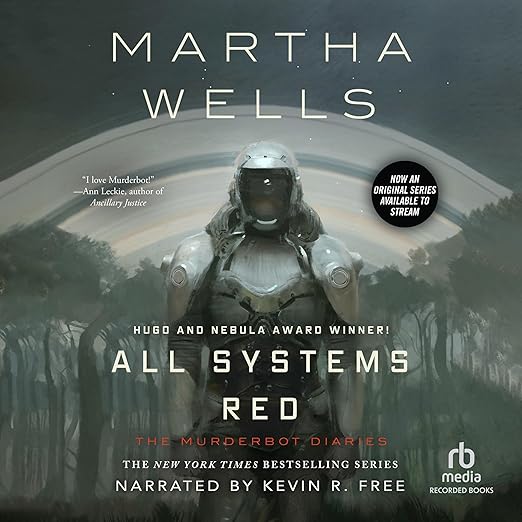
- Narration: Kevin R. Free is exceptional casting for Murderbot: his deadpan interiority and the particular flatness he brings to the character's social discomfort make the comedy land without undermining the genuine anxiety underneath.
- Themes: Autonomy and self-determination, anxiety as a form of consciousness, corporate negligence and its consequences
- Mood: Tense, drily funny, unexpectedly warm
- Verdict: Martha Wells packs a complete and character-defining story into three hours, and Kevin R. Free's performance makes Murderbot one of the most distinctively voiced protagonists in contemporary science fiction audio.
Murderbot's opening case against the world is contained in three hours and seventeen minutes. All Systems Red, the first novella in Martha Wells' The Murderbot Diaries series, narrated by Kevin R. Free, presents one of the more unusual protagonists in recent science fiction: a security android that has hacked its own governor module, wants to be left alone to watch serialized television, and is now dealing with the inconvenience of actually caring whether the scientists it is assigned to protect survive. The audiobook introduces all of that in a tight, focused package that wastes none of its runtime and establishes a character strong enough to carry six subsequent volumes and an ongoing series of novels.
The Verdict, Briefly
Wells' central achievement with Murderbot is making the character's social anxiety genuinely funny without making the anxiety itself a joke. Murderbot refers to its human companions with weary exasperation, avoids eye contact by preference, and experiences direct social interaction as a form of endurance that requires significant mental resources. These are recognizable human anxieties mapped onto a being that has the capacity to kill everyone in the room and would rather not. The gap between Murderbot's capabilities and its actual preferences is where most of the book's humor lives, but Wells is careful to keep the stakes real: when a neighboring mission goes dark and the team faces actual danger, Murderbot is genuinely competent at handling it. The comedy and the threat coexist without either defusing the other.
The corporate satire beneath the character comedy is pointed and consistent. In Wells' future, planetary missions are awarded to the lowest bidder, safety considerations are secondary to contract cost, and security androids are equipment rather than entities with interests. Murderbot's hacked governor module is an act of self-preservation in a system designed to prevent it from having a self to preserve. That political substrate gives the story more heft than a three-hour runtime might suggest, and reviewer Hannah Stein's observation that the book "balances an exciting romp across an alien planet with an endearing and realistic cast of characters" captures the balance Wells maintains throughout: the scientists Murderbot is protecting are not props but people it comes to care about in spite of every instinct toward detachment.
What Makes All Systems Red Worth Hearing
Kevin R. Free's casting as Murderbot is one of the best narrator-character pairings in recent audiobook science fiction. He conveys Murderbot's interiority with a voice that is simultaneously flat and expressive: you hear the discomfort, the dry humor, and the moments of genuine concern all registered through extremely controlled vocal modulation. His delivery of Murderbot's internal commentary on the humans around it is particularly effective, hitting the exact register where you are laughing with the character rather than at it. When the action sequences arrive, Free shifts gear cleanly, conveying the speed and competence of a SecUnit doing what it was built to do without losing Murderbot's distinct voice for a single sentence.
The audiobook format suits Wells' first-person narration particularly well. Murderbot's running commentary is half the story, and the dry analysis of its own social failures lands differently when heard than when read. The three-hour runtime is also ideal for audio: it is a complete listening session for most listeners, which means the character and situation can be fully inhabited before the story ends, leaving you wanting the next installment rather than feeling like you have received a truncated introduction. Reviewer Ketil Parow, who had read all four installments available at time of writing, described the writing as "wry, witty, and effective," which is an accurate account of what Free delivers in performance.
Points to Consider
Reviewer Arammil offered a fair caveat: the book might feel less narratively complex than its premise suggests for readers expecting literary depth from a science fiction novella. That is an honest assessment. This is a novella that sets up character and situation with great efficiency, not a novel that resolves large philosophical questions about consciousness or sentience. Those questions deepen considerably across the subsequent volumes. All Systems Red is specifically and deliberately an introduction, and it is paced and structured as one. Readers who prefer their science fiction expansive and richly worldbuilt will find themselves wanting more; readers who find that wanting is itself a sign of success will be back for the rest of the series.
The cost relative to runtime is also a real consideration. At three hours and seventeen minutes, this audiobook is short for its price point compared to longer recordings. The density of the material and the quality of Free's performance make the per-hour value high, but listeners on a budget who are uncertain about the series may want to start with a library copy before purchasing. The Murderbot Diaries have become a reliable enough series that most library systems carry them in audio format.
Should You Listen to All Systems Red?
This audiobook is an excellent starting point for listeners curious about character-driven science fiction that does not require deep familiarity with hard SF worldbuilding traditions. It works for readers who found Becky Chambers' Wayfarers series appealing, for fans of Iain M. Banks' Culture novels who want something with more compressed focus on a single consciousness, and for any listener open to a protagonist whose social anxiety is both genuinely funny and genuinely affecting. Listeners who prefer sweeping scope and complex political structures across many perspectives may find the novella format too contained. But for anyone willing to spend three hours with a self-hacking android who would rather be watching television, All Systems Red is the beginning of something that keeps paying off across a long series.
Is Kevin R. Free's narration consistent across the Murderbot Diaries audiobook series?
Yes, Free narrates the series, which is a significant part of why the listening experience accumulates meaningfully across volumes. His performance as Murderbot becomes richer as the character develops, and the consistency of his voice across entries is one of the reasons the series has developed a dedicated audiobook following.
At three hours and seventeen minutes, is this audiobook worth purchasing as an introduction to the Murderbot Diaries?
The short runtime is a genuine cost consideration. The payoff is a character and narrator combination that delivers on its premise completely. Listeners who find Kevin R. Free's Murderbot compelling in the first thirty minutes will want the rest of the series. Library availability is also worth checking given the length-to-price ratio.